
Views: 0 Author: Site Editor Publish Time: 2026-07-23 Origin: Site


Choosing your next vehicle often means balancing your household budget against ever-increasing pain at the fuel pump. You are likely moving past initial research and looking to select a specific model. Your main goal involves maximizing fuel economy without overpaying on the initial purchase price. Navigating this crowded automotive market can feel overwhelming. You need to clearly distinguish traditional hybrid electric vehicles (HEVs) from plug-in hybrids (PHEVs) and fully electric options. Buyers frequently struggle to weigh the initial financial premium against long-term fuel savings and vehicle depreciation. We will explore how to accurately calculate your personal payback period to ensure genuine long-term value. You will discover the top-performing models across both sedan and SUV categories tailored to specific driving habits. Let us dive into smart strategies for maximizing your automotive investment while minimizing your trips to the gas station.
Automakers typically charge more for electrified powertrains. You will often see a $1,500 to $3,000 price gap between a standard gas model and its electrified counterpart. This markup covers the complex battery packs, electric motors, and specialized power control units. Buyers must evaluate this initial premium critically. Paying $3,000 extra upfront only makes financial sense if your driving habits eventually recoup that cost. Dealership pricing strategies also impact this premium. High-demand models might carry additional dealer markups, extending the time required to break even.
Determining your personal break-even point requires a straightforward mathematical approach. You need three basic data points to evaluate the investment accurately. Follow these specific steps to model your financial timeline:
If the math shows a five-year payback period, but you plan to sell the vehicle in three years, the gas model might actually be the smarter financial choice.
Fuel savings represent just one piece of the financial puzzle. You must also evaluate secondary financial impacts. Regenerative braking systems use the electric motor to slow the vehicle down. This process recaptures energy and dramatically extends mechanical brake pad longevity. Many drivers easily surpass 100,000 miles on their original brake pads. Insurance rates occasionally run slightly higher due to expensive replacement components. However, historical resale value retention often offsets these minor insurance bumps. Highly efficient vehicles routinely command premium prices on the used market.
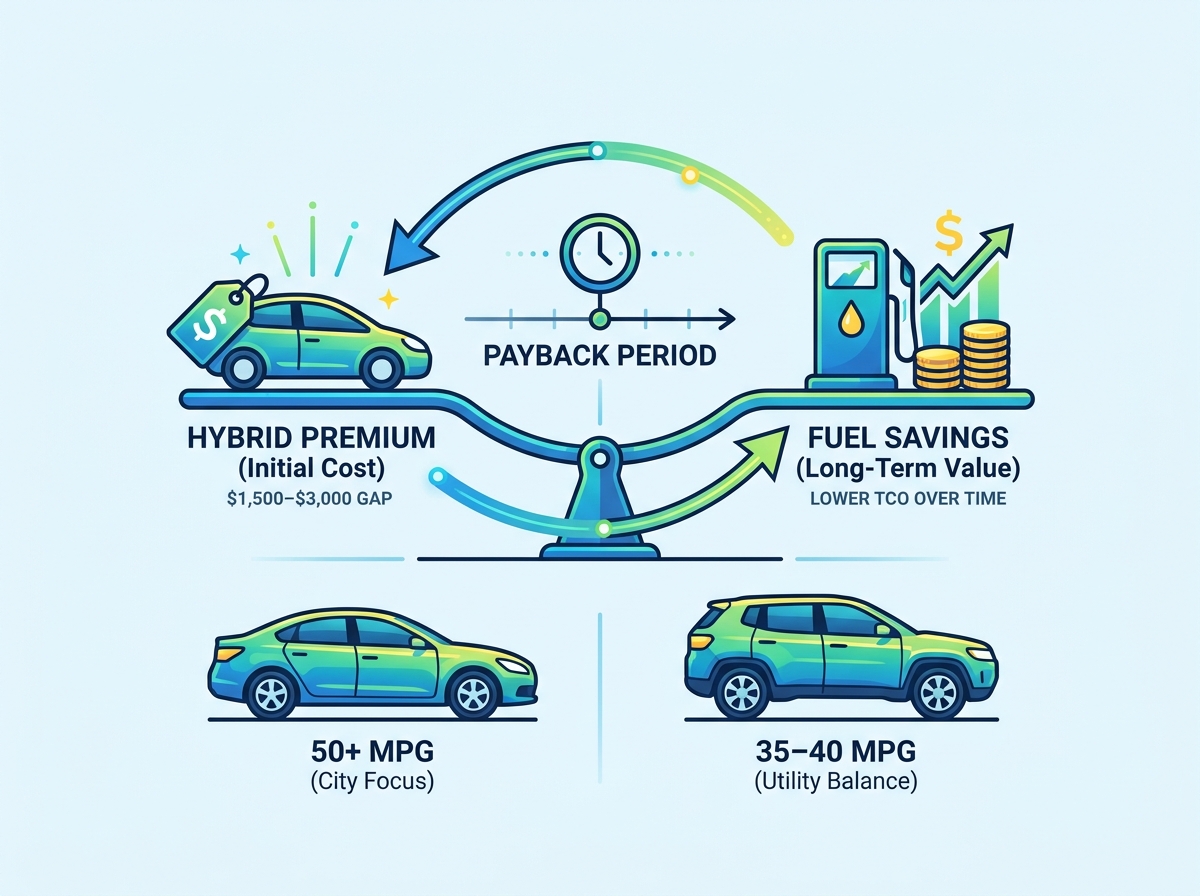
Compact sedans and hatchbacks dominate raw efficiency metrics. Class leaders like the Toyota Prius and Hyundai Elantra Hybrid consistently deliver over 50 miles per gallon. Manufacturers achieve these numbers through relentless aerodynamic optimization and lightweight materials.
These vehicles often demand a compromise between performance and economy. Engineers tune these engines specifically for fuel savings rather than aggressive acceleration. The Prius uses an electronically controlled continuously variable transmission (e-CVT). It prioritizes keeping the engine in its most efficient RPM band. The Elantra utilizes a dual-clutch transmission. It sacrifices a tiny bit of absolute efficiency to provide a more traditional, engaging driving feel.
You should also temper your expectations regarding EPA estimates. Extreme weather conditions heavily impact battery chemistry and efficiency. Running the cabin heater in winter forces the gas engine to run longer. Aggressive driving habits can easily reduce advertised MPG ratings by 10 to 15 percent.
Many buyers gladly trade a few miles per gallon for increased passenger volume. Midsize options like the Honda Accord Hybrid and Toyota Camry Hybrid excel here. These larger sedans typically achieve between 44 and 48 combined MPG.
These models represent the perfect success criteria for specific families. They cater to buyers prioritizing highway ride comfort, cabin sound insulation, and rear legroom. The extra wheelbase length absorbs road imperfections better than compact alternatives. They remain highly efficient while offering genuinely premium interior experiences.
Efficiency Overview for Popular Sedans
| Vehicle Segment | Notable Model | EPA Combined MPG | Primary Buyer Benefit |
|---|---|---|---|
| Compact Hatchback | Toyota Prius | 57 MPG | Maximum raw efficiency and distinctive styling. |
| Compact Sedan | Hyundai Elantra | 54 MPG | Traditional driving dynamics and strong value. |
| Midsize Sedan | Honda Accord | 48 MPG | Spacious interior and engaging handling. |
| Midsize Sedan | Toyota Camry | 51 MPG | Proven reliability and comfortable highway cruising. |
The compact crossover segment currently dominates the automotive sales charts. Top sellers like the Honda CR-V Hybrid and Toyota RAV4 Hybrid blend exceptional practicality with remarkable efficiency. Families flock to these models for their elevated seating positions and versatile cargo areas.
Their all-wheel drive (AWD) implementation differs fundamentally from traditional mechanical setups. Engineers place a dedicated electric motor directly on the rear axle. The vehicle sends power to the rear wheels electronically when it detects slippage. This eliminates the heavy mechanical driveshaft running down the center of the vehicle. It removes parasitic mechanical drag, improving both traction and fuel economy simultaneously.
You can reasonably expect a baseline of 35 to 40 combined MPG from these crossovers. This represents a massive leap over traditional gas SUVs, which often struggle to break 28 MPG. This substantial efficiency gap offers the fastest payback period for families needing cargo space.
Larger families require maximum seating capacity. The Toyota Highlander Hybrid and Kia Sorento Hybrid serve this specific demographic perfectly. Engineering a heavy, blocky three-row vehicle to achieve 35 MPG requires sophisticated power management. Buyers seeking three rows usually find these models offer the most compelling blend of space and daily running cost savings.
Battery failure remains the most common fear among prospective buyers. We must address this concern with realistic industry data. Modern battery packs routinely outlast the mechanical components of the vehicle. Whether they use older nickel-metal hydride (NiMH) chemistry or modern lithium-ion (Li-ion) cells, they are incredibly robust. Automotive engineers design these systems to operate within a very narrow state-of-charge window. They rarely charge to 100% or drain to 0%. This strict thermal and charge management means these packs routinely last well beyond 150,000 miles.
Federal regulations provide significant peace of mind. Every manufacturer must provide a minimum 8-year/100,000-mile warranty on the battery pack and related electrical components. If you live in a state adhering to California Air Resources Board (CARB) regulations, the mandate extends even further. CARB states require a 10-year/150,000-mile warranty. These comprehensive safeguards protect your investment heavily during the vehicle's primary lifecycle.
Evaluating a used Hybrid car demands a different checklist than inspecting a standard gas vehicle. You must prioritize specialized maintenance records to ensure long-term viability.
Urban commuters extract the maximum possible value from electrified powertrains. Stop-and-go traffic plays perfectly into the system's strengths. Every time you step on the brake pedal in city traffic, the regenerative braking system captures kinetic energy. It feeds this energy directly back into the battery. Furthermore, the gas engine frequently shuts off completely while idling at red lights or creeping through congestion. You consume zero liquid fuel during these moments. If your daily commute involves endless city blocks, electrified models offer unparalleled advantages.
Highway driving presents a completely different engineering challenge. Consistent speeds above 75 mph minimize the opportunity for regenerative braking. The electric motor provides very little assistance at these sustained high speeds. The gas engine does almost all the heavy lifting to overcome wind resistance. If your driving exceeds 80% highway usage, you will see diminishing returns. You should evaluate highly aerodynamic sedans over boxy SUVs in this scenario. Pushing a tall, square crossover through the air at 80 mph drains efficiency rapidly, regardless of the powertrain.
Reading specifications only provides part of the necessary context. You must schedule test drives to evaluate the unique driving dynamics. Pay very close attention to the brake pedal feel. Blended braking systems transition between electric regeneration and physical brake pads. Some manufacturers make this transition seamless, while others feel grabby or unpredictable. You should also evaluate the smoothness of the gas engine transition. The physical shudder when the internal combustion engine wakes up varies wildly across different brands. Finding the right Hybrid car requires ensuring these mechanical transitions match your personal driving preferences.
Determining the best electrified vehicle ultimately comes down to a clear mathematical decision. You must balance your specific commute type against your daily space requirements. Sedans offer the ultimate raw efficiency, while crossovers provide necessary family utility. Remember to accurately calculate your personalized payback period before signing any dealership paperwork. Do not pay a massive upfront premium if your annual mileage cannot justify the investment. Take the time to evaluate long-term financial factors, including brake longevity and resale value. Your next step is straightforward. Check your local dealership inventory for current pricing trends. Schedule back-to-back test drives of a top-rated sedan and a crossover to feel the mechanical differences yourself.
A: No, routine maintenance is often cheaper. Regenerative braking significantly reduces wear on mechanical brake pads. The electric motor also reduces the daily physical strain on the gas engine. You will still need regular oil changes and tire rotations. The only notable long-term financial risk is an out-of-warranty battery replacement.
A: They serve as a reliable baseline for comparing different models. However, they do not perfectly predict your personal experience. Cold weather impacts battery efficiency, and sustained high-speed highway driving drains fuel faster than city driving. Real-world results often fall slightly below advertised numbers during extreme temperatures.
A: This depends entirely on your charging access. Traditional models remain best for buyers with no home charging infrastructure. PHEVs offer superior value for drivers with short daily commutes and reliable access to a garage charger, allowing them to complete most local trips using only electricity.


