
Views: 0 Author: Site Editor Publish Time: 2026-07-28 Origin: Site


Transitioning from traditional internal combustion engines to a New energy forklift truck is no longer just an environmental initiative. Today, it stands as a core operational decision for modern warehouses. The shift in material handling demands immediate attention from operations leaders everywhere. However, selecting the right equipment requires a careful balancing act. You face higher upfront capital expenditures initially. You must weigh these costs against long-term financial returns and daily efficiency gains. Furthermore, you must ensure your facility infrastructure can actually support this technological change before committing.
This guide provides a vendor-neutral, evidence-based framework tailored for procurement professionals. You will learn how to evaluate, shortlist, and implement modern electric lift trucks effectively. We will help you navigate this complex transition without disrupting your current daily workflows. By following these steps, you can confidently upgrade your fleet.
You must map out the primary drivers for your switch before comparing spec sheets. Different organizations prioritize different outcomes. Indoor emission compliance is crucial for employee health. Noise reduction drastically improves warehouse communication. Achieving corporate ESG targets remains a top priority for public companies. Lowering routine maintenance costs drives daily profitability. Identify which specific goals matter most to your operations. This clarity guides every subsequent purchasing decision you make.
Shift your evaluation away from the initial sticker price. Instead, project costs over a standard five-to-seven-year lifecycle model. You must factor in multiple inputs for an accurate financial picture. Record the initial purchase price of the lift. Add the installation costs for charging infrastructure. Compare your anticipated electricity rates against current diesel or LPG expenses. Finally, calculate the expected reduction in routine maintenance. Electric motors have fewer moving parts, which slashes ongoing repair bills.
Acknowledge a basic assumption in material handling. Advanced electric models yield the highest return in multi-shift operations. High utilization maximizes your investment. Opportunity charging allows operators to plug in during short breaks. This practice minimizes costly equipment downtime. Conversely, single-shift operations usually face a longer payback period. A low-use environment stretches out the time required to recoup high initial battery costs. You must evaluate your specific shift schedules realistically.
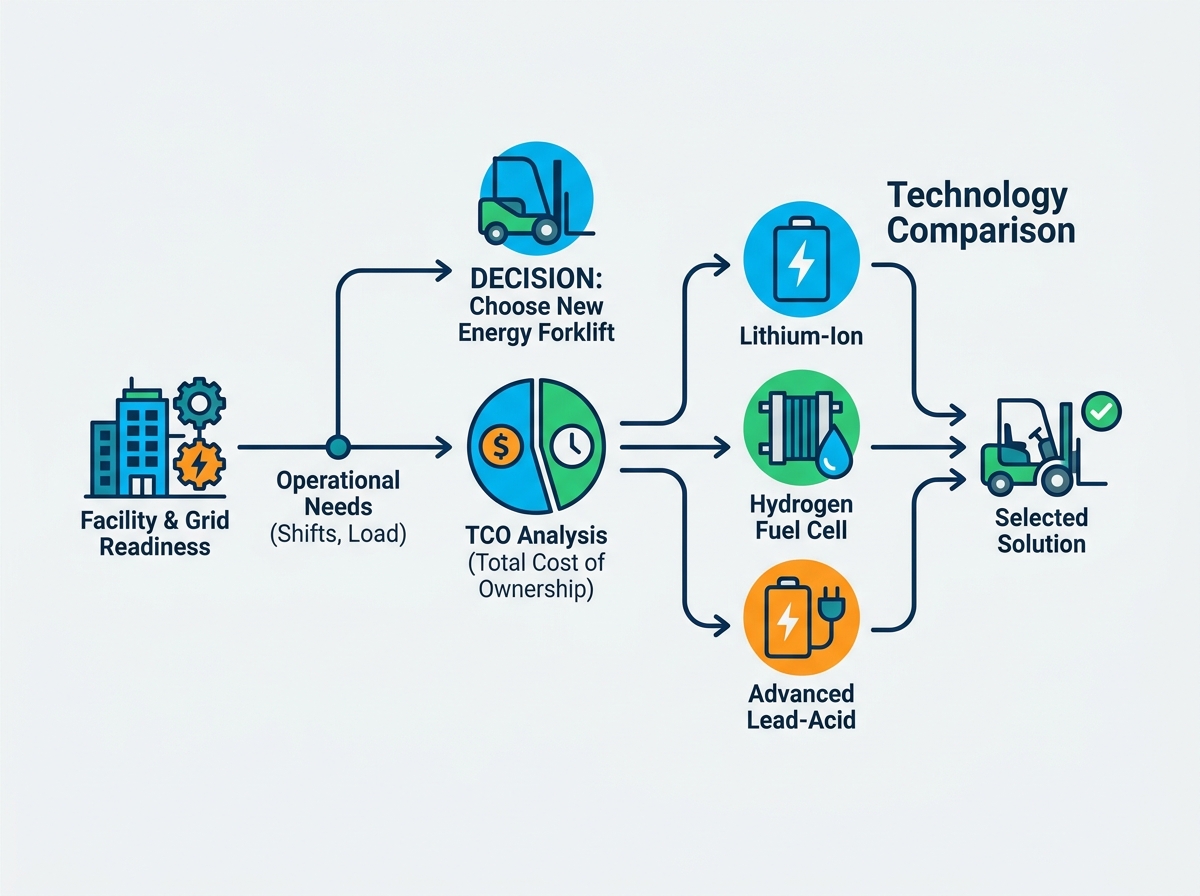
Evaluate your current facility infrastructure before buying new equipment. Commercial fast chargers draw massive amounts of power. High-frequency chargers can easily overwhelm an older building.
Failing to verify grid capacity often leads to blown breakers and delayed deployments.
Measure your aisle widths accurately. Warehouses categorize aisles as Standard, Narrow, or Very Narrow Aisle (VNA). These dimensions dictate the required turning radius for your new equipment. You cannot afford to buy a lift that gets stuck between racks. Next, account for charging station footprints. Wall-mounted chargers save floor space, but floor-standing units require dedicated zones. Ventilation requirements also matter. Even clean battery technologies require localized safety protocols. You must maintain clear pathways around all charging hubs.
Assess your specific working conditions. Cold storage operations negatively impact battery depletion rates. Freezing temperatures can reduce standard battery capacity by up to thirty percent. You will need specific thermal-managed power cells for freezer environments. Additionally, consider your flooring surfaces. Indoor and outdoor usage dictates your tire selection. Cushion tires perform beautifully on smooth indoor concrete. Pneumatic tires provide necessary traction for rough outdoor lumber yards. You must match the tire to the terrain.
Lithium-ion technology dominates modern material handling. This power source works best for continuous 24/7 operations. Multi-shift facilities benefit immensely from these batteries. The primary advantage is opportunity charging. Operators can safely plug in during lunch breaks. They require zero daily maintenance. Furthermore, they deliver consistent power output until fully depleted. However, they carry a high initial purchase cost. They also require disciplined charging habits from your operators to maximize battery life.
Hydrogen fuel cells suit massive fleets operating thirty or more trucks. They handle high-throughput distribution centers perfectly. Refueling a hydrogen lift takes only minutes. The experience mimics filling up a traditional ICE forklift. You experience zero performance degradation during a shift. Unfortunately, the infrastructure cost is astronomically high. You must generate hydrogen on-site or manage complex delivery logistics. This technology is simply not viable for small-to-medium enterprises.
Thin Plate Pure Lead offers a solid middle ground. It works best for one-to-two shift operations. Facilities looking for a lower-cost entry into electric equipment often choose TPPL. You pay a lower upfront cost than lithium-ion equivalents. They also offer moderately fast charging speeds. However, they are notably heavier. They require periodic watering and equalize charging schedules. Their overall lifespan falls short when compared to lithium-ion alternatives.
| Power Technology | Best Application | Primary Advantage | Major Drawback |
|---|---|---|---|
| Lithium-Ion | 24/7 Multi-Shift | Zero maintenance, fast charging | High initial capital cost |
| Hydrogen Fuel Cell | Massive Fleets (30+) | Rapid refueling in minutes | Extreme infrastructure costs |
| Advanced Lead-Acid | 1-2 Shift Operations | Lower upfront investment | Shorter overall lifespan |
Match the base capacity of the truck to your heaviest routine loads. Never underestimate your maximum lifting requirements. You must also factor in capacity de-rating. Specialized attachments change the physics of your lift. Clamps, rotators, and side-shifters push the load center forward. This shift significantly reduces the safe lifting capacity. A basic five-thousand-pound lift might only handle four thousand pounds safely once you add a paper roll clamp. Consult capacity plates carefully.
Ensure your maximum fork height aligns perfectly with your highest racking levels. Operators must reach the top shelf comfortably. However, reaching high introduces another problem. You must factor in the collapsed mast height. A tall mast might strike overhead doors or sprinkler pipes. Measure your standard doorway clearance meticulously. You need a mast that reaches your highest rack but still drives safely through your lowest loading dock door.
Evaluate operator-centric features to boost daily productivity. Comfortable operators make fewer mistakes. Look for integrated telematics systems. These systems track impacts and monitor fleet health automatically.
Address operator resistance proactively. Moving from traditional ICE equipment to a New energy forklift truck requires real behavioral shifts. Operators often dislike changing their routines. In the past, they ran diesel trucks until the tank hit empty. Now, they must plug in the equipment during every single break. You must train them on opportunity charging protocols. Post clear signage around charging bays. Host hands-on training sessions to build their confidence with the new technology.
Vet your suppliers based on their post-sale ecosystem. A cheap forklift becomes expensive if you cannot get parts. Ask your dealer critical questions. Do they offer comprehensive site audits prior to the sale? What is their Service Level Agreement (SLA) for replacement parts? Do they dispatch technicians within four hours? Ask if they assist with local utility rebates or green energy grants. Strong dealer support ensures your fleet stays operational.
We strongly recommend the pilot program approach. Never replace an entire fleet based on a brochure. Rent or lease a single unit first. Put it in your toughest application. Test real-world battery performance under heavy loads. Monitor how quickly the battery depletes in your specific environment. Gauge operator acceptance. Ask your drivers for honest feedback. Use this empirical data to validate your assumptions before committing to a full fleet overhaul.
A: Lithium-ion batteries typically last between 2,000 to 3,000 charging cycles. This equates to roughly five to seven years in a heavy-use environment. The exact lifespan depends heavily on the average depth of discharge. Strict adherence to proper opportunity charging protocols will maximize battery longevity.
A: It depends entirely on your fleet size and charger types. Fast-charging multiple lithium-ion trucks simultaneously draws significant electrical amperage. This load often overwhelms older building infrastructure. You should always conduct a professional power draw audit before purchasing fast chargers.
A: Yes. Many regions offer attractive tax incentives, carbon credits, or direct utility rebates for retiring ICE equipment. These programs aim to reduce industrial emissions. We advise buyers to consult their local equipment dealer or regional energy authority for specific available programs.
A: Yes, provided you check the IP (Ingress Protection) ratings. Many modern electric lifts are factory-sealed and rated for harsh outdoor or wet conditions. However, buyers must specifically request outdoor-rated models equipped with pneumatic tires for safe operation in the rain.


