
Views: 0 Author: Site Editor Publish Time: 2026-07-22 Origin: Site


Transitioning to a modern Hybrid car is no longer just for early adopters. You see these vehicles on every street corner today. However, the sheer variety of architectures available makes final selection quite complex. Buyers often overpay for technology they simply cannot fully utilize. For instance, you might buy a plug-in model without having reliable home charging access. You could easily miscalculate long-term financial benefits if you ignore real-world driving data. This guide provides a strict, specification-driven framework for your purchase journey. You will learn how to evaluate and shortlist vehicles based on your actual driving habits. We will explore verified reliability metrics and battery warranties to protect your investment. Let us remove the guesswork and find the perfect match for your daily commute.
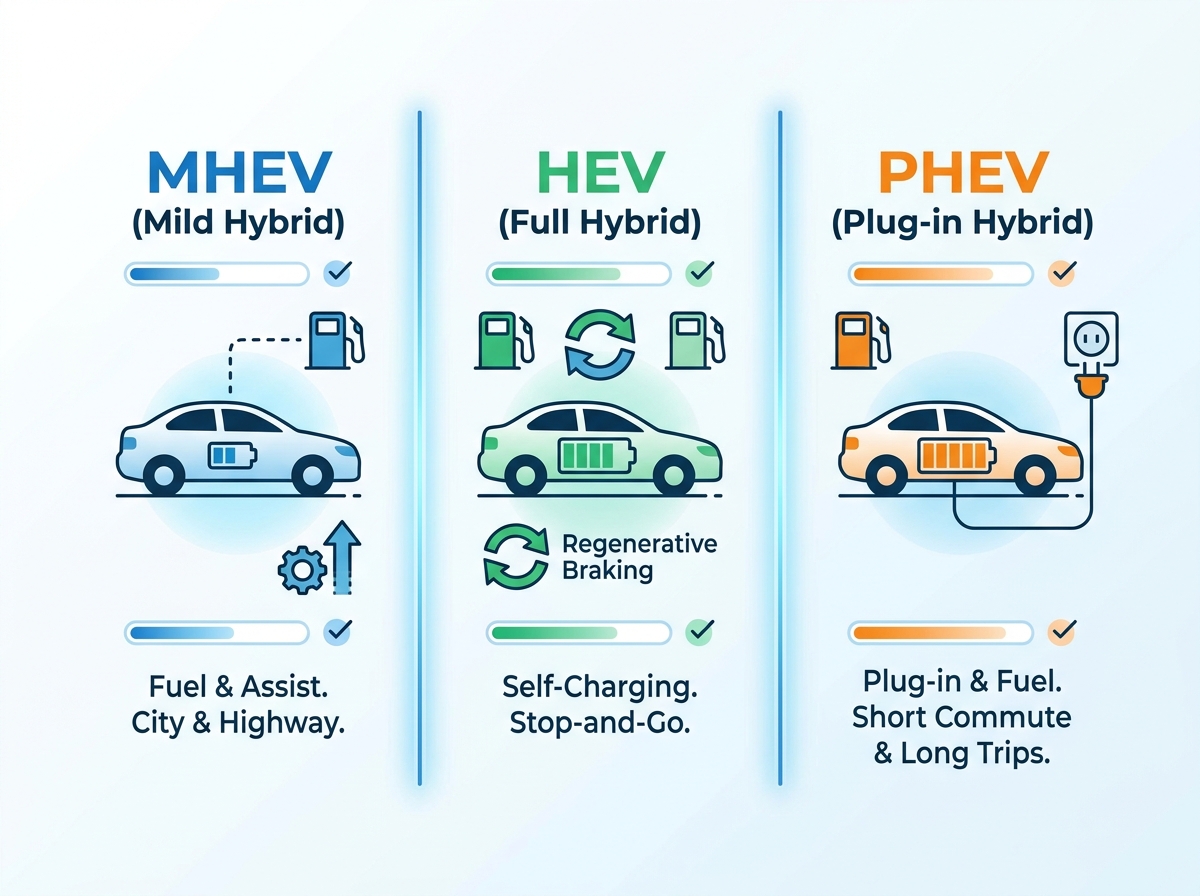
Automakers use varying mechanical approaches to achieve fuel efficiency. You must understand these distinct solution categories before visiting a dealership. Choosing the wrong architecture often leads to frustration and wasted money. We break down the three primary systems below without the confusing marketing jargon.
Think of a mild hybrid as an efficiency assist. It uses a small 48-volt battery and an electric generator. This system cannot power the vehicle on electricity alone. Instead, it supports the gasoline engine during acceleration. It also enables smoother start/stop functionality at traffic lights. You do not need to change your driving habits at all. This option is best for buyers wanting a slight MPG bump. You get improved efficiency without dealing with heavy battery packs or charging cables.
The full hybrid represents the traditional Hybrid car experience. It operates on a closed-loop system. You never plug this vehicle into a wall outlet. The battery charges itself through regenerative braking and engine power. An HEV can drive on pure electricity at low speeds for short distances. This architecture shines in stop-and-go traffic. It is ideal for high-mileage city commuters lacking home charging access. You get maximum fuel efficiency in urban environments where braking happens frequently.
A PHEV serves as the bridge between gas cars and fully electric vehicles. These models feature much larger battery packs. You must plug them into a Level 1 (120V) or Level 2 (240V) charger to maximize their potential. They typically offer an electric-only range between 25 and 45 miles. A PHEV only remains cost-effective if your daily driving falls within this specific range. If you routinely drive 80 miles a day without charging at work, you drag around a heavy, depleted battery. This drastically reduces your fuel efficiency on longer trips.
Dealership spec sheets often overwhelm buyers with numbers. You need to know exactly which metrics dictate real-world performance. Ignore the flashy marketing brochures. Focus on these specific evaluation dimensions to ensure the vehicle meets your daily requirements.
Automakers advertise a metric called MPGe (Miles Per Gallon equivalent) for plug-in hybrids. This number represents efficiency while the battery has a charge. However, a PHEV’s MPGe becomes completely irrelevant once you deplete the battery. At that point, the vehicle relies entirely on its combustion engine. You must check the gas-only MPG rating for longer road trips. If the gas-only MPG is poor, road trips will cost you significantly more than expected.
Battery capacity directly influences your electric range. For PHEVs, you must map the battery size directly to your real-world commute distances. Calculate your exact round-trip mileage to the office. You also need to factor in climate conditions. Cold weather drastically impacts lithium-ion batteries. Expect a 20-30% range drop in freezing temperatures. A PHEV rated for 30 miles might only deliver 21 miles during a harsh winter.
Many buyers focus heavily on engine displacement. In the hybrid world, combined system horsepower is far more important. The electric motor and gas engine work together to create total output. Furthermore, you should highlight the importance of low-end electric torque. Electric motors deliver maximum torque instantly. This makes city driving, overtaking, and highway merging feel incredibly responsive. A smaller gas engine paired with a strong electric motor often outperforms a larger, traditional V6 engine.
| Specification | Primary Function | What to Watch Out For |
|---|---|---|
| Gas-Only MPG | Measures fuel economy when battery is depleted (PHEV) or operating normally (HEV). | Do not confuse this with MPGe. Low gas-only MPG hurts highway road trip budgets. |
| Battery Capacity (kWh) | Determines how far the car can travel on pure electric power. | Cold climates reduce effective capacity by up to 30%. Plan your commute accordingly. |
| Combined Torque | Dictates off-the-line acceleration and merging power. | Ensure the manufacturer lists combined output, not just the gas engine specs. |
Every engineering choice involves physical compromises. Hybrid vehicle design is no exception. Automakers must integrate complex electrical systems into traditional chassis layouts. You must assess these hidden trade-offs to build a complete picture of everyday usability. Knowing these factors prevents buyer's remorse after driving the vehicle off the lot.
High-voltage battery packs require significant physical space. Engineers often place these heavy packs under the rear passenger seats or beneath the cargo floor. This placement frequently eats into trunk space. We strongly instruct buyers to compare the cubic footage of the hybrid model directly against its gas-only counterpart. You might lose several cubic feet of vertical storage. This seemingly small loss becomes highly noticeable when packing luggage for family vacations.
Electric motors and dense battery packs add substantial weight. A hybrid version of a standard sedan or SUV typically carries an extra 300 to 800 lbs. This increased curb weight alters vehicle dynamics. It accelerates tire wear intervals significantly. You will likely replace tires more frequently than you would on a lighter gas car. The suspension must also work harder to control the extra mass. This can result in a stiffer ride over potholes and broken pavement.
Weight reduction and space optimization are critical for hybrid efficiency. To compensate for heavy batteries, many manufacturers eliminate the traditional spare tire. They replace the spare tire with a small chemical patch kit and an air compressor. This is a critical detail for rural drivers. A patch kit cannot fix a major sidewall blowout. If you frequently drive through isolated areas, you must consider the logistics of traveling without a physical spare tire.
Evaluating the financial merit of a hybrid requires strict objective math. You must look past the dealership hype to understand true return on investment (ROI). Hybrids generally carry a higher upfront purchase price. We provide a straightforward framework to help you evaluate if the initial premium justifies the long-term savings.
You can easily determine your financial timeline using a simple formula approach. First, identify the price premium of the hybrid over the comparable gas model. Next, calculate your expected annual fuel savings based on your local gas prices and yearly mileage. Finally, use this formula: (Hybrid Price Premium) ÷ (Annual Fuel Savings) = Years to Break Even. If a hybrid costs $2,500 more upfront, and you save $500 annually on gas, you hit the break-even point in five years. If you plan to sell the car in three years, the math might not favor the hybrid.
Federal and state incentives can drastically alter your break-even math, particularly for PHEVs. However, you must verify eligibility carefully. Strict regulations govern these tax credits. Eligibility often depends on domestic battery sourcing, vehicle assembly location, and your personal income limits. We advise avoiding over-promises from eager sales staff. Always consult current government databases or a tax professional to confirm exact rebate amounts before signing the final paperwork.
Daily running costs differ from traditional vehicles. You will experience distinct savings on routine wear items. Regenerative braking does most of the work when slowing down. Consequently, brake pads often last twice as long on a hybrid. However, you must contrast these savings against potential premiums. Specialized hybrid system diagnostics require certified technicians. If complex electrical components fail outside the warranty window, hourly labor rates for specialized mechanics run significantly higher than standard repair costs.
Battery failure remains the most common objection among hesitant buyers. It is a valid concern, considering the battery acts as the heart of the powertrain. However, modern technology includes massive safety nets. You can mitigate risk by understanding degradation curves and legal warranty standards.
Automakers cannot legally sell you a hybrid without substantial battery protection. In the United States, federal law mandates a baseline warranty of 8 years or 100,000 miles for high-voltage batteries. If you live in a CARB (California Air Resources Board) compliance state, the mandate extends even further. CARB states require a baseline of 10 years or 150,000 miles. Always verify these terms in the manufacturer's warranty booklet.
You must delineate between natural capacity loss and total system failure. Battery degradation is entirely normal. Over five years, a PHEV might lose 10% of its total electric range due to chemical aging. This capacity loss does not mean the battery is broken. Total system failure, where the vehicle refuses to drive, is exceedingly rare. Advanced thermal management systems actively cool and heat the battery to prevent catastrophic failure.
Transparency matters when discussing worst-case scenarios. If you plan to keep the vehicle far past its warranty period, you must budget for potential replacement. Average out-of-pocket replacement estimates range from $3,000 to $8,000. The final cost depends heavily on the battery size and the specific automaker. Grounding this risk in reality helps you decide whether to trade the vehicle in before the 100,000-mile mark.
Research only gets you halfway to a decision. You must test the mechanical integration in person. Hybrid systems behave differently than standard combustion engines. Give yourself actionable steps for the dealership visit. Use the following checklist to evaluate the refinement of your shortlisted models.
Buying a Hybrid car is fundamentally an exercise in matching battery architecture to your daily driving realities. You avoid overpaying by strictly aligning your commute length, charging access, and cargo needs with the right mechanical system. Look past dealership marketing and evaluate the real-world metrics. Compare gas-only efficiency, combined torque, and suspension trade-offs.
Modern hybrid systems are heavily stress-tested and highly reliable when chosen correctly. Warranties lasting up to a decade provide an exceptional safety net against component failure. You can buy with confidence once you understand the actual break-even timeline.
Take action today. Calculate your average daily commute mileage and assess your local charging options. Once you know your numbers, begin shortlisting two to three models. Schedule back-to-back test drives to evaluate brake feel, cabin noise, and overall powertrain refinement.
A: Hybrids yield the highest efficiency in stop-and-go city traffic due to regenerative braking. Highway driving relies heavily on the combustion engine. This narrows the MPG gap between hybrids and traditional gas cars. While still efficient, highway commuters will see a slower financial return compared to city drivers.
A: It depends on the architecture. Full hybrids (HEVs) are self-charging and require no plugs. Plug-in hybrids (PHEVs) can use a standard 120V wall outlet for slow overnight charging. However, upgrading to a 240V Level 2 charger provides much faster charging times for PHEVs.
A: In most full hybrids (HEVs), a dead high-voltage battery triggers immediate fail-safes. The computer will prevent the car from operating to avoid drivetrain damage. This differs from a standard 12V battery issue. Regular maintenance and addressing warning lights early is key to avoiding this scenario.


