
Views: 0 Author: Site Editor Publish Time: 2026-07-24 Origin: Site


Today's automotive market creates noticeable friction for modern buyers. You often find yourself caught squarely between two compelling options. On one side, you have the proven reliability of internal combustion engines. On the other side sits the promised efficiency of electrification. Choosing your next vehicle feels more complicated than ever before. It is no longer just about horsepower metrics or sleek aesthetics. It requires a rigorous lifestyle audit and detailed long-term financial planning. You must evaluate direct expenses over your entire ownership period. Our objective is to provide a transparent, evidence-based decision framework. We will help you evaluate if a Hybrid car aligns practically with your financial goals. We will explore how it fits your daily commute and long-term risk tolerance. You will learn exactly how upfront premiums balance against daily operational savings.
A Hybrid car typically carries a noticeable price premium. You will find it costs more upfront than a traditional gas counterpart. We must calculate this average premium carefully before making decisions. Generally, buyers pay a markup for the dual-powertrain technology involved. However, you must clearly define your specific "break-even horizon." This essential metric depends heavily on current localized fuel prices. It also relies heavily on your average annual mileage accumulation. High daily mileage accelerates your financial payback period considerably.
You should also factor in compliance-based financial levers available locally. Federal and state tax rebates often apply to Plug-In Hybrids. These government incentives can drastically reduce your effective purchase price. They help bridge the initial cost gap much faster. Let's break down the exact steps for your calculation.
Follow this systematic approach to determine your exact break-even timeline:
You must address the potential insurance gap early in your research. Specialized parts can elevate comprehensive insurance premiums slightly. High-voltage battery packs remain quite expensive to replace after collisions. Insurers actively factor this financial risk into their actuarial models. They adjust coverage rates to account for these specific technological components. Despite this minor drawback, historical depreciation curves show highly positive trends.
A used Hybrid car typically maintains robust secondary market demand today. Buyers highly value the proven fuel economy of these efficient vehicles. This persistent demand often offsets any lingering battery-degradation anxieties. Strong resale values actively protect your long-term automotive investment. You usually recoup a larger percentage of your purchase price eventually.
| Expense Category | Traditional Gas Vehicle | Hybrid Vehicle |
|---|---|---|
| Initial Purchase Price | Lower baseline MSRP | Higher baseline MSRP |
| Fuel Expenditures | Higher daily operating costs | Lower daily operating costs |
| Insurance Premiums | Standard industry coverage rates | Slightly elevated coverage rates |
| Asset Depreciation | Steeper early value drop | Stronger overall value retention |
Mechanics consistently notice a massive mechanical shift in brake wear. Kinetic energy recovery drastically extends the life cycle of traditional brake pads. The electric motor essentially reverses its primary function during deceleration. It captures forward momentum and actively recharges the heavy battery pack. This seamless process handles most of your braking needs entirely naturally.
Your physical rotors experience significantly less abrasive physical friction daily. Drivers often reach incredibly high mileages before needing basic brake replacements. This technological advantage saves you considerable time and money over a decade. It removes one of the most common routine maintenance headaches completely.
We must transparently assess the genuine risks of maintenance. You are essentially maintaining two separate powertrains simultaneously. The internal combustion engine and electric motor must work together perfectly. This dual-system design introduces complex technical interactions under the hood. Standard battery warranties offer strong risk mitigation for new buyers. Manufacturers typically provide robust warranties spanning eight years or 100,000 miles.
Realistic out-of-pocket replacement costs matter greatly post-warranty. Replacing a degraded battery pack requires significant capital investment later. Dealerships or highly specialized independent technicians become strictly necessary. Standard neighborhood lube shops lack the high-voltage training required. You must plan for specialized servicing routines throughout your ownership. This reality means you cannot always rely on cheap local mechanics.
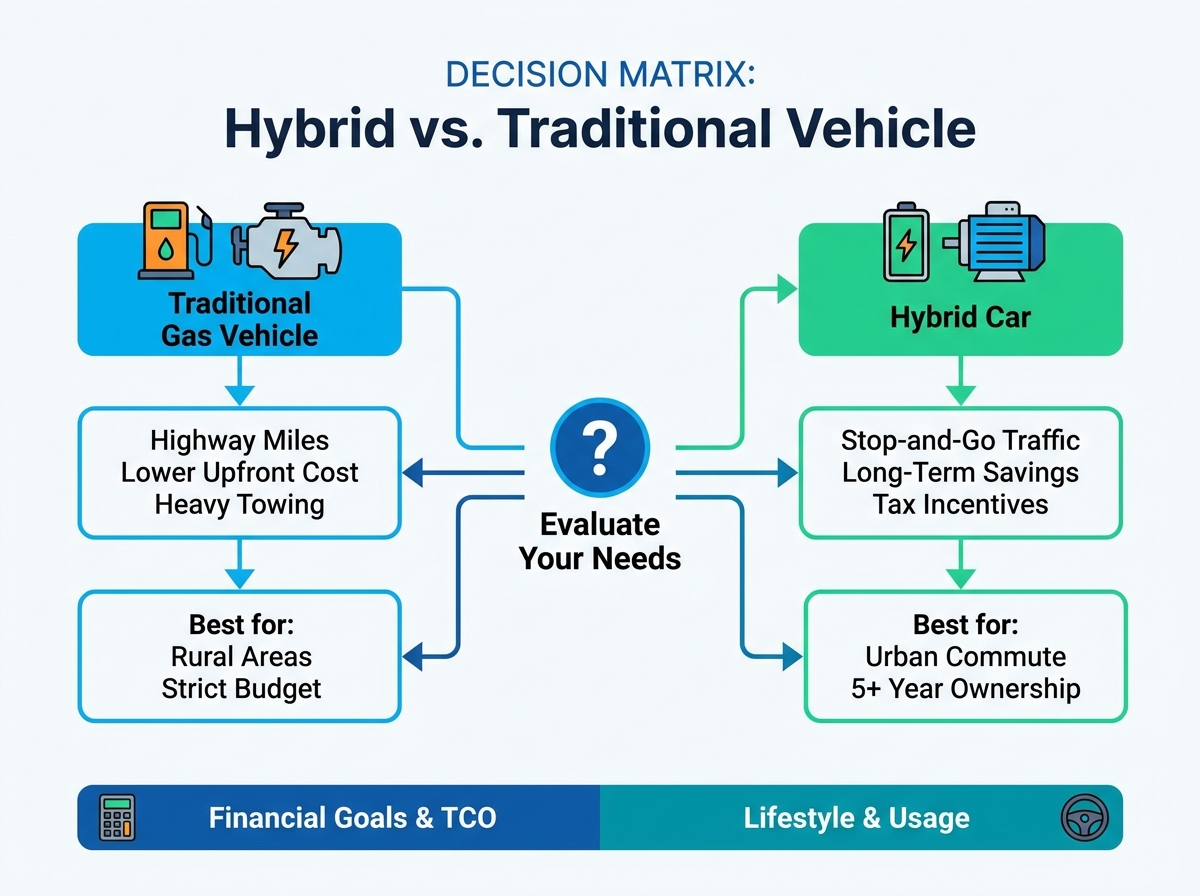
We break down efficiency using MPGe and real-world fuel economy. Your daily route topography dictates your actual financial savings. Urban gridlock heavily favors a Hybrid car every single time. The electric motor thrives in messy stop-and-go traffic scenarios. It prevents the gas engine from idling uselessly at red lights.
Conversely, interstate cruising relies heavily on the standard gas engine. You must address the well-known "highway penalty" objectively. Traditional gas vehicles remain highly competitive in these environments. Drivers logging primarily high-speed, long-distance routes see much smaller efficiency gaps. Aerodynamic drag at high speeds taxes electric motors quite heavily. You need the internal combustion engine for sustained highway momentum.
Extreme weather introduces notable performance variables for any electrified vehicle. Deep cold impacts lithium-ion battery efficiency significantly and immediately. The internal combustion engine takes over cabin heating duties quickly. This essential function reduces the electric range drastically during harsh winter months. You will notice lower fuel economy when temperatures drop below freezing.
You must also compare traction and handling dynamics carefully. Heavy battery placement alters the vehicle's entire weight distribution fundamentally. These dense packs sit low within the core chassis structure. This layout lowers the center of gravity considerably for the driver. It often improves cornering stability compared to traditional top-heavy chassis designs. Drivers generally report a more planted and secure driving feel overall.
Verifiable data strongly supports lifecycle carbon footprint reductions. Manufacturing a Hybrid car generates higher initial industrial emissions. Battery production requires intense global resource extraction and processing. However, dramatically reduced tailpipe emissions quickly offset this early manufacturing debt.
Over a ten-year lifespan, hybrids emit significantly fewer greenhouse gases. They burn less fossil fuel during daily municipal operation. This makes them tangibly better for your local air quality. They offer a highly practical middle ground for eco-conscious consumers. You reduce your personal carbon footprint without experiencing severe range anxiety.
We need to clarify distinct technological differences to eliminate adoption friction. Standard Hybrid Electric Vehicles (HEVs) require absolutely no external plug. They offer total grid independence for urban and rural drivers alike. They recharge their batteries purely through internal generation and regenerative braking.
Plug-In Hybrid Electric Vehicles (PHEVs) rely heavily on the electrical grid. They need external charging to achieve their maximum stated efficiency. They provide dedicated electric-only ranges for short daily commutes. This clear distinction appeals strongly to specific types of buyers. Buyers lacking dedicated home-charging infrastructure should strictly avoid PHEV models. Standard HEVs remain the better practical choice for apartment dwellers.
We must organize these variables into an actionable framework. Your choice depends heavily on your unique daily circumstances.
When to Choose a Traditional Gas Vehicle:
When to Upgrade to a Hybrid Car:
Next Steps: You should review specific manufacturer model warranties very carefully. Next, calculate your personal lifetime vehicle expenses thoroughly using local data. Finally, schedule back-to-back test drives at your preferred local dealerships. Experiencing the driving dynamics firsthand remains the most crucial step.
Neither vehicle option reigns universally superior for every single driver. The "best" choice represents a mathematical and practical lifestyle alignment. You must match the powertrain specifically to your unique use case. A well-researched decision balances your upfront budget with anticipated running costs.
You should browse current local inventory for both vehicle types today. Contact a specialized sales consultant for professional, unbiased guidance. Ask them to run a personalized return-on-investment calculation based on your mileage. Taking these deliberate actions ensures you make a fully informed automotive investment.
A: Industry standards suggest battery packs last between 100,000 and 150,000 miles. Most manufacturers back this up with robust 8-year or 100,000-mile warranties. Software management systems actively prevent deep depletion, which dramatically extends battery lifespan. You rarely need to replace them prematurely under normal driving conditions.
A: Yes, they can command slightly higher comprehensive insurance premiums initially. High-voltage battery packs and specialized electronic components cost more to replace after accidents. However, your standard liability rates generally remain identical to traditional gas vehicles. You often recoup this minor premium difference through daily fuel savings.
A: It entirely depends on the specific model you choose. Standard hybrids (HEVs) recharge internally through regenerative braking and engine power. They never require an external plug. Plug-in hybrids (PHEVs) feature larger batteries. They require grid charging to utilize their full electric-only driving range.
A: They are not inherently worse, but their efficiency advantage shrinks significantly. The electric motor provides less benefit at sustained high speeds. However, modern aerodynamic designs and efficient gas engines ensure they still perform well. They generally outperform or perfectly match traditional 4-cylinder vehicles on the highway.


