
Views: 0 Author: Site Editor Publish Time: 2026-07-26 Origin: Site


The transition from traditional Internal Combustion Engine (ICE) models to advanced material handling equipment is accelerating rapidly across the global supply chain. Strict environmental mandates now force warehouses to rethink operational strategies entirely. Modern facilities also demand much higher daily operational efficiency to remain highly competitive.
Replacing a legacy fleet requires enormous capital expenditure up front. You must heavily adapt existing facility infrastructure to safely support modern electrical power systems. Operational benefits often look very clear initially on paper. However, hasty equipment replacements frequently create major workflow bottlenecks and severe unexpected expenses.
This guide skips basic definitions to offer operations and procurement leaders a highly practical, rigorous evaluation framework. We show you exactly how to evaluate, shortlist, and implement a highly effective New energy forklift truck fleet. You will master facility readiness checks and ensure maximum long-term value for your operations.
Model your transition carefully before making large purchases. Compare initial equipment costs against long-term operational savings. You eliminate expensive diesel fuel purchases entirely. You remove routine engine maintenance tasks from daily schedules. You no longer need to buy distilled water for lead-acid batteries. Calculate the specific break-even timeline for your exact facility layout. Single-shift operations take slightly longer to recover initial costs. Multi-shift operations see much faster financial returns due to constant utilization.
Modern power systems remove traditional workflow bottlenecks immediately. They eliminate massive, space-consuming battery swapping stations. You no longer need specialized battery maintenance personnel on site. Operators utilize opportunity charging naturally during their regular shifts. They plug machines in during short coffee breaks or shift changes. This simple practice drastically improves overall labor efficiency. Your team spends more time moving heavy pallets. They spend significantly less time managing equipment power levels.
Sustainability goals drive modern corporate decision-making today. Transitioning fleets helps facilities meet strict indoor air quality standards quickly. You actively reduce your corporate carbon footprint. Old technology presents severe workplace hazards daily. You remove dangerous acid spill risks completely. You eliminate toxic off-gassing events during routine charging cycles. Modern closed-loop battery systems guarantee a much safer warehouse environment. Clean air improves general worker health and boosts daily morale.
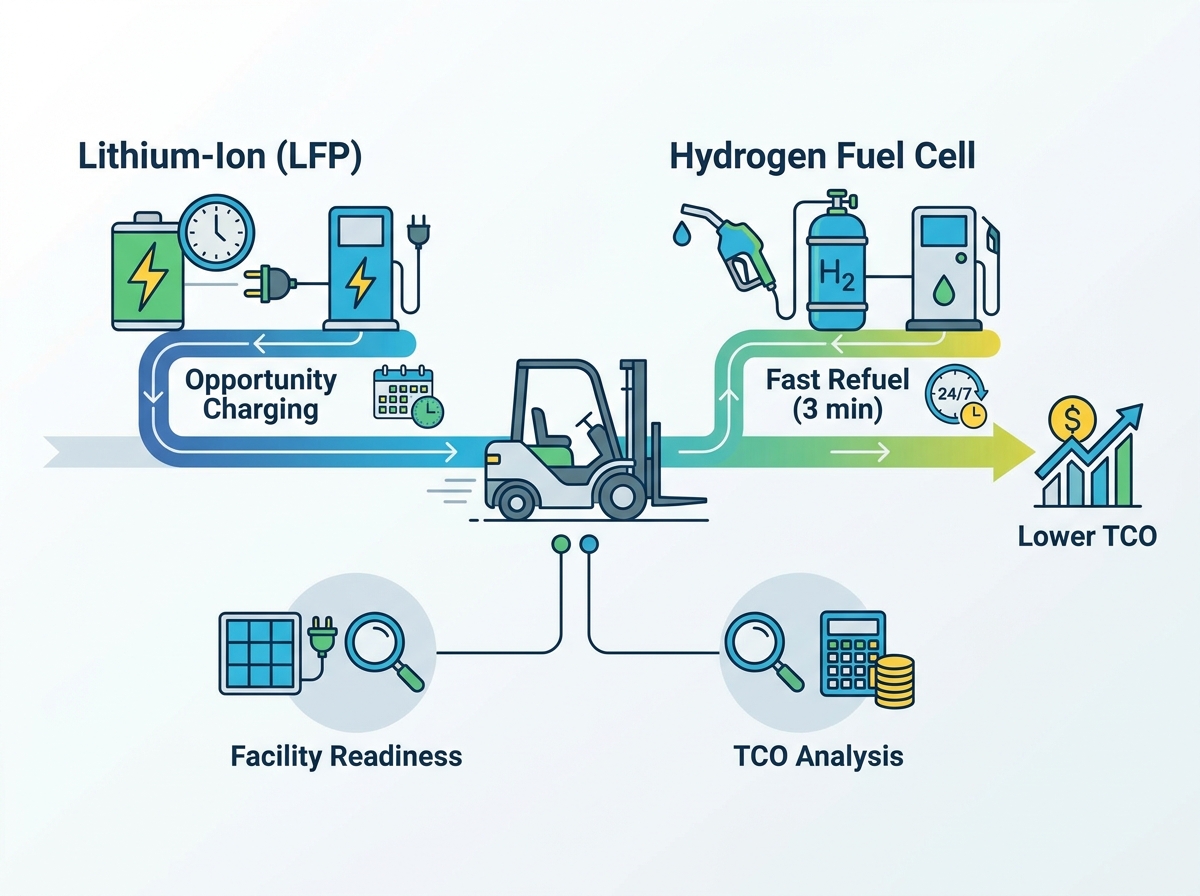
Lithium Iron Phosphate (LFP) chemistry currently dominates material handling sectors. High energy density keeps trucks running longer between charges. They require absolutely zero daily watering or internal maintenance. LFP safely handles aggressive opportunity charging profiles daily. They boast a highly reliable lifespan exceeding 3,000 deep cycles. Extreme cold degrades LFP performance quickly without intervention. Cold storage needs specialized internal thermal management systems. They also require high-amperage chargers to work effectively. LFP remains ideal for intense two-to-three-shift warehouse operations. Cold storage applications work well when explicitly equipped for freezing temperatures. Busy manufacturing facilities benefit immensely from LFP safety and stability.
Hydrogen fuel cells offer a completely different operational dynamic. Refueling takes only three minutes from empty to full. This workflow mimics traditional ICE operational habits perfectly. Fuel cells deliver highly consistent power output until completely empty. They suffer zero performance drop in harsh freezer environments. On-site hydrogen generation demands massive initial capital expenditure. Storage infrastructure requires immense specialized spatial planning. Supply chain volatility sometimes threatens local hydrogen fuel availability. Hydrogen remains best for ultra-large distribution centers using fifty plus trucks. Continuous 24/7 operations find hydrogen refueling highly beneficial. Sites lacking adequate floor space for multiple electrical chargers often prefer this route.
| Technology Type | Primary Advantage | Main Limitation | Best Fit Environment |
|---|---|---|---|
| Lithium-Ion (LFP) | Zero maintenance, long cycle life | Requires high-amperage grid capacity | Multi-shift indoor warehouses |
| Hydrogen Fuel Cell | 3-minute rapid refueling | Massive infrastructure costs | Ultra-large 24/7 distribution centers |
| Standard Lead-Acid | Low initial CapEx | Requires heavy daily maintenance | Light-duty, single-shift operations |
Match equipment specifications directly to your physical warehouse layout. Measure your narrowest aisle width precisely before ordering. Calculate maximum rack heights carefully. Determine the heaviest payload requirements for your daily operations. Avoid the common industry mistake of over-speccing machines. Buying excessive lift capacity inflates initial costs unnecessarily. Larger masts require heavier chassis counterweights. This extra weight drains electrical power much faster. A properly sized New energy forklift truck perfectly balances lifting capability and financial budget.
Calculate Amp-hour (Ah) or Kilowatt-hour (kWh) needs highly accurately. Base these calculations on actual historical draw-down rates. Observe true energy usage during your absolute peak operational hours. Maintain highly transparent assumptions during this evaluation process. Factor in hidden parasitic loads accurately. Heavy hydraulic attachments drain battery power much faster than standard forks. Cabin heaters reduce overall LFP run times significantly in winter. Overlooking these parasitic loads leaves operators stranded mid-shift.
Operator comfort directly impacts daily warehouse productivity levels. Evaluate the interior cabin layout for natural body movement. Check digital display interfaces for clear, readable text. Ensure control precision matches specific load-handling requirements. Good ergonomics ensure fast operator adoption rates. Comfortable drivers experience significantly less physical fatigue. Happy operators maintain higher safety standards throughout long shifts. Look for adjustable seating and highly responsive hydraulic joysticks.
Modern material handling relies heavily on rich data streams. Assess how well machines integrate into your current digital ecosystems. They must communicate directly with existing Warehouse Management Systems (WMS). Track specific monitoring metrics to ensure optimal fleet health. Data reveals hidden operational inefficiencies quickly.
The hidden cost of fleet transition lies deeply within facility infrastructure. Assess your facility's current electrical panel thoroughly upfront. Determine if it truly supports concurrent fast charging demands. Multiple 480V/3-phase chargers pull massive grid amperage simultaneously. Deploy a strong mitigation strategy early to avoid blown transformers. Schedule staggered charging windows to balance electrical loads safely. Invest in smart-charging load management systems immediately. These systems throttle power dynamically based on real-time grid availability.
Strategic charger placement prevents wasted daily operational time. Map out main forklift travel routes carefully across your floor. Find optimal opportunity charging locations naturally along these paths. Place fast chargers near employee break rooms. Install secondary chargers near main staging areas. This minimizes useless dead travel time effectively. Drivers plug in quickly during routine operational pauses. Poor placement forces operators to drive empty trucks across massive buildings.
New energy systems introduce distinct regulatory requirements globally. Understand local fire codes regarding high-capacity battery storage. Lithium-ion charging requires specific spatial planning and ventilation consideration. Ensure every machine carries proper recognized UL listings. Strictly adhere to regional OSHA regulations for modern equipment handling. Safety compliance protects your workforce and your heavy financial investment.
Deconstruct complex battery warranties fully before signing binding contracts. Look closely for specific end-of-life battery degradation clauses. A good warranty guarantees 80% capacity retention over several years. Compare strict cycle-count limits against flat chronological year limits. Demand guaranteed response times for on-site technical support. Clear Service Level Agreements (SLAs) prevent frustrating future disputes. Unclear warranties often leave buyers covering massive replacement costs unexpectedly.
Assess the specific vendor's local support footprint critically. A technically superior machine fails if replacement parts remain unavailable. Poor local parts availability destroys your projected financial modeling. Extended equipment downtime ruins warehouse productivity completely. Choose vendor partners maintaining robust local inventory networks. Fast physical repairs keep your supply chain moving forward. Ask dealers specifically about their localized technician headcounts.
Never procure a complete fleet blindly without field testing. Procurement teams should mandate a rigorous onsite pilot program. Run one or two test units for 30 to 60 days. Define clear, measurable success metrics for this pilot phase. Collect direct operator feedback on machine handling and comfort. Measure actual battery depletion rates during your heaviest peak shifts. Verify charger reliability under harsh, real-world warehouse conditions.
Investing in a modernized fleet remains fundamentally an infrastructure decision. It represents a long-term strategic commitment, not merely a quick equipment upgrade. Prioritize complete facility electrical audits first. Execute strict financial modeling before locking into any specific brand. Do not commit to specific battery chemistries prematurely.
Download our comprehensive fleet evaluation calculator today. Request a detailed facility consultation with our fleet transition specialists. Browse our extensive online inventory of high-performance models to find your next solution.
A: Expect a robust cycle life ranging from 3,000 to 5,000 full charging cycles. This easily translates to 7 to 10 years of reliable service. The exact duration depends heavily on your daily shift intensity. Batteries remain highly functional until degradation naturally hits 80% of original capacity.
A: It depends entirely on your specific fleet size and charger output. Fast chargers demand very significant electrical amperage from the grid. A professional site audit remains completely mandatory before purchase. This crucial step helps avoid blown transformers and expensive electrical failures.
A: Lithium-ion systems support aggressive daily opportunity charging. They take just 1 to 2 hours to reach full capacity. Operators can safely charge them in 15-minute bursts during breaks. Traditional lead-acid batteries require a rigid 8-hour charge followed by a mandatory 8-hour cool-down period.
A: The answer depends entirely on your specific operational scale. Hydrogen wins easily on rapid 3-minute refuel times. However, it loses heavily on massive infrastructure capital expenditure. Facilities operating fewer than 50 trucks usually find lithium-ion chemistry much more practical and efficient.


