
Views: 0 Author: Site Editor Publish Time: 2026-07-23 Origin: Site


The global automotive landscape is shifting at an unprecedented pace today. Buyers often feel caught between traditional internal combustion engines and fully electric vehicles. A Hybrid car offers a highly practical middle-ground for navigating this complex transition. Evaluating this option goes far beyond making a simple environmental choice. You must carefully weigh your daily lifestyle fit, specific commuting habits, and personal risk tolerance. Shoppers face a tough decision balancing immediate upfront premiums against future fuel savings. We will explore the objective realities of hybrid ownership throughout this comprehensive guide. You will learn about the different architectures currently available on the market. We will examine measurable efficiency gains alongside specific, real-world maintenance requirements. This detailed analysis will ultimately help you determine if this specific technology fits your unique driving profile.
We must define the underlying terminology before you visit a local dealership. Manufacturers utilize various acronyms across their marketing materials. These terms often confuse average buyers. A modern Hybrid car generally falls into three distinct engineering categories. You must choose the right architecture carefully. This choice dictates your daily charging routine moving forward. It also heavily impacts your overall fuel consumption.
Full hybrids represent the most traditional and widespread approach. They utilize both a standard internal combustion engine and a dedicated electric motor. The vehicle self-charges continuously during operation. It captures kinetic energy during regenerative braking events. The gas engine also operates as a generator, creating electricity while driving. You never plug this vehicle into a wall outlet.
Best for: Buyers wanting noticeably better fuel economy instantly. You do not need to alter your existing fueling habits. You simply pump gas and drive normally. The onboard computer manages all power distribution automatically in the background. It transitions smoothly between gas and electric modes.
Plug-in hybrids bridge the technological gap toward fully electric vehicles. They feature a significantly larger onboard battery pack. You must physically charge this battery using the local electrical grid. A standard 120-volt household outlet works perfectly for overnight charging. Dedicated Level 2 charging stations provide much faster charging speeds. A PHEV typically offers 20 to 40 miles of pure electric driving range. The gas engine engages seamlessly once the main battery depletes.
Best for: Commuters possessing reliable home charging access. You can theoretically eliminate daily gasoline usage entirely. You still retain the traditional gas tank for long weekend road trips. This architecture removes range anxiety completely.
Mild hybrids utilize a much smaller 48-volt electrical system. This compact system replaces the traditional alternator and starter motor entirely. It powers auxiliary electronics like the air conditioning and infotainment systems. It also dramatically smooths out the automatic stop-start function at traffic lights. A mild hybrid cannot drive on electric power alone under any circumstances. The small electric motor simply assists the gas engine during hard acceleration.
Best for: Drivers seeking marginal efficiency gains without massive price hikes. These specific vehicles carry very minimal upfront cost premiums. Automakers increasingly include this mild technology as standard equipment on modern models.
Hybrid Architecture Comparison Matrix
| Architecture Type | Power Source | Grid Charging Required? | Pure Electric Range | Primary Use Case |
|---|---|---|---|---|
| Mild Hybrid (MHEV) | Gas Engine + Small Motor Assist | No | None | Smoothing auto stop-start, slight MPG bump |
| Full Hybrid (HEV) | Gas Engine + Electric Motor | No | 1-2 miles (low speed) | Maximum city fuel efficiency without plugging in |
| Plug-in Hybrid (PHEV) | Large Battery + Gas Engine Backup | Yes (Highly Recommended) | 20-40 miles | Zero-emission daily commutes, gas engine for road trips |
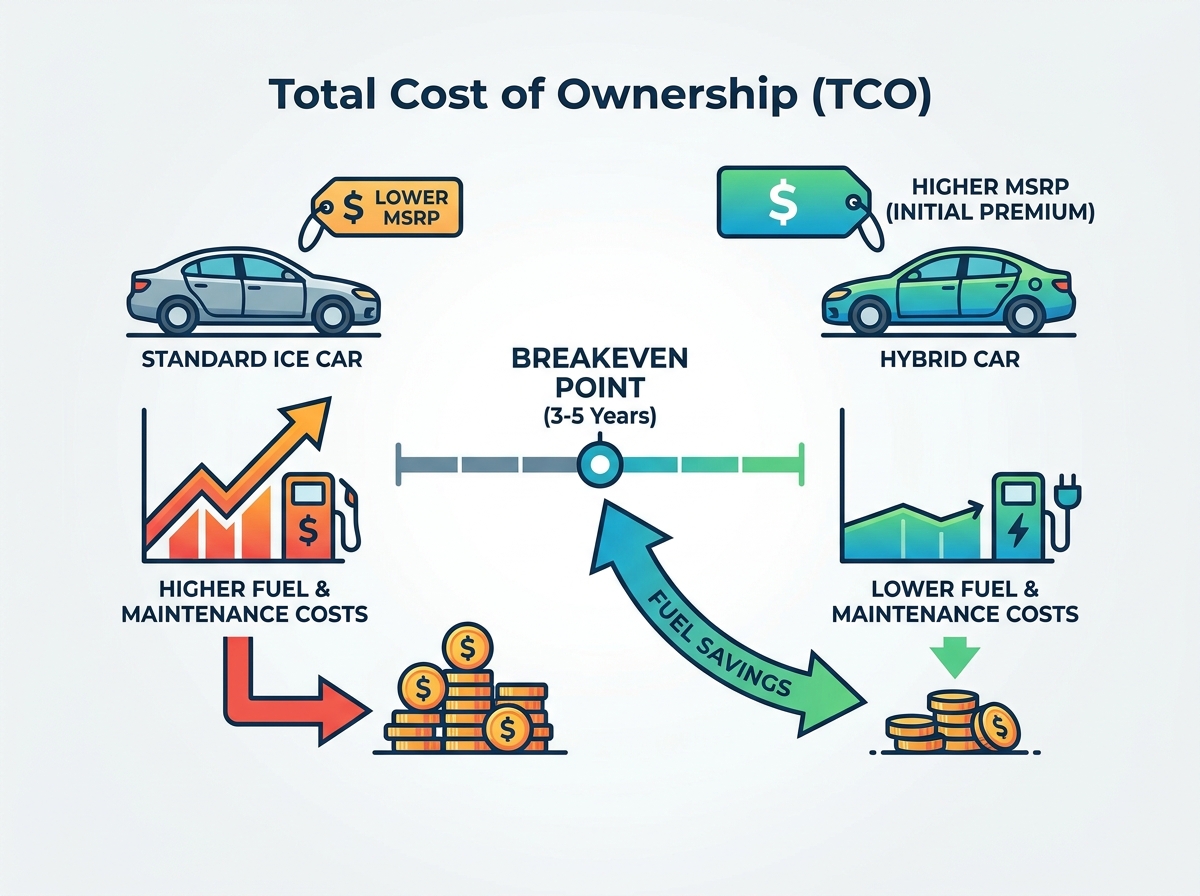
You must look past the flashy marketing brochures. A modern hybrid vehicle provides several highly tangible benefits. We can measure these advantages clearly over a standard ownership period. They span from daily operational savings to long-term value retention.
A hybrid powertrain excels particularly in heavy stop-and-go traffic. The low-speed electric motor handles most grueling city driving tasks. The gas engine remains completely off during extended idling periods. This engineering strategy produces a massive improvement in city miles per gallon. You immediately become much less sensitive to volatile global gasoline prices. Your monthly commuting budget becomes highly predictable and stable over time.
Regenerative braking systems transform kinetic energy into stored electrical energy. This ingenious process physically slows the heavy vehicle down safely. You rely significantly less on traditional friction brake components. Brake pads and iron rotors last substantially longer as a result. Drivers often exceed 80,000 miles before needing standard brake replacements. The internal combustion engine also experiences far less continuous mechanical strain. It shuts off frequently during low-speed crawling, saving engine hours.
Fuel-efficient used vehicles historically sustain incredibly strong resale values. Established, reliable hybrid models remain in exceptionally high demand globally. Secondary buyers actively seek out these efficient vehicles during sudden fuel price spikes. You will likely recover a larger portion of your initial investment later. Dealerships often pay premium prices for well-maintained hybrid trade-ins.
Plug-in models frequently qualify for lucrative regulatory benefits and rebates. You might establish eligibility for substantial federal tax credits. Many individual states offer additional point-of-sale rebates or tax deductions. Some densely populated municipalities grant solo drivers High-Occupancy Vehicle (HOV) lane access. These varied incentives effectively lower your initial purchase price significantly. They also reduce your daily commute times dramatically.
You must evaluate potential compromises objectively before signing a contract. These advanced vehicles are certainly not perfect for every single situation. We must examine the hidden drawbacks closely. Understanding these risks prevents frustrating surprises during your ownership experience.
Manufacturers inevitably charge more for installing dual complex powertrains. A hybrid strictly commands a higher MSRP compared to identical gas-only models. This initial price premium limits your immediate financial gratification. You must drive efficiently for years to see actual monetary savings. Careful household budgeting requires thorough consideration of this initial financial hurdle. Financing a larger loan principal also means paying more in total interest.
Dual powertrains introduce significantly higher mechanical and electrical complexity. The vehicle houses thick high-voltage wiring alongside specialized battery cooling systems. Technicians require specific safety certifications for high-voltage system diagnostics. You might lose the convenient ability to use cheap, independent neighborhood mechanics. Dealerships often become your absolute only option for complex powertrain repairs.
High-voltage traction batteries inevitably lose storage capacity over time. Chemical science dictates this unavoidable physical reality. Post-warranty battery replacement costs run exceptionally high across the industry. Owners typically spend between $2,000 and $6,000 for a refurbished or new battery. Most major manufacturers provide an 8-year or 100,000-mile warranty mandate. You must factor this rare, expensive risk into any decade-long ownership plans.
Automakers must hide physically large, heavy battery packs somewhere inside the chassis. They often place these units directly under the rear passenger seats or trunk floor. This necessary placement frequently reduces overall trunk volume and cargo flexibility. Many newer models eliminate the traditional spare tire entirely to save weight and space. They provide a simple chemical inflation kit instead. You might find this highly inconvenient during a severe highway tire blowout.
We built a practical framework to test your specific vehicle compatibility. Review these three common driver profiles carefully. Match your daily routine against these realistic scenarios. This test helps prevent expensive purchasing mistakes.
Verdict: High Match.
You drive through heavy, congested city traffic daily. Stop-and-go conditions dominate your grueling morning commute entirely. This specific environment maximizes your regenerative braking opportunities perfectly. The battery stays charged continuously without plugging in. The noisy gas engine rarely engages during gridlock. You will extract maximum efficiency and comfort from this advanced setup.
Verdict: Moderate to Low Match.
You drive 80 miles on the open interstate every single day. Continuous high-speed driving relies heavily on the gas combustion engine. The small electric motor provides very minimal assistance at sustained highway speeds. You effectively negate the primary efficiency advantage of the dual powertrain. Standard gas vehicles often deliver incredibly similar highway mileage numbers. Traditional gas cars cost significantly less money upfront.
Verdict: Requires Risk Tolerance.
You plan to keep the vehicle indefinitely, driving it into the ground. You will undoubtedly enjoy years of uninterrupted daily fuel savings. However, you face the statistical probability of a future battery replacement. You must weigh these accumulated daily savings against a massive potential repair bill in year nine. Cold weather climates can also accelerate this battery degradation process slightly.
Conduct a thorough personal driving audit before scheduling any test drives. Follow this specific numbered checklist to gather your facts:
A hybrid vehicle functions as a practical financial tool alongside being a daily transportation mode. Your ultimate purchasing decision hinges heavily on upfront premiums versus personal driving habits. The technology offers incredible efficiency in specific urban environments. It falters noticeably in continuous, high-speed highway cruising scenarios. You must calculate your personal usage metrics carefully before buying.
We highly recommend experiencing the unique regenerative braking system firsthand. Schedule a comprehensive test drive at a local dealership soon. Evaluate exactly how the complex powertrain transitions between gas and electric modes. Make your final purchasing decision based purely on empirical evidence and lifestyle compatibility.
A: Industry standards typically project a battery lifespan of 100,000 to 150,000 miles. Many well-maintained units last 10 to 15 years under normal driving conditions. Federal law strictly mandates an 8-year or 100,000-mile warranty on all high-voltage batteries. Some specific states mandate 10-year warranties. Regular driving and proper cabin climate control usage actively help extend overall battery longevity.
A: Routine scheduled maintenance often costs less overall. Regenerative braking saves brake pads from premature wear. The gas engine runs far less frequently, significantly extending engine oil life. However, out-of-warranty repairs become incredibly expensive. Specialized high-voltage components require highly trained, certified technicians. You essentially trade lower routine costs for slightly higher catastrophic failure risks later.
A: Highway driving relies heavily on the internal combustion engine. Aerodynamic drag at high speeds drains electric battery reserves very quickly. Standard gas vehicles often match or exceed hybrid highway efficiency numbers. You might never recover the initial vehicle price premium. A traditional gas vehicle usually makes better financial sense for extensive, daily interstate commuting.
A: A dead standard 12-volt accessory battery will strand you, exactly like a normal gas car. However, a heavily degraded high-voltage traction battery behaves quite differently. The vehicle usually defaults automatically to a reduced-power gas mode. You can still drive it temporarily to a service center. A complete catastrophic physical failure of the traction battery may prevent operation entirely.


