
Views: 0 Author: Site Editor Publish Time: 2026-07-25 Origin: Site


Modern warehouse operations face intense compounding pressures today. You must constantly balance rising energy costs. You also face stricter indoor emissions regulations. Facilities demand relentless, ever-increasing throughput. Relying on outdated equipment puts your operational efficiency at serious risk. The transition from internal combustion engines to a New energy forklift truck changes everything. It is no longer just a sustainability initiative. It serves as a core margin-protection strategy for modern facilities. We see advanced lithium-ion and hydrogen fuel cells rapidly replacing legacy systems. This guide strips away the marketing hype entirely. We examine the quantifiable operational impacts of adopting modern material handling equipment. You will explore how new equipment transforms daily workflows. You will learn practical strategies to help your team build a rigorous, evidence-based business case for upgrading your fleet.
Procurement teams often hesitate when comparing initial purchase prices. Legacy internal combustion engine (ICE) and lead-acid models typically look cheaper on paper. However, a New energy forklift truck fundamentally changes your daily expenditure profile. You must look past the sticker price. Upfront capital investments quickly yield massive operational savings. The equipment simply costs far less to run every single shift.
Energy cost arbitrage offers an immediate advantage. Liquid propane gas (LPG) and diesel fuel prices fluctuate wildly. These unpredictable spikes destroy operating budgets. Grid electricity remains highly stable by comparison. Charging lithium-ion or hydrogen units during off-peak hours multiplies this mathematical advantage. You slash monthly energy bills dramatically. You achieve this while maintaining peak lifting performance across the facility.
Internal combustion engines require constant mechanical attention. They rely on hundreds of moving components. Maintenance teams must perform frequent oil changes. They constantly replace spark plugs and service heavy transmissions. These routine tasks pull equipment off the floor. Advanced electric systems eliminate these mechanical failure points. The simplified drivetrain rarely requires intervention. You keep the equipment moving pallets instead of sitting in the repair shop.
Legacy lead-acid systems demand grueling daily upkeep. Your staff must manually water every single cell. They must perform complex equalizing charges weekly. Spilled sulfuric acid requires immediate, hazardous cleanup procedures. Advanced battery systems eliminate these chores entirely. They feature sealed, maintenance-free designs. Your team recovers countless labor hours. They redirect this lost time toward actual revenue-generating activities.
Traditional lead-acid batteries severely cripple multi-shift operations. They operate on a rigid 8-8-8 schedule. You use the battery for eight hours. You charge it for eight hours. You must then let it cool down for another eight hours. This massive 16-hour downtime window forces a terrible compromise. You must purchase two or three heavy batteries per truck. Modern technologies completely eliminate this archaic bottleneck.
Opportunity charging seamlessly integrates into your daily operational workflows. Operators simply plug in their equipment during natural downtime. They connect the chargers during 15-minute coffee breaks. They top off the power during shift changes or lunch hours. This rapid power boost does not degrade the battery lifespan. It keeps the fleet running constantly. You eliminate the need for spare batteries entirely.
The impact on daily throughput is staggering. We consistently see facilities recapture massive amounts of lost labor time. Operators no longer waste time driving across the warehouse. They no longer travel to isolated charging rooms. They no longer operate dangerous overhead hoists to physically swap massive lead cells. Eliminating these dead-time activities boosts your daily pallet movement numbers immediately.
| Operational Metric | Legacy Lead-Acid Systems | Advanced New Energy Systems |
|---|---|---|
| Charging Protocol | Strict 8-hour charge + 8-hour cooldown | Flexible 15-minute opportunity charging |
| Spare Parts Needed | 2 to 3 batteries per truck | 1 battery per truck (integrated) |
| Swapping Labor | 30-45 minutes per shift change | Zero swapping time required |
| Performance Drop | Fades as battery discharges | Full power until completely empty |
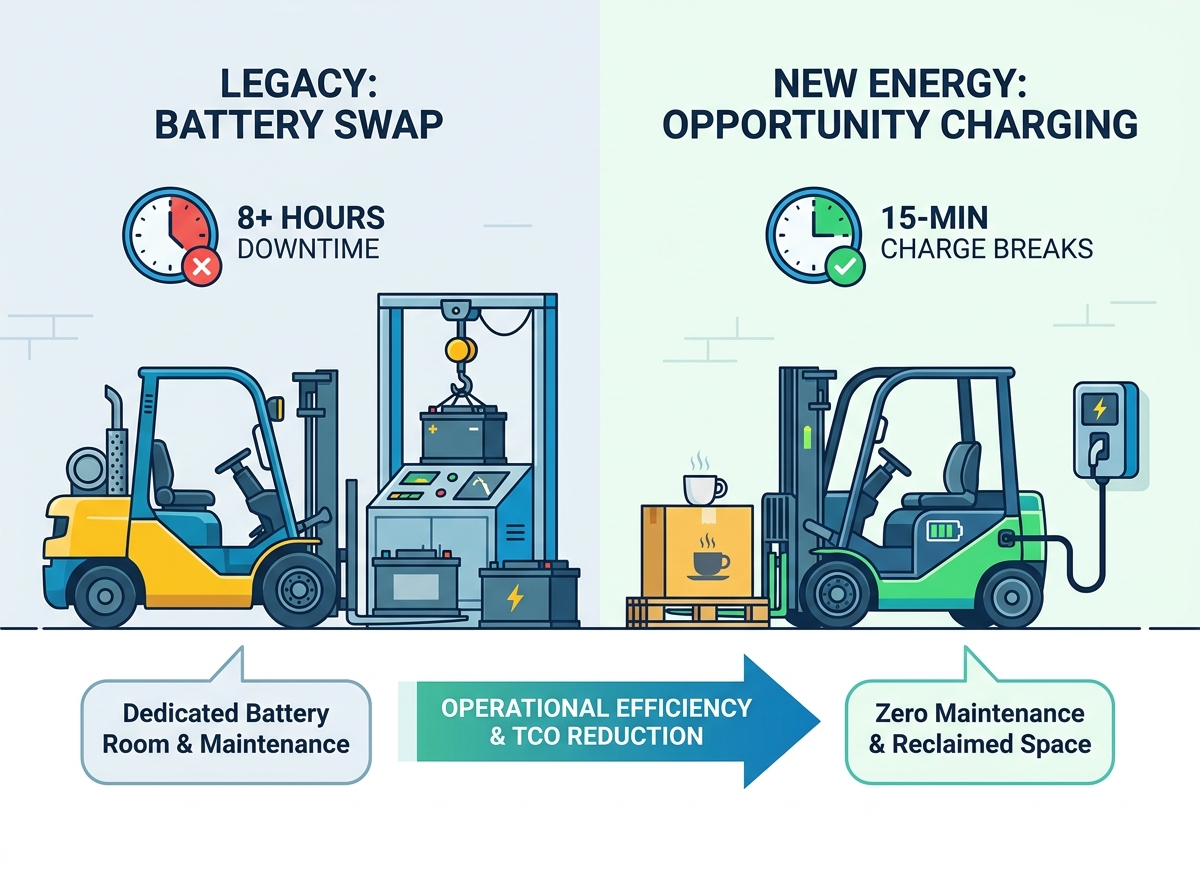
Legacy electric fleets force you to waste valuable real estate. They require strictly regulated, isolated charging rooms. These specialized zones demand acid-resistant flooring. They need massive ventilation systems to exhaust toxic off-gassing safely. They require emergency eyewash stations and specialized safety gear. A New energy forklift truck operates much differently. You can safely charge these units directly at staging areas or active loading docks.
Eliminating the dedicated battery room opens up exciting layout possibilities. Industrial real estate costs are breaking historical records. Every square foot must generate revenue. Reclaiming this dead space provides immediate value.
Advanced power sources also offer exceptional energy density. Manufacturers pack more power into much smaller footprints. This allows them to build incredibly compact chassis designs. These streamlined profiles enable much tighter turning radiuses. You can safely navigate narrower aisle configurations. Shrinking your aisle width allows you to fit more racks into the same building footprint. You maximize both vertical and horizontal storage density.
Indoor air quality stands as a top priority for modern facilities. Internal combustion engines produce dangerous tailpipe emissions. Propane and diesel exhausts severely degrade warehouse air quality. Zero-emission operations inherently eliminate carbon monoxide exposure risks. You achieve immediate compliance with OSHA regulations. You also meet strict regional indoor air quality standards easily. You provide a significantly healthier breathing environment for your entire workforce.
Chemical hazards plague legacy electric setups. Sulfuric acid poses severe risks during daily operations. Transitioning away from lead-acid batteries removes these constant threats. You eliminate the risk of toxic liquid spills. You stop harmful hydrogen gas from venting during the charging process. This transition greatly reduces your facility liability. It drastically lowers your overall workplace hazard profile.
Noise pollution often goes ignored in warehouse safety discussions. ICE forklifts generate extreme noise levels during heavy acceleration. Lower decibel operations significantly reduce operator fatigue over a long shift. A quieter New energy forklift truck dramatically improves warehouse floor communication. Operators can hear approaching colleagues clearly. They can hear automated guided vehicles and alarms. When situational awareness improves, pedestrian-equipment safety incidents drop sharply.
Modern material handling equipment utilizes sophisticated digital-first architectures. A New energy forklift truck acts as a mobile data node. It integrates seamlessly with your warehouse management systems (WMS). This connectivity gives managers total visibility over fleet movements. You can monitor precise productivity metrics in real time. You stop guessing about equipment utilization and start making data-driven decisions.
Predictive maintenance fundamentally changes how you run the shop. Advanced battery management systems (BMS) constantly track internal cell health. They monitor the precise state of charge (SOC) continuously. They track critical temperature limits during heavy usage. This constant data stream allows you to prevent catastrophic failures. You address minor mechanical anomalies before they become expensive downtime events.
Operator accountability improves dramatically with native telematics. Managers can track individual operator performance meticulously. The system records impact events the second they happen. It monitors idle time and energy efficiency per user. This objective data helps supervisors refine their training programs. You identify reckless driving habits early. You ultimately improve overall fleet utilization while reducing careless equipment damage.
Fast-charging an entire fleet requires highly robust electrical infrastructure. This grid capacity assessment remains a massive hidden constraint. Older facilities often lack the necessary electrical backbone. Buyers must strictly audit their facility's amperage capacity before purchasing anything. You cannot plug ten fast-chargers into a standard legacy panel. A transparent electrical assessment prevents devastating installation delays later.
Completely retiring a legacy fleet overnight carries unnecessary operational risks. We strongly recommend a phased rollout strategy. You should test the new equipment in demanding, high-usage zones first. Cold storage environments and busy cross-docking areas provide excellent testing grounds. This allows your team to adapt to the new charging workflows gradually. You prove the concept locally before scaling it facility-wide.
Do not evaluate vendors purely on their initial sticker price. The lowest bidder often lacks necessary aftermarket support. You must scrutinize the entire partnership ecosystem carefully.
Upgrading to advanced material handling technology requires strategic vision. It yields compounding daily returns in labor efficiency and space utilization. You drastically improve facility safety and indoor air quality. By eliminating archaic maintenance chores, you empower your team to focus on throughput. A New energy forklift truck fundamentally upgrades how your entire operation functions day in and day out.
Do not base your vital procurement decisions on assumptions. Request a comprehensive site energy audit from a qualified material handling partner. Analyze your specific electrical grid capacity closely. Map out your exact daily workflow requirements. By gathering hard data today, you secure your warehouse's operational efficiency for the next decade.
A: Advanced batteries typically deliver excellent cycle life. You can expect 2,000 to 3,000 full charge cycles before the battery capacity degrades to 80%. This impressive longevity easily outlasts traditional lead-acid options. It ensures highly reliable, long-term performance even in demanding, multi-shift warehouse operations.
A: Yes, they excel in low temperatures. Advanced lithium-ion and hydrogen cells maintain exceptional thermal stability. Legacy lead-acid batteries lose severe capacity in freezers. Modern units deliver highly consistent power and reliable runtime, even in extreme cold storage environments.
A: It heavily depends on your current infrastructure. Standard single-phase power panels usually cannot support modern fast-charging demands. You will typically require dedicated three-phase power upgrades. This allows your grid to handle multiple units charging simultaneously without overloading your facility.


