
Views: 0 Author: Site Editor Publish Time: 2026-10-29 Origin: Site


Urban drivers desperately need agile maneuverability and lower running costs to navigate congested city streets. Yet, many still face real range anxiety and frustrating charging infrastructure bottlenecks when considering the switch. Navigating these hurdles requires more than just skimming glossy automaker brochures. This article provides an evidence-based evaluation of the top compact EVs on the market today. We intentionally skip the hype-driven spec sheet comparisons. Instead, we focus on real-world range constraints, daily usability, and practical implementation strategies. Our primary goal is simple. We provide a clear, decision-stage framework to help buyers like you shortlist the right compact vehicle. You will discover how to match specific commute patterns and strict budget constraints to the ideal model. Read on to explore actionable insights and find out which mini electric car truly deserves a spot in your driveway.
Objective evaluation requires strict criteria. We ignore marketing fluff entirely. Instead, we analyze four specific engineering and usability pillars. This framework helps you judge small EVs fairly.
Finding the perfect commuter vehicle involves matching your daily routine to specific automotive strengths. We reviewed the market and categorized the top contenders below.
Table: Compact EV Market Positioning
| Ranking Segment | Representative Model | Primary Strength | Ideal Buyer Persona |
|---|---|---|---|
| Driving Dynamics Pick | MINI Cooper SE Electric | Agile handling & premium interior | Brand enthusiasts & dynamic drivers |
| Ultra-Compact Specialist | Fiat 500e | Tight turning radius & footprint | Deep-urban city dwellers |
| Tech-Forward Minimalist | Volvo EX30 | High-density battery & advanced UI | Tech-savvy premium buyers |
| Range & Practicality Champion | Chevrolet Bolt EV / Nissan Leaf | Cargo space & proven architecture | Pragmatic single-car households |
| Emerging Market Disruptor | MG4 EV / Hyundai Kona Electric | Disruptive pricing & extended warranty | First-time EV adopters |
Features: The MINI Cooper SE Electric retains iconic go-kart handling. It features a remarkably low center of gravity. Premium interior materials elevate the entire cabin experience. Drivers enjoy rapid urban acceleration consistently. The instant torque makes darting through heavy traffic effortless.
Pricing: It sits firmly inside the premium pricing tier. Buyers should anticipate steeper depreciation curves initially. This trend aligns perfectly against historical brand performance metrics. You pay a definitive premium for the heritage badge.
Best For: We recommend this model specifically for driving enthusiasts. It suits buyers prioritizing driving engagement over utility. It perfectly matches consumers valuing brand heritage over maximum highway range.
Features: The Fiat 500e dominates crowded European-style streets. It boasts an exceptionally tight turning radius. The lightweight chassis ensures snappy responsiveness around every corner. Inside, the intuitive infotainment system simplifies daily operation. It intentionally lacks unnecessary digital clutter.
Pricing: Fiat offers a highly accessible entry price point. However, higher trims and technology option packages escalate costs quickly. Careful configuration prevents unwanted budget overruns.
Best For: It excels profoundly in deep-urban environments. It serves city dwellers flawlessly. For these buyers, physical parking footprint remains their primary success criterion.
Features: Volvo brings crossover-like technology directly into a smaller package. The EX30 offers impressive high-density battery options. It delivers surprisingly aggressive acceleration. The minimalist user interface controls almost all vehicle functions via a central screen. Sustainable cabin materials proudly replace traditional leather interiors.
Pricing: This model occupies the mid-to-high tier. Yet, it delivers a highly competitive feature-to-price ratio. You receive flagship-level software wrapped inside an entry-level package.
Best For: It targets tech-savvy commuters explicitly. Buyers wanting advanced safety systems enjoy this model immensely. It fits a premium crossover experience seamlessly into a tiny parking spot.
Features: These reliable veterans utilize proven battery architectures. They offer substantially higher cargo capacity than stylish European rivals. Their exterior designs remain conservative but highly functional. Physical buttons and sensible dashboard layouts prioritize daily convenience.
Pricing: Both models scream pure value. They feature aggressive baseline pricing structures. They also frequently qualify for substantial local tax incentives. This combination creates an unbeatable financial proposition.
Best For: Pragmatic buyers love these utilitarian models. They need one reliable vehicle daily. It must handle standard city commutes effortlessly. It must also tackle occasional regional trips without hesitation.
Features: Brands like MG and Hyundai are rewriting established rules. The MG4 EV offers surprisingly spacious rear seating. It includes standard fast-charging capabilities across all trims. Most notably, it provides extended factory warranties. The dedicated rear-wheel-drive platform ensures balanced handling.
Pricing: It carries a highly disruptive MSRP. The manufacturer designed this pricing strategy to undercut legacy automakers directly. It delivers exceptional range per dollar.
Best For: We highly recommend it for first-time EV buyers. It appeals strongly to consumers seeking maximum warranty coverage. It delivers exceptional peace of mind for every dollar spent.
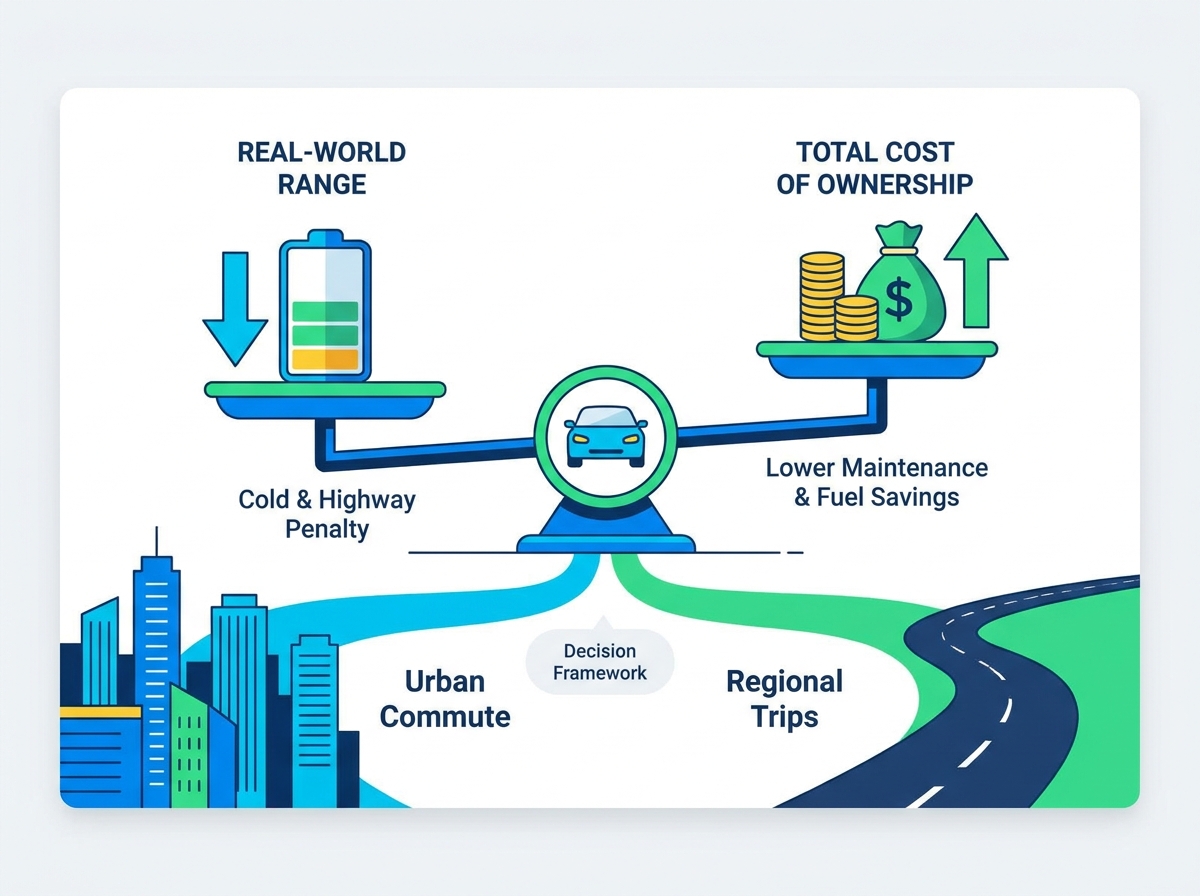
Understanding battery chemistry prevents frustrating disappointment. The cold weather penalty represents a significant ownership risk. Winter temperatures severely limit lithium-ion cell performance. You might buy a vehicle promising a 150-mile range. Activating the cabin heater can reduce this capacity to 100 miles rapidly. Heating a car interior requires immense electrical energy. Traditional combustion engines use free waste heat. Electric motors run too efficiently to provide this luxury.
Highway driving introduces another harsh reality. Gas cars often achieve peak efficiency on open rural roads. Conversely, an electric vehicle suffers greatly at sustained high speeds. Aerodynamic drag increases exponentially as you accelerate. Furthermore, highway cruising eliminates most regenerative braking opportunities. This combination drains small battery packs rapidly. A mini electric car performs best in stop-and-go city traffic.
How do you protect your driving range effectively? We recommend implementing strict risk mitigation strategies immediately. Follow these proven steps:
Daily electric driving requires solid residential infrastructure. Relying purely on public stations causes immense frustration over time. You must prioritize home charging necessities. Installing a Level 2 (240V) home charger acts as a mandatory implementation step. This residential project involves purchasing the hardware itself. You must also hire a certified electrician for labor. While upfront installation costs exist, this setup guarantees a full battery every single morning. It transforms vehicle ownership completely.
Public network compatibility also requires careful evaluation today. The automotive industry is currently transitioning. Many legacy brands are shifting from CCS to NACS port standards. Buyers must evaluate what standard their short-listed vehicle uses natively. Using bulky adapters works, but native compatibility ensures reliable software handshakes at public stations. Always check local charging network maps before finalizing your purchase decision.
We must also issue stern battery degradation warnings. Public DC fast charging seems incredibly appealing. However, you should strictly avoid relying on it exclusively. Fast chargers force immense electrical current into small-capacity batteries. This rapid process generates extreme internal heat. Heat represents the ultimate enemy of lithium-ion cell longevity. Frequent fast charging stresses the pack and degrades its overall capacity prematurely. Protect your long-term investment. Use Level 3 DC fast chargers only during mandatory regional road trips. Always rely on slower, cooler Level 2 home charging for your everyday energy needs.
Let us summarize the shortlisting logic clearly. Budget limits and range requirements often dictate the final choice. If they represent your absolute priorities, focus entirely on practical champions like Chevrolet and Nissan. They offer unmatched utilitarian value. Conversely, you might prioritize a small parking footprint and driving joy. In this specific scenario, premium compacts like MINI or Fiat deserve your undivided attention.
Remember to audit your actual daily mileage truthfully. Do not purchase a massive vehicle based solely on a theoretical annual road trip. Most modern drivers cover fewer than 40 miles daily. A small EV handles this routine effortlessly. It saves you money and parking headaches.
Take decisive action today. Schedule back-to-back test drives of your top two choices soon. Additionally, contact a certified local electrician. Request a home electrical assessment for your future charger installation. These practical steps guarantee a remarkably smooth transition to electric driving.
A: Most manufacturers provide a standard 8-year or 100,000-mile warranty covering the main battery pack. Modern active thermal management systems help preserve cell health significantly. You can expect minor degradation over time. Generally, small EVs retain about 80% to 85% of their original charging capacity after a decade of normal daily use.
A: Yes, they are highly safe for highway travel. These vehicles feature heavy floor-mounted batteries. This structural design creates an exceptionally low center of gravity. Consequently, they often achieve better rollover safety ratings than similarly sized gas cars. Standard advanced driver assistance systems further enhance overall crash protection.
A: Yes, but it is rarely practical for daily commuting. A standard 120V wall outlet provides basic Level 1 charging. This slow method typically adds only 3 to 5 miles of range per hour. It works adequately for plug-in hybrids. However, pure EVs require a dedicated Level 2 home charger for overnight replenishment.


