
Views: 0 Author: Site Editor Publish Time: 2026-07-29 Origin: Site


Purchasing heavy equipment is a major capital expenditure for any small business. You cannot treat this decision like a weekend hobby purchase. Landscapers, property managers, and small-scale farmers require reliable machinery to maintain steady cash flow. Over-buying drains your available capital quickly. Under-buying limits operational capacity and drastically increases daily equipment wear. To make a smart choice, you must look far beyond raw engine horsepower. Buyers should focus strictly on Power Take-Off (PTO) performance and hydraulic pump capacity. This guide compares five top-tier equipment categories based on feature sets and realistic pricing ranges. We explore how different models directly impact your daily productivity. You will learn exactly how to match machine specifications to your specific business tasks. A well-chosen tractor functions as the backbone of your physical operations.
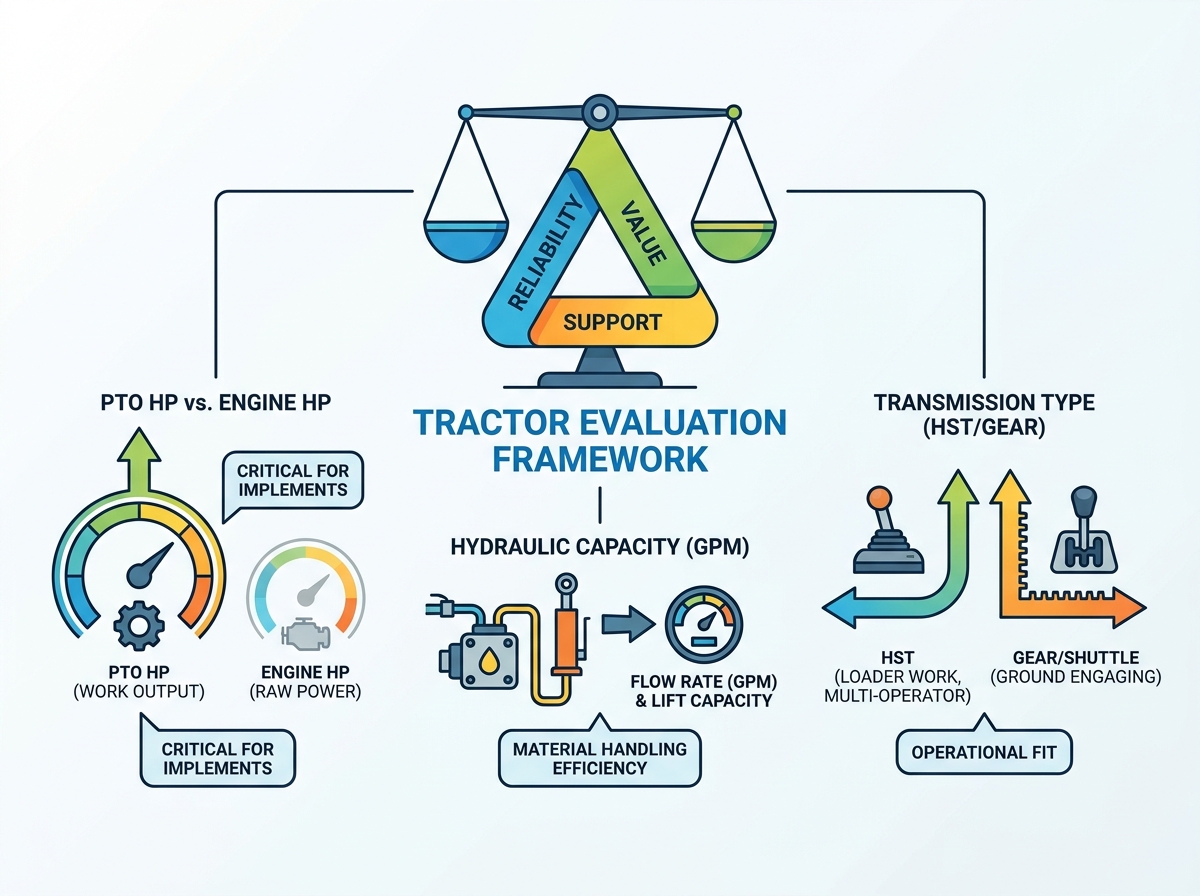
Business buyers need a rigorous standard for evaluating heavy machinery. We use a three-pillar evaluation framework to assess each machine. This reliability, value, and support triangle separates commercial-grade equipment from consumer toys. Predictable uptime matters most. The cost-to-capability ratio ensures you get maximum lifting power per dollar spent. Finally, robust OEM warranty support guarantees long-term operational security.
Many new buyers mistakenly focus on gross engine horsepower. However, engine power rarely dictates how well a machine performs in the field. Power Take-Off (PTO) horsepower is the true metric you should evaluate. The PTO shaft transfers rotational power directly to your heavy implements. Rotary cutters, tillers, and large mowers rely entirely on PTO horsepower. You must always size your implement to the PTO rating, never the engine rating.
Hydraulic capacity heavily influences material handling efficiency. We measure this capability using hydraulic flow rate, usually expressed in gallons per minute (GPM). Higher GPM means faster loader cycle times. You also need to examine loader lift capacity measured directly at the pins. Do not rely on lift capacity measured at the bucket center. Pin measurements provide a realistic expectation for lifting dense materials.
Selecting the right transmission impacts daily operator fatigue. Hydrostatic (HST) transmissions operate much like an automatic car. They use fluid dynamics to provide infinite speed variations. HST is superior for loader work and multi-operator businesses. New employees learn HST controls very quickly. Conversely, Gear or Power Shuttle transmissions lock into specific speeds. They deliver maximum engine power directly to the wheels. Gear transmissions remain vastly superior for continuous ground-engaging work like deep tillage.
We categorized the market into five distinct archetype profiles. Each profile represents a specific operational need. We populated these profiles using reliable models from leading brands. Brands like Kubota, John Deere, Mahindra, Kioti, and New Holland dominate these categories.
Target Specs: 30–40 HP, HST transmission, ~2,000 lb loader lift capacity.
Key Features: Operator comfort options, intuitive controls, high-capacity dual hydraulic pumps.
Estimated Price Range: $25,000 – $35,000 (Base).
Business ROI: This category offers exceptional versatility. It suits businesses shifting daily between mowing, grading, and material handling. A model like the Kubota L3901 exemplifies this segment. It provides enough weight for stability but remains light enough for easy transport. Your crews can swap from a box blade to a pallet fork seamlessly. The dual hydraulic pumps ensure the steering remains responsive even while lifting heavy loads.
Target Specs: 40–50 HP, Gear or Power Shuttle transmission, heavy cast-iron chassis.
Key Features: Heavier operating weight for traction, fewer electronic sensors, robust rear hitch.
Estimated Price Range: $22,000 – $28,000 (Base).
Business ROI: This class delivers maximum power-per-dollar. It fits operations skipping delicate turf care. Models like the Mahindra 4540 fall perfectly here. They utilize thick cast-iron frames instead of aluminum components. This added weight provides incredible ground traction for heavy pulling. Furthermore, they feature fewer electronic sensors. Mechanically inclined business owners can perform basic maintenance easily. This cuts down expensive service calls.
Target Specs: 35–45 HP, integrated GPS guidance capability, electronic PTO engagement.
Key Features: Auto-steering readiness, advanced telematics, programmable implement settings.
Estimated Price Range: $30,000 – $45,000+ (Base).
Business ROI: Precision agriculture is no longer just for massive corporate farms. Machines like the John Deere 4044R reduce operator fatigue immensely. They minimize overlap waste during spraying or planting. The advanced telematics system tracks maintenance intervals automatically. Fleet managers can monitor machine health remotely. This tech-forward approach suits row-cropping operations aiming to scale rapidly.
Target Specs: 20–25 HP, mid-mount PTO, turf tire compatibility, tight turning radius.
Key Features: Fits standard utility trailers, lightweight footprint, easily interchangeable light implements.
Estimated Price Range: $15,000 – $20,000 (Base).
Business ROI: A sub-compact machine replaces multiple walk-behind units. Models like the Kioti CS2220 allow small landscaping crews to operate inside residential backyards. They fit comfortably through standard fence gates. Their lightweight nature causes minimal turf damage. Crews can finish mulch installations or soil grading in half the time.
Target Specs: 45–55 HP, upgraded front axle, skid-steer style quick attach (SSQA).
Key Features: Dedicated max hydraulic flow for loaders, counter-weight readiness, robust bucket options.
Estimated Price Range: $35,000 – $50,000 (Base).
Business ROI: Hardscaping demands serious material handling. A machine like the New Holland Workmaster 50 safely moves heavy pallets of stone. It handles dense wet soil without stalling. It features an upgraded front axle to support aggressive loader work. This saves you from buying a dedicated standalone skid steer. It provides farm-level utility alongside commercial lifting capabilities.
| Category | Ideal Application | Engine HP | Estimated Base Price |
|---|---|---|---|
| Premium Compact Workhorse | Mixed Commercial Use | 30–40 HP | $25,000 – $35,000 |
| Budget-Conscious Utility | Raw Lifting & Tillage | 40–50 HP | $22,000 – $28,000 |
| Tech-Enabled Precision | High-Yield Farming | 35–45 HP | $30,000 – $45,000+ |
| Sub-Compact Specialist | Tight Landscaping | 20–25 HP | $15,000 – $20,000 |
| Heavy-Duty Loader-Optimized | Hardscaping Materials | 45–55 HP | $35,000 – $50,000 |
Evaluating commercial equipment requires looking past the base sticker price. A bare machine rarely performs useful commercial work. You must budget carefully for the fully equipped asset.
Equipment dealers often advertise incredibly low base prices. However, a tractor without a loader or implements generates zero revenue. You need attachments to move earth or cut grass. Implement packages usually add 20 to 30 percent to the initial upfront cost. Front-end loaders alone often cost thousands of dollars. You must request quotes for a fully equipped package. Compare these comprehensive bundle deals rather than naked machine costs.
Modern diesel engines above 25 horsepower face strict environmental regulations. They utilize Diesel Particulate Filters (DPF) to reduce emissions. You must understand the maintenance realities of DPF systems. The filter captures soot during operation. Eventually, it must run a "regeneration cycle" to burn off this accumulated soot. This cycle requires high engine RPMs. Sometimes, regeneration forces the operator to park the machine temporarily. You must account for this occasional downtime in your scheduling. Ignoring DPF warnings can lead to catastrophic engine derating.
Strategic purchasing can ease capital burdens. Major equipment brands frequently offer zero-percent financing promotions. These offers allow small businesses to acquire modern fleets while preserving cash reserves. Additionally, commercial buyers should explore Section 179 tax deductions. The IRS allows businesses to deduct the full purchase price of qualifying equipment during the current tax year. This significantly lowers your immediate tax liability. We strongly advise consulting a certified CPA to maximize these structural tax benefits safely.
Your machinery acts as a universal power source for attachments. Ensuring broad compatibility protects your capital investment long-term.
The agricultural industry relies heavily on standardized connection points. You must ensure any new machine uses industry-standard linkage. Look for Category 1 or Category 2 3-Point Hitches on the rear. These standard sizes allow you to rent or buy implements from any manufacturer. For the front loader, demand a Skid Steer Quick Attach (SSQA) system. An SSQA faceplate lets you swap buckets for pallet forks in seconds. You can even borrow attachments from standard skid steers on the job site.
Basic front loaders only move up, down, and curl. Advanced businesses often need more functionality. If you use grapple buckets or 4-in-1 buckets, you need extra hydraulic flow. You must ensure the machine includes a third-function hydraulic valve. If it lacks one from the factory, check if it is pre-plumbed for easy upgrading. Adding a third-function kit later can be surprisingly expensive if the base machine lacks routing space.
Entry-level models sometimes use proprietary attachment systems. We strongly warn against buying these restricted machines. Manufacturers use them to lock you into their specific brand of attachments. This artificially limits your third-party implement sourcing. If you need a specialized auger, you might find your proprietary hitch cannot accept it. Always prioritize open, universal connection standards to maintain complete operational flexibility.
Many buyers obsess over paint colors and brand names. However, seasoned commercial operators know a different truth. The local dealership network matters far more than the factory badge.
A broken machine costs your business money every single hour it sits idle. Consumer-level warranties rarely cover lost business revenue. Commercial buyers should negotiate Service Level Agreements (SLAs) directly with the dealership. An SLA guarantees priority shop access. When your hydraulics fail mid-season, you cannot wait three weeks in a residential repair queue. Priority service ensures you return to the job site quickly.
Even the toughest equipment breaks under commercial stress. You must evaluate your physical proximity to the dealer. Furthermore, ask about their on-hand parts inventory. You need immediate access to common failure points. Hydraulic hoses burst. Filters clog. Belts snap under heavy loads. If a dealer has to order basic maintenance items from overseas, your crew stops working. Choose dealers who warehouse wear parts locally.
Transporting a downed machine requires heavy trailers and wasted labor hours. High-quality dealers offer mobile service capabilities. They send fully equipped mechanic trucks directly to your job site. Mobile mechanics can swap blown hoses, reset software codes, and replace starters in the field. This capability proves invaluable for small businesses lacking dedicated transport trucks. It keeps your crew productive while the repair happens concurrently.
Choosing the right heavy equipment requires balancing several critical variables. Your available budget always dictates the starting point of your search. However, your daily implement needs must dictate the actual machine specifications. Finally, your local dealer network should dictate your ultimate brand choice. Do not buy a high-end brand if the nearest authorized mechanic sits two hours away.
Your actionable next step is straightforward. First, outline the top three tasks your crew performs daily. Second, determine the absolute heaviest item they need to lift regularly. Bring these two specific data points to your local dealers. Use them to request comprehensive commercial quotes. This targeted approach prevents costly mistakes and secures reliable machinery for your business.
A: The 25 to 40 HP range represents the sweet spot for small business versatility. This range balances robust lifting capability with easy transportability. Machines in this class handle severe landscaping tasks while remaining light enough to tow on standard utility trailers.
A: You must weigh the upfront cash savings of used models against long-term reliability. New models offer comprehensive factory warranties and zero-percent promotional financing. Used equipment costs less initially but carries unknown wear history and higher immediate maintenance risks.
A: Most machines rated under 26 HP completely bypass complex Tier 4 Final emissions regulations. They do not require Diesel Particulate Filters (DPF) or DEF fluid. This makes sub-26 HP models highly desirable for low-maintenance commercial fleets.
A: They serve different core purposes. Compact tractors excel at varied, ground-engaging, and PTO-driven work across large areas. Skid steers remain strictly superior for repetitive, heavy material handling in highly confined spaces. Evaluate your primary daily task before substituting one for the other.


