
Views: 0 Author: Site Editor Publish Time: 2026-08-01 Origin: Site


Modern agricultural machinery requires massive capital expenditure. Choosing the right equipment directly impacts operational efficiency. It heavily influences daily labor costs and determines overall farm profitability. Equipment buyers often face a difficult choice. They must weigh the year-round flexibility of a high-horsepower utility vehicle against a specialized alternative. The unmatched efficiency of a dedicated harvesting machine is hard to ignore. Making the wrong choice leads to wasted capital or lost crops.
We designed this guide to help you evaluate both options thoroughly. We provide an objective, criteria-based evaluation of both machines. Farm operators, agribusiness managers, and procurement leads will find this breakdown highly valuable. You will learn the mechanical differences, asset utilization rates, and overall cost implications. We also explore the operational risks you might face. Ultimately, this framework helps you make a confident, evidence-backed investment decision.
Buyers must understand the mechanical baseline of each machine. We must look past basic definitions. Instead, we focus on mechanical purpose and power delivery.
First, consider the tractor as a prime mover. It supplies mobile power. It does not inherently harvest, plow, or plant. Instead, it drives distinct attachments. Power transfer happens through three core mechanisms. The Power Take-Off (PTO) shaft delivers rotational energy directly to implements. The drawbar provides raw, reliable pulling force. Finally, complex hydraulic systems lift and manipulate heavy attachments. These three systems make the machine highly adaptable. You can attach a baler in the morning. By afternoon, you can hitch a planter.
Conversely, the combine harvester operates as a compound machine. It executes a highly specific sequence in a single pass. You cannot alter its fundamental purpose. First, the front header cuts the crop precisely. Next, the internal threshing drum takes over. This drum aggressively separates the grain from the stalk. Finally, vibrating sieves and straw walkers clean the yield. They separate chaff from the valuable grain. This single machine replaces three historical harvesting steps. It is brilliant but rigid.
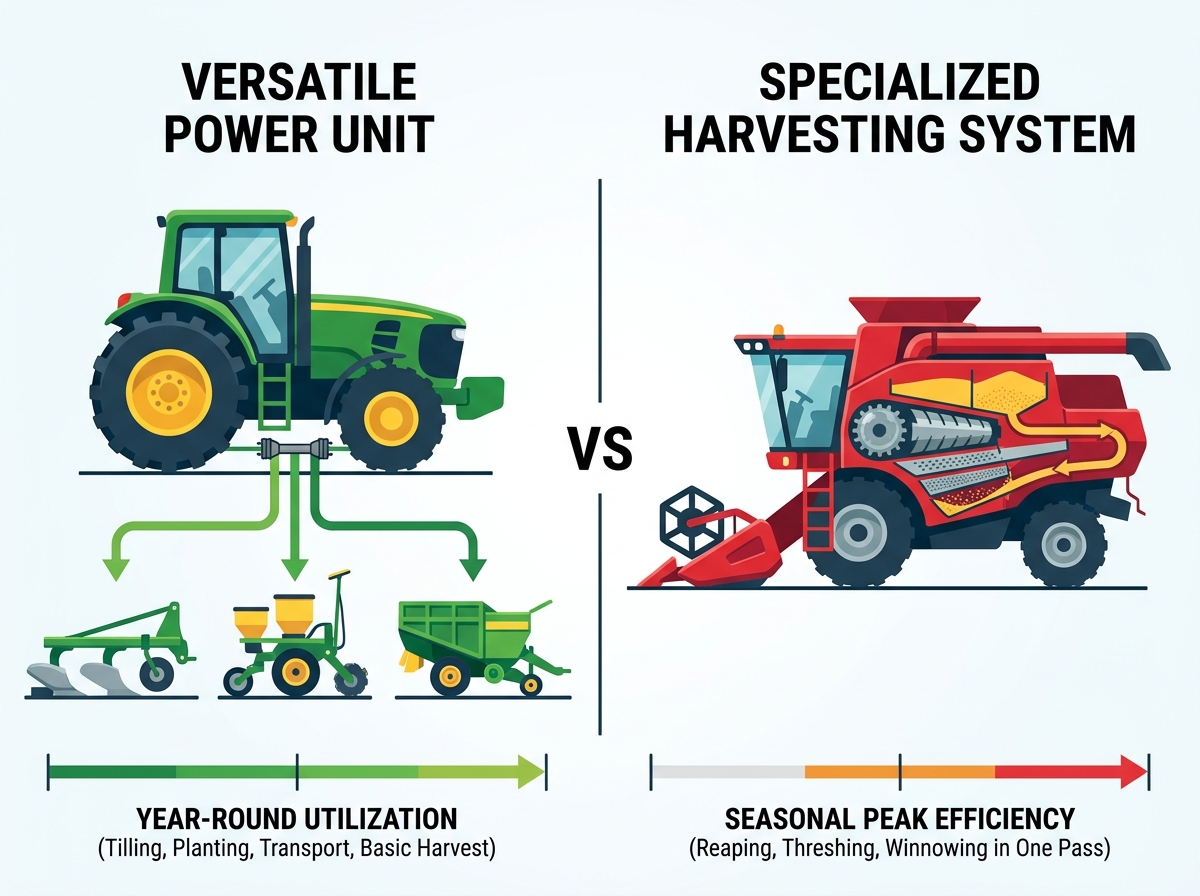
Comparing features directly to field outcomes helps buyers evaluate their options. Each machine solves different operational bottlenecks.
Asset utilization measures how often equipment actively runs. A tractor boasts an incredibly high utilization rate. You use it twelve months a year. Typical tasks include plowing, seeding, spraying, and transport. It rarely sits idle in the shed. This constant usage spreads your capital investment across multiple seasons.
Combines suffer from notoriously low utilization rates. You might only use them for three weeks annually. However, they deliver disproportionately high value during that short window. Narrow, weather-dependent harvest windows require massive throughput. The combine excels during these critical periods. It captures crop value before storms can destroy it.
Field speed directly affects grain retention and harvest quality. Using a tractor alongside a pull-type harvester means slower field speeds. Slower speeds increase your potential for grain loss. You often need multiple passes to finish a field. Sometimes, you need extra labor to clean the grain later.
Combines offer high-speed, single-pass processing. They feature precise grain retention systems. Modern units even include real-time yield monitoring sensors. They drastically reduce field-to-storage time. This extreme speed protects your yield from sudden weather changes. It guarantees the crop reaches the silo quickly.
| Capability Dimension | Power Unit + Implements | Self-Propelled Combine |
|---|---|---|
| Primary Function | Multi-tasking, pulling, powering | Reaping, threshing, winnowing |
| Annual Utilization | High (Year-round) | Low (Seasonal only) |
| Operating Speed | Slower (Multiple passes often required) | Very High (Single-pass efficiency) |
| Labor Efficiency | Moderate (Requires attachment changes) | High (Automated internal processes) |
Financial reality dictates equipment choices. Buyers must maintain a skeptical, evidence-based view regarding payback periods.
First, let us contrast the initial capital expenditure (CAPEX). A mid-to-high horsepower tractor requires significantly less initial capital. You must also buy the necessary harvesting implements. Even then, the combined price stays relatively reasonable. A self-propelled combine carries a massive premium cost. It requires a staggering upfront investment. Only high-acreage operations can comfortably absorb this shock.
Buyers need a reliable formula to evaluate these investments. You must calculate your true cost per acre. We recommend this standard approach:
This formula reveals your baseline operational cost. It strips away marketing claims and highlights true financial exposure.
Maintenance complexity also differs wildly. Combines generate higher complex-maintenance costs. They rely on specialized parts. Belts stretch, sieves crack, and delicate sensors fail. Replacing these components takes time and money. Conversely, a tractor distributes its depreciation across multiple seasonal tasks. This broad usage potentially offers a faster baseline ROI. Mixed-crop farms benefit greatly from this distributed depreciation model.
Adopting heavy machinery introduces friction points. Understanding these risks demonstrates real-world operational experience.
Operator expertise remains a critical hurdle. Combines require highly skilled operators. Drivers must adjust drum speeds on the fly. They constantly tweak sieve clearances based on crop moisture. Improper calibration leads to massive grain loss. It can also damage the crops entirely. Operating a tractor proves generally more standardized. The core driving controls remain consistent across different tasks. Complex implements still require training, but the learning curve feels less punishing.
Downtime vulnerability poses another major threat. Equipment breaks down inevitably. A broken power unit rarely stops an entire farm. You can often rent a temporary replacement easily. Neighbors might even lend you a spare. A broken combine poses a severe risk. A breakdown during a tight harvest window ruins crops completely. Dealer proximity becomes crucial here. Fast parts availability is an absolute necessity. You cannot wait three days for a replacement belt while a storm approaches.
Finally, address the storage and logistics footprint. Combines demand significant off-season storage space. They need enclosed, weather-protected barns. You must protect sensitive internal components from rust. Pests love to chew unprotected belts and wiring harnesses. You cannot leave a combine in an open field. Power units require storage too, but they take up much less space.
Farm profiles dictate equipment strategies. We developed a clear shortlisting logic based on operational size.
We recommend buying a versatile tractor paired with PTO-driven pull-type harvesters. This strategy maximizes capital efficiency. You avoid the massive sunk cost of an idle combine. Small farms simply cannot justify a premium harvester. The machine would sit unused for eleven months. Pull-type threshers handle smaller yields perfectly well.
We strongly recommend a dedicated combine harvester. The cost of delayed harvesting creates massive financial risks. Severe weather events cause immediate grain shedding. The resulting yield loss easily exceeds the machine's initial cost. High acreage requires maximum throughput. You need to clear fields rapidly. Only a specialized compound machine provides this necessary speed.
Consider a hybrid approach. You can own a reliable fleet of power units. They handle daily farm operations year-round. Then, you hire custom combine contractors specifically for the harvest window. This limits your capital exposure entirely. You pay for harvesting only when needed. You avoid maintenance nightmares and storage costs. This option works beautifully for mid-sized farms transitioning to larger acreage.
Choosing between these two machines defines your operational workflow. A tractor serves as an indispensable foundational asset. It handles nearly every farm task year-round. Meanwhile, a combine remains a specialized scaling tool. You buy it strictly for throughput, speed, and yield protection during critical windows.
Before contacting dealers, follow these specific next steps. First, conduct a precise acreage audit. Second, assess your local dealer support for emergency replacement parts. Third, calculate your specific five-year equipment depreciation. Do these steps before requesting any quotes. This preparation ensures a smarter, risk-averse investment.
A: Yes, but only in a limited capacity. You need specific PTO-driven implements. The process moves at a much slower pace. It usually demands higher labor requirements to clean the grain afterward. It works well for small farms but fails on large acreage.
A: Generally no. A combine sits idle too long on small farms. The only exception involves harvesting extremely high-margin specialty crops. As a rule of thumb, operations under 200 acres should stick to pull-type implements.
A: Tractors often run smoothly for 4,000 to 10,000 hours. They see continuous year-round use. Combines often age out by obsolescence or rust. Off-season deterioration ruins them long before their engines hit high operational hours.
A: Absolutely. They serve as an excellent middle-ground option. A pull-type unit powered by a tractor bridges the capability gap. It suits mid-sized farms perfectly. You avoid the massive engine cost of a self-propelled unit while maintaining reasonable field speed.


