
Views: 0 Author: Site Editor Publish Time: 2026-07-28 Origin: Site


Green logistics are rapidly reshaping global supply chains. Procurement teams face a massive challenge today. You must evaluate highly variable equipment specifications alongside complex pricing models. Transitioning from traditional internal combustion engines or legacy lead-acid batteries to a new energy forklift truck changes everything. These modern machines, typically powered by lithium-ion or hydrogen fuel cells, introduce a fundamentally different balance between capital expenditures and operational expenses.
You need a transparent, skeptical-friendly framework to assess these technical specifications accurately. Our objective is to help you decipher the true operational costs involved. You will learn how battery chemistry, infrastructure upgrades, and environmental conditions directly impact your budget. We will guide you through decoding upfront costs and measuring long-term performance.
Evaluating modern material handling equipment requires looking beyond base lifting capabilities. The core components of a new energy forklift truck determine both its baseline price and its daily operational output. You must understand these variables to avoid overpaying for unnecessary capacity or under-speccing a machine.
Power sources heavily influence the sticker price. The industry standard relies heavily on Lithium-Ion technology. Specifically, Lithium Iron Phosphate (LFP) chemistry offers high energy density and extreme stability. They allow for opportunity charging during breaks. You gain zero maintenance requirements compared to legacy power sources. Hydrogen fuel cells represent the premium tier. They provide zero emissions alongside rapid refueling. Refueling takes minutes rather than hours. These fuel cells perfectly suit ultra-high-throughput operations running around the clock.
Electrical ratings directly translate to work output. Voltage dictates the overall power available for travel speed and heavy lifting. A 36V system works well for light-duty indoor tasks. A 48V setup serves as the standard for mid-range warehousing. You will need an 80V system for heavy-duty outdoor yards or moving massive multi-ton loads. Amp-hour (Ah) ratings measure the total fuel tank size. Higher Ah ratings extend runtime per charge. Expanding the battery capacity significantly raises the initial purchase price.
Maximum load limits set the foundation for chassis size. Heavier counterweights and reinforced frames scale up the base cost rapidly. Mast configuration adds another layer of pricing complexity. You must match the mast type to your racking infrastructure.
| Mast Configuration | Key Characteristics | Cost Impact |
|---|---|---|
| Simplex (Single Stage) | Basic lifting mechanism. No free lift. | Lowest base cost. Best for flat outdoor yards. |
| Duplex (Two Stage) | Offers free lift capabilities. Good for low ceilings. | Moderate price increase. Ideal for truck loading. |
| Triplex (Three Stage) | Maximum reach height. Excellent free lift. | Highest premium. Necessary for high-bay warehousing. |
Modern fleets have transitioned entirely to fully enclosed, brushless AC motors. They eliminate carbon brush replacements and reduce heat generation. These advanced motors carry higher IP (Ingress Protection) ratings. An IP65 or IP67 rating ensures dust and water resistance. You pay a slight premium upfront for this sealed architecture. However, this protects the internal components from harsh warehouse environments and weather conditions.
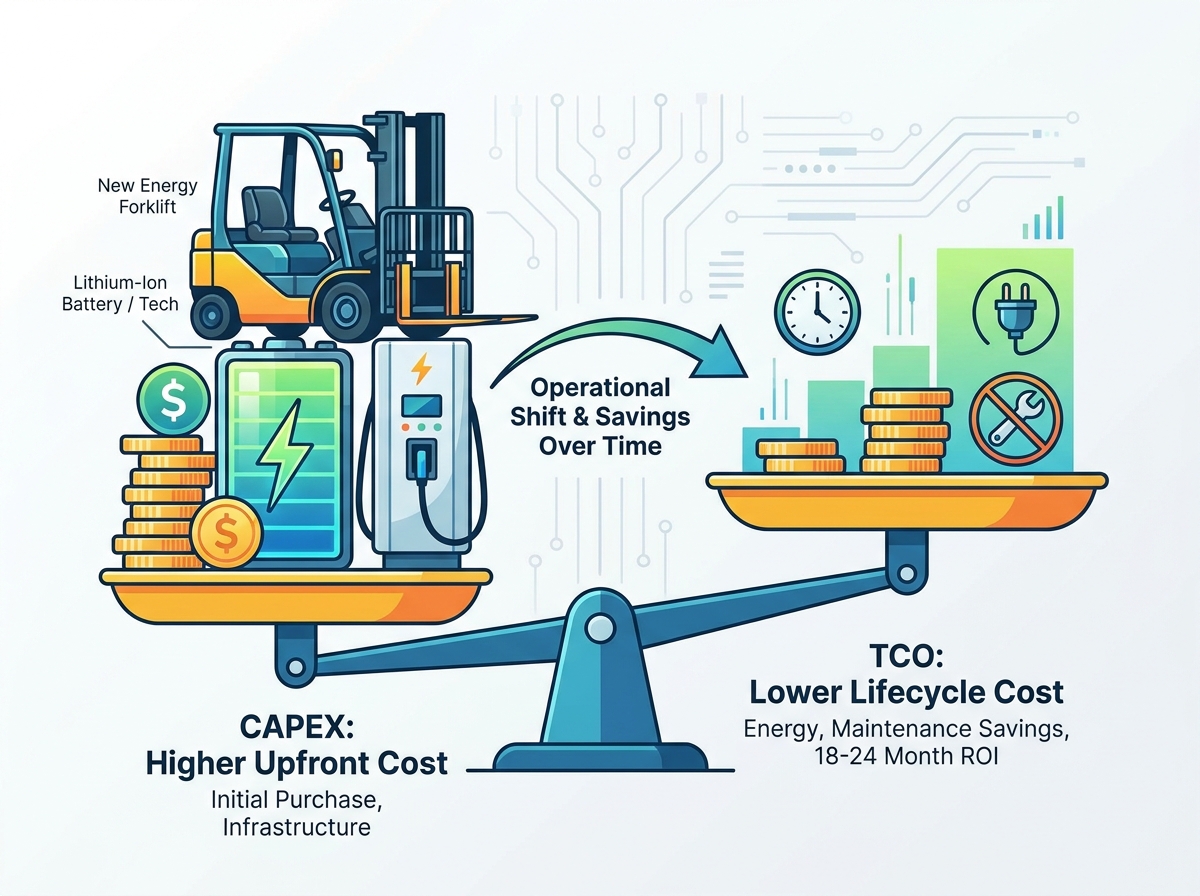
When you receive a quote for green logistics equipment, the numbers can look intimidating. Dissecting the invoice helps you understand exactly where your capital goes. The components of these modern machines carry vastly different price weights compared to older internal combustion models.
Quotes generally split into two main buckets. You pay for the structural chassis and you pay for the power system. The chassis covers the steel frame, wheels, hydraulics, and mast. The battery and charging system often account for 30% to 40% of the initial invoice. High-capacity lithium packs command a hefty premium. Understanding this split helps you negotiate better terms when standardizing your fleet across multiple facilities.
Charging infrastructure demands careful budget consideration. Standard chargers replenish batteries slowly over an entire shift. High-frequency fast chargers inject massive amounts of energy during brief operational pauses. Fast-charging hardware adds substantial upfront cost. However, it reduces your required battery pool. You no longer need to purchase spare batteries for multi-shift operations. This equipment tradeoff often justifies the premium charger price.
Establishing realistic baseline budgets prevents procurement surprises. A standard 3-wheel electric model designed for narrow aisles represents the entry-level tier. Moving up to a heavy-duty 4-wheel lithium-ion configuration increases the price significantly due to dual-drive motors and larger counterweights. Keep in mind that base MSRP rarely reflects the final invoice. Customized attachments like side-shifters, paper roll clamps, or advanced telematics modules will inflate these baseline figures.
You might consider the second-hand market to offset high capital demands. Refurbished equipment availability is growing. However, realistic lifecycle expectations differ wildly from legacy machines. You face specific battery degradation risks in second-hand units. A used lithium pack might only hold 60% of its original charge. You must demand rigorous diagnostic reports on battery health before investing in refurbished power units.
The true financial advantage of modern logistics equipment reveals itself in the operational phase. Day-to-day expenses drop significantly when you transition away from fossil fuels. You must model these ongoing savings accurately to justify the initial capital investment.
Advanced electric drivetrains operate with incredible energy efficiency. You calculate the cost per kilowatt-hour (kWh) and compare it against traditional fuel costs like propane or diesel. Electric motors convert a massive percentage of their energy directly into mechanical work. Internal combustion engines lose most of their energy to heat. Even in regions with high utility rates, the electrical energy cost per hour of operation falls drastically below combustible fuel equivalents.
Mechanics spend countless hours maintaining older equipment. Modern green machines erase most of this labor. You completely quantify the removal of ICE-related maintenance. You no longer buy engine oil, spark plugs, or transmission filters. You also eliminate lead-acid maintenance. No more weekly watering schedules. No more equalization charges. You completely avoid hazardous acid spill cleanups. This represents a massive reduction in operational downtime.
Setting realistic expectations for power cell longevity ensures accurate long-term budgeting. Modern lithium-ion configurations typically offer 3,000 or more cycles before degrading to 80% capacity. You must model replacement costs over a 7-to-10-year lifecycle. Most facilities replace the entire forklift chassis before the lithium battery completely fails. This longevity acts as a major financial safeguard against future capital outlays.
Do not ignore the reclaimed labor hours. Workers in legacy facilities spend roughly 20 to 30 minutes swapping heavy lead-acid batteries between shifts. Refueling propane tanks also burns valuable productivity. Opportunity charging reclaims this lost time. Operators simply plug the machine in during scheduled breaks. You convert non-productive maintenance time directly back into active material handling.
| Expense Category | Legacy Equipment Profile | Modern Energy Profile |
|---|---|---|
| Daily Fuel/Energy | High (Propane/Diesel refills) | Low (Nightly/Opportunity charging) |
| Routine Maintenance | High (Oil, filters, engine tuning) | Minimal (Tire checks, greasing mast) |
| Labor for Refueling | High (Battery swaps, tank changes) | Zero (Plug-in during normal breaks) |
| Facility Ventilation | High (Dedicated exhaust/HVAC) | Zero (No toxic emissions) |
You cannot simply buy advanced electrical equipment and plug it into a standard wall outlet. Integrating these machines requires serious facility planning. Infrastructure bottlenecks will delay deployment if you do not prepare your warehouse environment beforehand.
Conducting a facility power audit before purchasing remains absolutely necessary. You need to know your building's exact electrical capacity. Installing multiple high-frequency fast chargers draws massive amperage. Will this new equipment require costly transformer upgrades? You might need to pull new 480V 3-phase wiring across the warehouse. Factor these electrical contracting costs into your deployment budget immediately.
Legacy fleets demand dedicated, heavily ventilated battery rooms. These spaces require specialized acid-resistant flooring and expensive eye-wash stations. Opportunity charging eliminates the need for these hazardous rooms. You can scatter compact charging pedestals throughout the facility near break areas. This shift frees up hundreds of square feet. You can convert this reclaimed footprint directly into revenue-generating pallet storage.
High-voltage infrastructure brings new regulatory scrutiny. You must meet strict local fire codes regarding electrical installations. Occupational safety requirements govern how you route charging cables to prevent trip hazards. Lithium-ion storage mandates specific thermal management protocols. Partner closely with your facility manager to ensure your new charging stations comply fully with local safety standards.
Selecting the right equipment requires a systematic approach. Do not rely solely on glossy vendor brochures. Use this standardized framework to evaluate potential models against your unique operational realities.
Procuring advanced material handling equipment represents a major infrastructure investment. It is never just a simple equipment swap. You are changing how your facility manages energy, labor, and safety. The initial capital outlay might seem aggressive. However, the operational savings realized over a multi-year lifecycle fundamentally transform your warehouse profitability.
We encourage buyers to consolidate their facility’s electrical data and operational metrics immediately. Gather your shift schedules, load weights, and utility rates before requesting custom operational ROI models or vendor quotes. Take action today by scheduling a comprehensive fleet audit or downloading a standardized specification checklist to guide your upcoming procurement meetings.
A: Yes, they carry a noticeably higher day-one capital cost. The advanced battery chemistry and electrical controllers command a premium. However, they deliver drastically lower lifecycle operational costs. You stop paying for combustible fuels, oil changes, and engine maintenance. This creates a rapid return on investment, often offsetting the higher initial price tag within two years.
A: These advanced power packs generally provide 3,000 to 4,000 full charge cycles before their capacity drops to 80%. In a standard single-shift operation, this lifespan easily translates to 7 to 10 years of reliable performance. Their degradation timeline remains incredibly stable compared to older lead-acid alternatives.
A: It depends on your operational speed. Basic 110V/220V slow charging might work on existing grid setups for light usage. However, heavy-duty applications require 480V 3-phase high-frequency fast chargers. These fast chargers demand dedicated industrial wiring and often require facility transformer upgrades to handle the high amperage draw safely.
A: They perform exceptionally well if configured properly. Sub-zero environments do cause a realistic loss of battery runtime due to chemical resistance. However, premium models feature advanced thermal management systems. These integrated battery heaters keep the internal cells at optimal temperatures, minimizing energy loss and preventing condensation damage in freezing conditions.


