
Views: 0 Author: Site Editor Publish Time: 2026-08-13 Origin: Site


Procurement teams often face a major friction point when upgrading warehouse equipment. The sticker price of a Lithium battery forklift truck heavily outweighs traditional alternatives upfront. This initial shock can easily stall critical fleet modernization efforts. However, enterprise warehouses and third-party logistics providers (3PLs) are increasingly evaluating this switch. They desperately need solutions for continuous multi-shift productivity. They also want to reclaim valuable facility space previously dedicated to hazardous maintenance rooms. You simply cannot afford to ignore these operational shifts in a highly competitive supply chain environment. This article moves past common marketing claims to deliver a transparent, line-by-line breakdown of true equipment costs. We will carefully examine required infrastructure updates, maintenance realities, and realistic return on investment timelines. You will gain actionable insights to evaluate internal battery management systems and navigate complex vendor warranties. Ultimately, this guide provides the evidence-based data you need. We want to help you make confident, long-term procurement decisions for your material handling fleet.
We must thoroughly understand what actually goes into the lifespan cost of material handling equipment. You can calculate this financial framework by combining acquisition, infrastructure modifications, routine maintenance, and daily energy costs. You then subtract the estimated salvage value at the end of the equipment's life. Let us break down the initial Capital Expenditure (CapEx) in detail. When you look at the sticker price, you are paying for three distinct components. You buy the heavy-duty forklift chassis, the advanced lithium battery pack, and the specialized high-frequency chargers required to power the system. We must be fully transparent here. Your initial costs are significantly higher compared to legacy lead-acid technologies. You cannot downplay this heavy upfront investment when presenting budgets to your finance department.
However, Operational Expenditure (OpEx) reductions quickly begin to offset these steep initial costs. First, consider the dramatic differences in energy efficiency. Advanced battery systems convert approximately 90-95% of energy from the grid into usable mechanical work. Traditional alternatives typically hover around a meager 65-70% conversion rate. This inefficiency wastes electricity as heat during the charging cycle. Over five years, that wasted energy translates into thousands of dollars in excess utility bills per truck.
Next, we must examine aggressive labor reallocation. You instantly eliminate the hourly labor costs tied to daily watering routines. You no longer pay technicians to perform weekly equalizing charges. You completely eliminate the mid-shift physical battery swaps that bring warehouse operations to a grinding halt.
Finally, consider your tangible real estate value. You likely maintain a large, heavily ventilated battery maintenance room inside your facility. By transitioning your fleet, you reclaim this valuable, climate-controlled floor space. You can convert this area into revenue-generating storage racks. You might also expand critical staging operations to speed up outbound logistics.
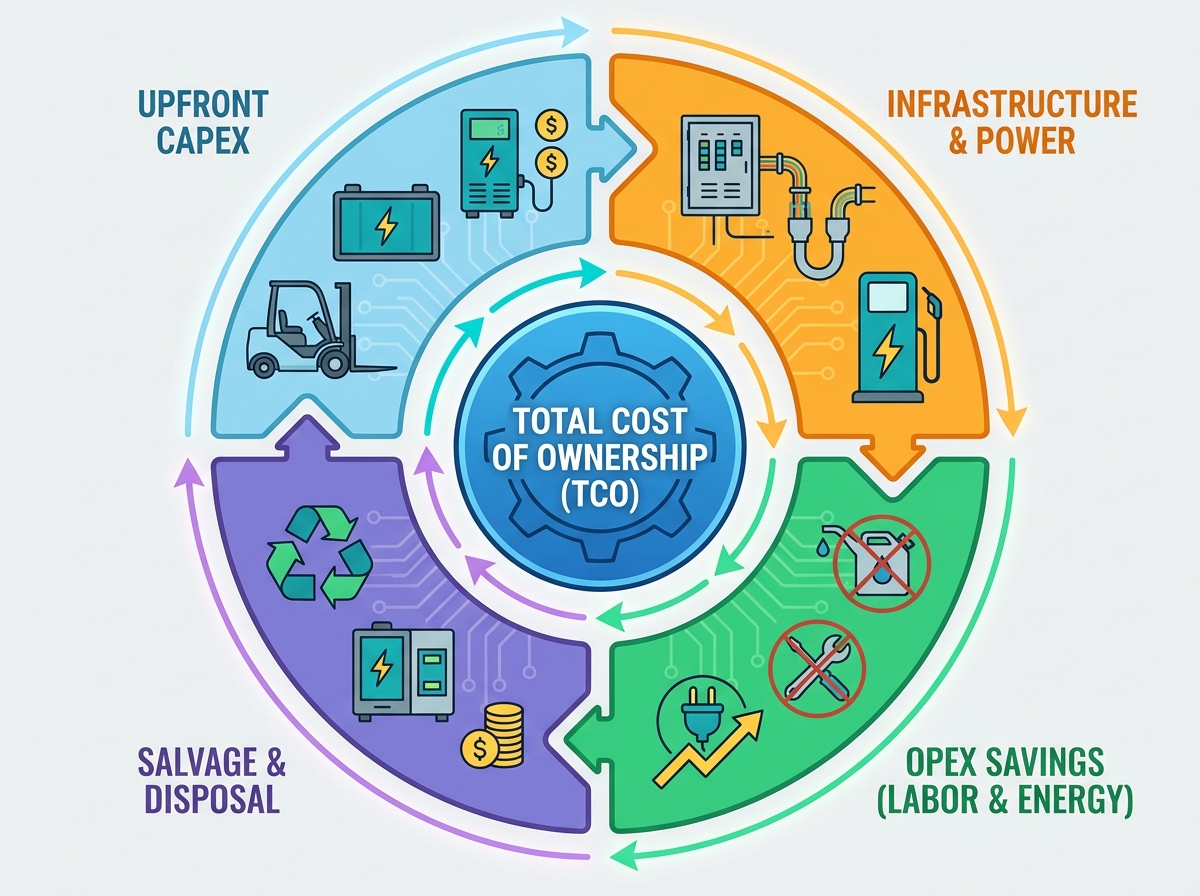
Facility electrical capacity represents a significant implementation risk that many buyers overlook. Fast, opportunity charging pulls much higher peak power from your local electrical grid. You must highlight the potential hidden cost of required electrical panel upgrades before you finalize any equipment orders. Utility demand charges can also spike dramatically if you charge your entire fleet simultaneously during peak operational hours. If your facility operates on an older electrical grid, the necessary infrastructure upgrades could cost tens of thousands of dollars.
Workflow restructuring introduces another complex layer of operational cost. You must invest considerable time into retraining your forklift operators. They need to plug the equipment in during every coffee break and lunch hour for short bursts of opportunity charging. This shifts the daily routine entirely away from driving to a central battery room at the end of a shift. Based on extensive field implementation experience, operator adoption remains a common hurdle during year one. Operators often forget to connect the chargers during brief downtimes. This negligence can lead to dead trucks mid-shift, undermining your productivity goals.
End-of-life disposal also demands careful financial planning. The current industrial reality reveals that lithium recycling carries specific, unavoidable costs. Unlike older technologies, you do not gain an immediate scrap value payout when the battery dies. Lead-acid batteries contain highly recyclable lead, which scrap yards buy eagerly. Lithium packs require complex chemical breakdown processes. However, second-life applications are emerging rapidly across the industry. Repurposing degraded packs for stationary grid storage offers a highly practical way to offset future disposal fees. These packs may no longer push a heavy forklift, but they can still store solar energy for warehouse lighting.
You must evaluate the multi-shift versus single-shift threshold carefully to justify the expense. High equipment utilization makes your investment return achievable very quickly. In demanding multi-shift operations running two to three shifts daily, you can typically reach a breakeven point within 1.5 to 3 years. This rapid return happens because a single advanced power unit replaces two or three traditional batteries per truck. You avoid buying backup batteries entirely. You also avoid buying the massive extraction equipment previously needed to swap them. Conversely, low-utilization warehouses running single shifts face very different financial realities. They may not see an immediate financial justification for this advanced technology. You must calculate these utilization metrics precisely before committing capital.
Consider the heavy opportunity cost of operational downtime. You gain massive productivity simply by keeping the truck on the floor for the entire shift. A Lithium battery forklift truck maintains consistent, peak voltage as it discharges. It does not suffer from sluggish voltage drops as capacity depletes late in the day. This stable power ensures your lifting speeds and travel speeds remain completely uniform from the first hour to the last. Operators move more pallets per hour when their equipment performs predictably.
To visualize this impact, you can use a simplified mathematical calculation model. Take your current annual operational expenditures and subtract your projected new operational expenditures. This simple subtraction reveals your total annual savings. Next, divide your initial capital expenditure premium by these annual savings. This formula determines your exact breakeven timeline in years.
| Cost Impact Category | Single-Shift Operation Impact | Multi-Shift Operation Impact |
|---|---|---|
| Capital Expenditure Premium | High impact, difficult to absorb quickly | Easily offset by avoiding multiple backup batteries |
| Daily Labor Savings | Minimal daily maintenance savings | Massive daily labor reduction across all shifts |
| Downtime Elimination | Low impact on overall throughput | High impact, keeps logistics moving 24/7 |
| Typical Breakeven Timeline | 4+ Years (May exceed lease term) | 1.5 - 3 Years (Highly profitable) |
Choosing the right warehouse equipment requires looking deep into the integrated technology. Battery Management System (BMS) quality is absolutely paramount to your success. The internal software protecting the individual lithium cells from overcharging and overheating is just as critical as the heavy metal hardware itself. A robust, well-engineered BMS prevents catastrophic thermal events and actively extends operational lifespans. It constantly balances the cells during rapid charging phases.
Integration with the forklift chassis is equally important for daily reliability. Look for flawless Controller Area Network (CAN) bus communication capabilities. The power unit and the forklift chassis must communicate seamlessly in real-time. This digital handshake ensures highly accurate dashboard battery readings. It also enables responsive safety cut-offs and optimizes overall energy delivery to the hydraulic pumps. If the CAN bus integration fails, your operators fly blind without accurate battery gauges.
When reviewing vendor proposals, aggressively compare warranty terms against actual projected cycle life. You must distinguish between "calendar years" and "energy throughput" hidden within the warranty fine print. A ten-year warranty means nothing if it limits you to a low total energy throughput. Look for transparent agreements that guarantee specific capacity retention over time. For example, demand a written guarantee of 80% capacity retention after 3,000 rigorous cycles.
Finally, strictly enforce equipment certifications and facility compliance. Insist on purchasing Underwriters Laboratories (UL) Listed systems exclusively. Well-known testing frameworks like UL 2580 satisfy strict commercial insurance policies and stringent facility safety requirements. Do not compromise on certified safety standards to save a few dollars upfront.
Before you finalize a massive fleet purchase, you need empirical data. We strongly advise you to conduct a comprehensive power study. Request a detailed telemetry and power audit from your vendor on your current fleet. This affordable study exposes your actual fleet utilization rates, peak energy draws, and hidden dead times. It prevents you from overspending on massive battery capacities that your specific operational volume does not actually require.
Next, run a targeted, real-world pilot program inside your facility. Test the new equipment in your absolute most demanding applications. Cold storage environments and heavy-lifting cycles push these electrical systems to their absolute limits. This practical, hands-on trial validates the vendor’s glossy performance claims under your specific roof. Monitor the pilot equipment closely to see if operator adoption metrics meet your initial expectations.
Vendor alignment determines your long-term operational success. Evaluate the local dealer’s ability to service advanced electronic components swiftly. They must do much more than just repair traditional hydraulic hoses or worn mechanical tires. They need certified technicians trained specifically in high-voltage diagnostics. Fast local response times protect your daily uptime and secure your capital investment.
Replacing your material handling fleet is not a universal silver bullet for warehouse efficiency. It represents a highly strategic, calculated capital expenditure. You deliberately trade heavy upfront costs for aggressive, long-term operational savings and eliminated maintenance labor. To succeed financially, you must map your exact fleet utilization rates and audit your facility's electrical limits. We highly recommend partnering with certified power integration specialists to audit your site thoroughly before signing any purchase orders. Calculate your precise breakeven timeline based on real telemetry data, rather than relying on generalized sales brochures. Take decisive action today by running a structured pilot program to measure your direct productivity gains in real-time.
A: These advanced power units typically last between 7 to 10 years. This translates to 3,000 or more full charging cycles. They maintain their usable capacity much longer than legacy alternatives, provided your operators charge them correctly and strictly follow recommended daily opportunity charging protocols.
A: Many existing trucks can easily accept drop-in battery boxes. However, you must verify proper counterweighting to maintain safe lifting capacities. A certified technician must also ensure the digital CAN bus communication integrates smoothly with your older forklift chassis.
A: These systems perform exceptionally well in sub-zero environments compared to older technologies. They do require built-in internal heaters to regulate core cell temperatures safely. This specialization slightly increases your initial purchase price and draws a small amount of additional energy during operation.


