
Views: 0 Author: Site Editor Publish Time: 2026-07-22 Origin: Site


Many car buyers face a difficult choice today. You might want to leave traditional combustion engines behind. However, jumping straight to a fully electric vehicle often feels risky. A Hybrid car offers a pragmatic middle ground for drivers everywhere. It eases concerns about intense range anxiety and fluctuating fuel costs. It also noticeably reduces your daily environmental impact. Our goal is to provide a highly transparent look at how this technology operates. We want to help you figure out if these vehicles align perfectly with your specific driving habits. You will learn about the dual-powertrain mechanics behind these models. We will also explore the real-world financial benefits and long-term maintenance realities. By the end, you will know exactly which architecture suits your daily commute. You can then make a confident, evidence-based purchasing decision.
A Hybrid car relies on a brilliant dual-powertrain system. It pairs a traditional gasoline engine alongside a dedicated electric motor. An onboard computer continuously controls this complex setup. It automatically switches between power sources to maximize your fuel efficiency. Sometimes, it combines both systems for sudden acceleration. You never have to flip a switch yourself. The vehicle constantly reads your speed and throttle inputs. It then decides the most efficient way to propel you forward. Automotive engineers often utilize specialized planetary gearsets to blend these two power sources seamlessly. This engineering ensures you experience smooth, uninterrupted power delivery during your commute. The gasoline engine handles high-demand situations. The electric motor manages low-speed crawling and initial acceleration.
Many drivers wonder how standard models charge their batteries. They use a clever system called regenerative braking. Traditional cars waste kinetic energy as heat when slowing down. A hybrid captures this energy instead. The electric motor reverses its primary function during deceleration. It acts as a generator to feed electrical power back into the battery pack. This elegant process completely eliminates the need to plug in standard models. Your daily driving naturally replenishes the electrical reserves. When you lift your foot off the accelerator, you might feel a slight drag. This drag indicates the system is actively harvesting energy. It transforms your routine stop-and-go traffic into a valuable charging opportunity.
You will encounter three distinct categories when shopping. Each offers unique benefits and requires different infrastructure.
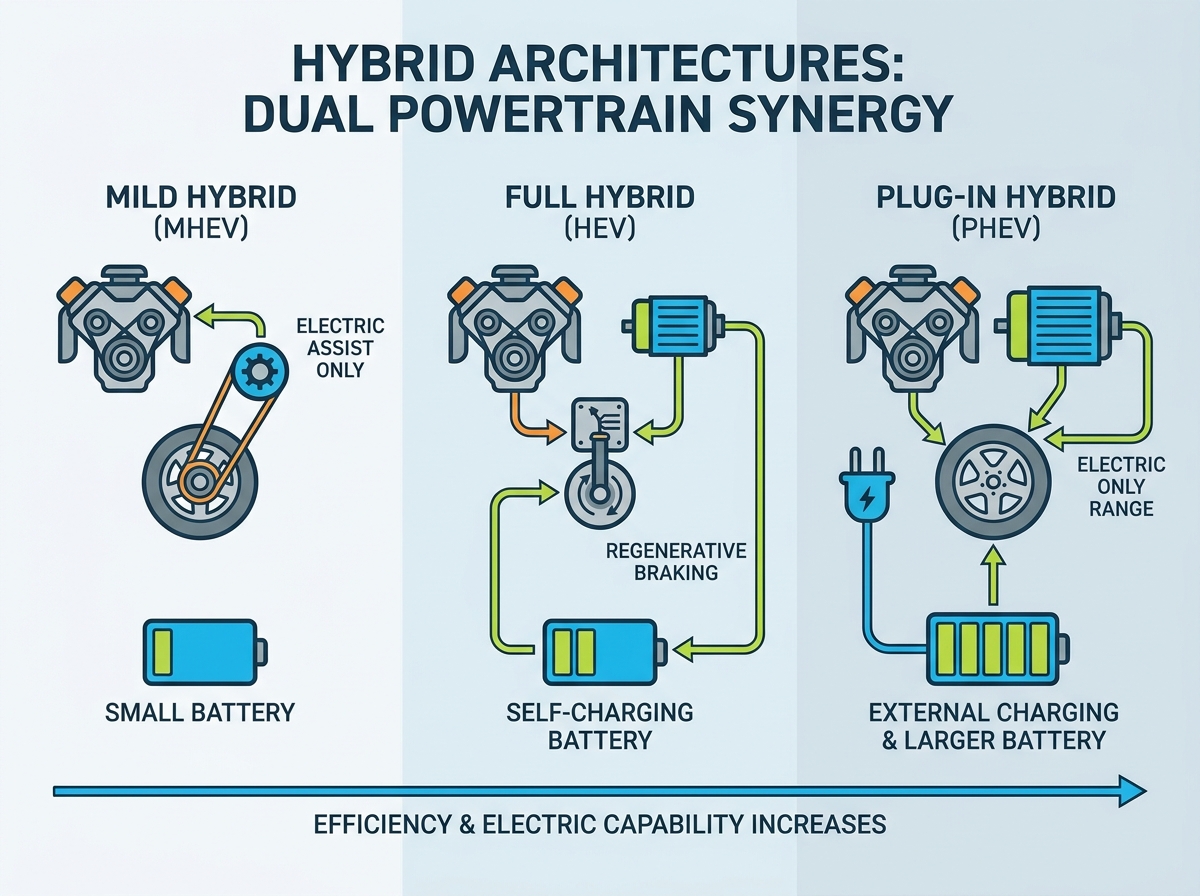
Fuel savings actively drive most buyers toward hybrid technology. The miles-per-gallon (MPG) improvements look incredibly appealing on paper. However, context deeply matters. You see the highest efficiency yields in urban, low-speed environments. Stop-and-go traffic allows the electric motor to truly shine. The engine shuts off frequently, saving expensive fuel. Continuous highway driving relies heavily on the gas engine. You still save money, but urban drivers experience the most dramatic financial returns. Consider a typical driver covering 12,000 miles annually. Switching from a 25-MPG gas vehicle to a 50-MPG hybrid cuts fuel consumption in half. Over several years, these savings easily amount to thousands of dollars.
Fully electric vehicles often trigger intense range anxiety. A standard Hybrid car completely eliminates this fear. You bypass the current public charging infrastructure gap entirely. Finding a reliable public charger can sometimes be frustrating. Broken chargers and long wait times remain common issues. These vehicles utilize existing gas stations everywhere instead. They require zero changes to your daily routing. You never have to upgrade your home electrical setup for standard HEVs. You get to enjoy modern electric efficiency. At the same time, you keep traditional, lightning-fast refueling convenience for long road trips.
Government policies actively encourage greener driving habits globally. You might qualify for federal, state, or local tax credits. PHEVs often receive the most generous financial incentives due to their plug-in capabilities. These credits can effectively offset the initial purchase premium. Dealers can usually outline specific compliance rules for your area. Securing these incentives makes the financial transition much easier to justify. Some municipalities even offer secondary perks. You might gain access to high-occupancy vehicle (HOV) lanes. You might also receive discounted toll rates or reduced registration fees.
Hybrid variants carry a higher Manufacturer's Suggested Retail Price (MSRP). You will pay more upfront compared to identical gas-only counterparts. Calculating your break-even point is a crucial step. You must compare your local gas prices against your expected annual mileage. We often see buyers recover the initial premium within three to five years.
| Financial Factor | Standard Gas Vehicle | Hybrid Equivalent | Impact on Break-Even Timeline |
|---|---|---|---|
| Average MSRP Premium | Standard Baseline Price | +$1,500 to +$3,000 | Extends time to reach ROI |
| Annual Fuel Expenses | Significantly Higher | Substantially Lower | Accelerates time to reach ROI |
| Available Tax Incentives (PHEV) | None Available | Up to $7,500 (Varies heavily) | Drastically reduces break-even timeline |
You must do the math based on your real-world driving patterns. High-mileage drivers will reach the break-even point much faster.
A common misconception suggests these vehicles dominate all driving conditions equally. They actually offer diminishing returns during continuous high-speed highway miles. Highway driving requires constant power to overcome aerodynamic drag. This steady demand relies heavily on the internal combustion engine. The electric motor provides less assistance at 75 mph. If your commute consists entirely of highway miles, your MPG gains shrink considerably. City drivers benefit far more from electric low-speed cruising. Urban environments leverage the electric motor exactly where gas engines struggle most.
Automakers must package bulky high-voltage battery packs somewhere. They often place them beneath the rear passenger seats or under the cargo floor. This necessary addition can slightly reduce your available trunk space. Families needing maximum cargo volume should check these dimensions carefully. The extra batteries also increase the overall vehicle curb weight. Heavier cars sometimes exhibit different handling dynamics. The suspension must manage the extra mass around sharp corners. Increased weight can also lead to slightly faster tire wear over time. Always test drive the vehicle to ensure these minor physical trade-offs feel acceptable.
Skeptical buyers almost always ask about battery life expectancy. It remains the most common objection at dealerships today. Modern battery packs boast impressive engineering and longevity. Industry-standard warranties typically cover 8 years or 100,000 miles. Many units last well beyond 150,000 miles before noticeable degradation occurs. Replacement costs can be steep if a failure happens out of warranty. A new pack might cost several thousand dollars. However, catastrophic failures remain quite rare. Proper cooling systems and intelligent charging software protect the individual cells daily.
You gain surprising advantages in routine mechanical maintenance. Regenerative braking does most of the heavy lifting when slowing down. This drastically extends the life of your traditional brake pads and rotors. Mechanics often see hybrid brakes lasting well over 80,000 miles. Additionally, the gas engine idles far less frequently in traffic. Reduced engine runtime lowers the overall wear on internal combustion components. Your oil degrades slower, and moving engine parts experience less stress. You consistently save money on consumable parts over the vehicle's lifespan.
Routine maintenance tasks remain mostly standard across the board. You still need regular oil changes, wiper replacements, and new tires. Electrical drivetrain diagnostics present an entirely different story. High-voltage systems require highly trained, certified technicians. You cannot take complex electrical issues to just any local corner mechanic. Bright orange high-voltage cables signify systems requiring specialized safety protocols. This reality potentially limits your third-party repair shop options. Dealership service centers often become your safest choice for powertrain repairs. Always verify local specialized service availability before making a purchase.
Selecting the perfect powertrain depends heavily on your daily routine. We created a practical matrix to guide your final decision.
You need to assess your home charging capabilities next. PHEVs require a dedicated wall outlet or a Level 2 charger for maximum convenience. Calculate your daily mileage accurately. This helps you determine if a PHEV battery covers your entire commute. Finally, schedule a comprehensive test drive at a local dealership. You need to experience the seamless powertrain transition firsthand. Pay close attention to the regenerative braking feel and acceleration smoothness. Evaluating these nuances ensures you pick the right model for your comfort.
A Hybrid car proves to be a highly practical investment for modern drivers. You achieve much lower daily operating costs. You also reduce your personal carbon footprint significantly. Best of all, you avoid the drastic lifestyle changes required by fully electric vehicles. You get remarkable electric benefits wrapped up in traditional refueling convenience. We highly recommend viewing current inventory at your trusted local dealerships. Use an online fuel-savings calculator to run your personal commute numbers. Contact a dedicated sales team today for a personalized financial consultation. They can expertly help you map out the exact benefits for your unique driving profile. Take action today to modernize your daily commute.
A: Most modern batteries are engineered to last between 100,000 and 150,000 miles reliably. Automakers back this expected longevity with strong factory warranties. The industry standard mandates coverage for at least 8 years or 100,000 miles. Severe degradation before this milestone is exceptionally rare due to advanced thermal management systems.
A: It depends entirely on the specific architecture. Standard Full Hybrids (HEVs) are completely self-charging through regenerative braking and internal engine power. You never plug them in. Plug-in Hybrids (PHEVs) require external charging to maximize their larger batteries and unlock pure electric driving ranges.
A: Insurance premiums can be slightly higher due to expensive specialized electrical components. However, this is often balanced by noticeably lower routine mechanical maintenance costs. Regenerative braking saves expensive brake pads, and reduced engine runtime limits general wear and tear on the motor.
A: Standard hybrids rely heavily on deeply integrated system dependencies. If the high-voltage battery completely fails, the vehicle usually will not operate safely. The computer requires the electrical system to manage the transmission and engine starts. Fortunately, total sudden battery failures remain highly uncommon.


