
Views: 0 Author: Site Editor Publish Time: 2026-10-30 Origin: Site


The transition to electric mobility often forces drivers to choose between generic efficiency and genuine driving joy. You want an EV combining zero emissions and iconic design. Evaluating a mini electric car requires balancing brand heritage against the practical realities of owning a compact EV. Many buyers struggle to align urban use cases against long-range touring metrics. This misalignment inevitably leads to frustrated expectations.
This guide breaks down the critical evaluation criteria for prospective buyers. We explore real-world range validation, home charging infrastructure, and crucial financial considerations. You will gain a transparent, actionable framework. By the end of this article, you will know exactly if this unique vehicle fits your daily driving requirements and lifestyle.
Official EPA and WLTP estimates represent controlled testing environments. Real-world highway driving alters these figures significantly. Sustained speeds above 65 mph increase aerodynamic drag exponentially. This drag forces the electric motor to consume power at a higher rate. Climate control also plays a major role in battery depletion. Running the heater during winter temperatures slows down battery chemistry. This combination routinely reduces overall driving distance.
Tire selection impacts efficiency directly. Sticky summer tires provide excellent grip but increase rolling resistance. All-season, low-rolling-resistance tires help maximize range. You must factor these seasonal and mechanical variables into your range calculations.
Estimated Range Impact Based on Driving Conditions| Driving Condition | Impact on Stated Range | Primary Cause |
|---|---|---|
| Mild City Driving | 0% to +5% | Frequent regenerative braking, low aerodynamic drag |
| Highway Cruising (70+ mph) | -15% to -20% | High continuous energy demand, severe wind resistance |
| Winter Weather (Below 32°F) | -20% to -30% | Battery chemistry limitations, active cabin heating |
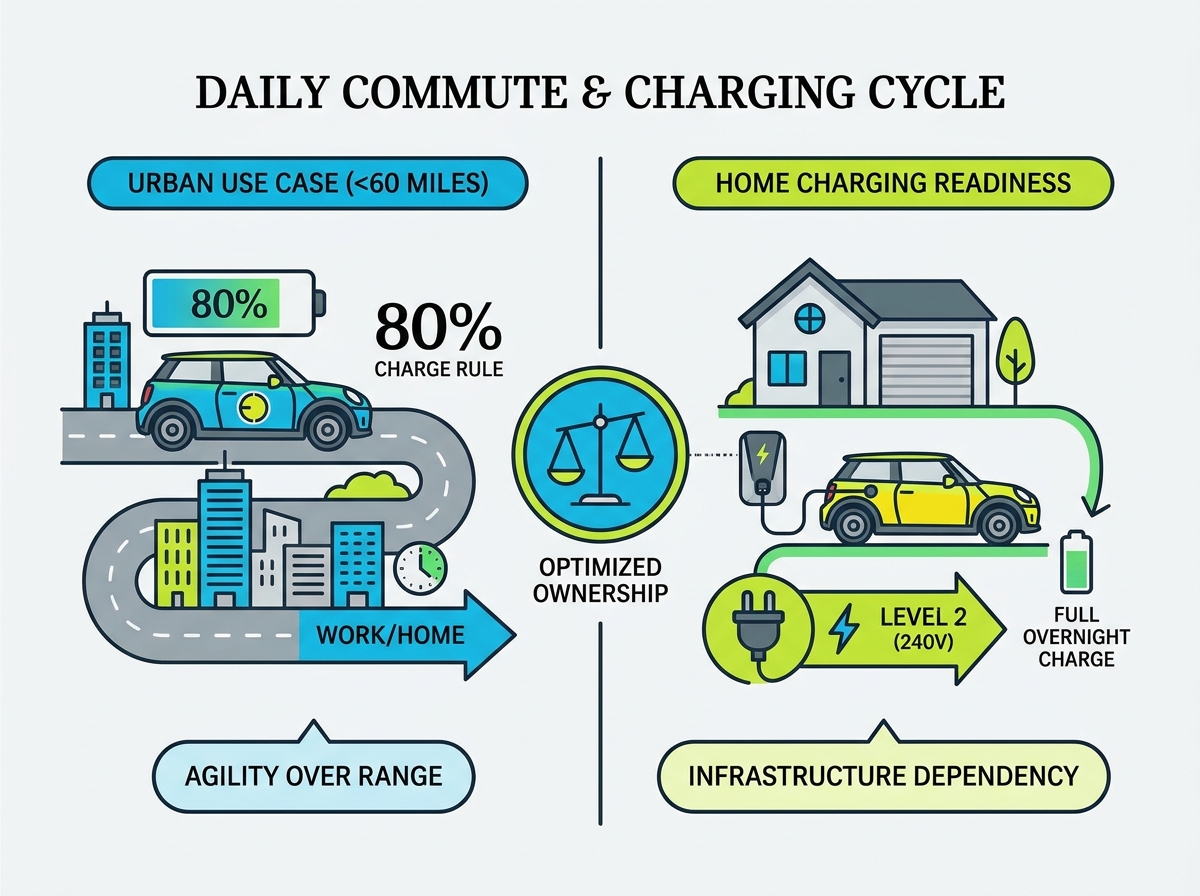
You must map your daily commute distances against the 80% charge rule. Automotive engineers recommend charging lithium-ion batteries to 80% for daily use. This practice preserves battery longevity over several years. If your round-trip commute falls under 40 miles, a smaller battery serves you perfectly.
A smaller battery reduces overall curb weight. Shedding excess pounds improves cornering agility and braking performance. Drivers averaging brief commutes benefit immensely from this efficiency. You avoid carrying thousands of pounds of unused battery capacity for hypothetical road trips.
We must assess cargo capacity objectively. The trunk offers limited space when the rear seats remain upright. You can fit standard grocery bags or two small duffel bags. Folding the rear seats down transforms the utility profile entirely. The expanded cargo floor easily accommodates large suitcases or bulky sports equipment.
Rear-seat usability requires honest evaluation. The second row feels tight for average adults. They serve best for daily child transport or occasional adult passengers. You should not plan to use this vehicle for daily adult carpooling.
EV architecture translates beautifully to this specific chassis. An electric motor delivers instant torque the moment you press the accelerator. The rigid chassis minimizes body roll during sharp turns. Engineers placed the heavy battery pack low in the floorboard. This placement creates a remarkably low center of gravity. These elements combine to deliver an authentic, thrilling driving experience.
Regenerative braking integration deserves special attention. The system captures kinetic energy and feeds it back into the battery. This setup allows for true one-pedal driving. Lifting your foot off the accelerator aggressively slows the vehicle. New drivers face a brief learning curve. Once mastered, one-pedal driving makes stop-and-go city traffic effortless.
The interior blends retro design cues and modern digital interfaces. You must evaluate the technology suite before purchasing.
Material quality easily surpasses non-premium compact EV competitors. Soft-touch plastics, premium upholstery, and solid switchgear define the cabin. Engineers heavily insulated the interior to manage Noise, Vibration, and Harshness (NVH). Without a loud combustion engine, wind and tire noise become obvious. The acoustic dampening keeps the cabin serene even at highway speeds.
MSRP analysis requires careful navigation of state, federal, and local EV tax incentives. Direct purchase compliance often proves difficult due to strict battery sourcing regulations. Many buyers find they do not qualify for federal credits when buying outright. However, evaluating lease loop-holes reveals significant savings. Finance companies capture commercial clean vehicle credits and pass them to consumers. This strategy lowers monthly lease payments dramatically.
You must factor insurance premium expectations into your budget. Premium compact EVs cost more to insure than standard economy cars. Specialized battery repair protocols and premium replacement parts elevate underwriting risks. We recommend securing multiple insurance quotes before finalizing any dealership paperwork.
Historical depreciation curves for early-model years show steep initial drops. This depreciation makes the secondary market incredibly appealing for budget-conscious buyers. Purchasing a used mini electric car requires a distinct evaluation process.
You must request a battery state-of-health (SoH) report. Dealership service departments generate these diagnostic documents easily. An SoH report reveals the exact percentage of original battery capacity remaining. It removes the guesswork from used EV shopping. Additionally, you need to understand the 8-year/100,000-mile high-voltage battery warranty. Automakers typically transfer this coverage to subsequent owners. Verify this transferability policy in writing to protect your investment.
A seamless ownership experience relies entirely on your home charging setup. Follow these critical steps to prepare your residence:
You will eventually need public charging infrastructure for longer trips. Understand your vehicle's maximum DC Fast Charging (DCFC) acceptance rates. Many premium compact EVs cap charging speeds around 50 kW to protect battery chemistry. You should set realistic expectations for commercial stations.
Charging from 10% to 80% usually takes about 35 minutes under optimal conditions. After crossing the 80% threshold, charging speeds taper off dramatically. We advise unplugging at 80% to save time and money. Finally, monitor connector standards. The industry currently uses CCS connectors, but a transition to NACS (Tesla-style) looms. You will likely need to purchase an adapter in the coming years.
Buyers routinely cross-shop various compact EVs. Comparing European micro-car designs highlights unique packaging priorities. The Fiat 500e emphasizes retro styling and exceptional urban maneuverability. However, its interior packaging feels slightly more restrictive for taller drivers.
Comparing against the Nissan Leaf or Chevy Bolt changes the criteria entirely. The Leaf and Bolt prioritize higher range and a lower cost-per-mile. They function excellently as practical appliances. You must weigh their utilitarian nature against premium interior finishes and sheer driving joy. If you value engaging steering feedback, the utility-focused alternatives may feel uninspiring.
Compact EV Market Comparison| Vehicle Segment | Primary Advantage | Notable Compromise |
|---|---|---|
| Premium Micro-Car (e.g., Mini, Fiat 500e) | Exceptional handling, premium cabin materials, easy parking | Lower total range, limited rear-seat legroom |
| Economy Hatchback (e.g., Chevy Bolt) | Maximum range per dollar, spacious cargo area | Slower DC fast charging, utilitarian interior plastics |
| Legacy Commuter (e.g., Nissan Leaf) | Proven reliability, comfortable ride quality | Outdated CHAdeMO charging port, air-cooled battery |
Buy if: You have reliable home charging and a predictable daily commute under 60 miles. You should proceed if you prioritize driving engagement, premium design, and effortless parking over maximum cross-country range utility.
Pass if: You frequently drive intercity routes exceeding 100 miles. You should look elsewhere if you lack dedicated overnight charging access. Pass on this vehicle if you require a primary transport vehicle for a growing family of four.
The premium compact EV occupies a unique position in the automotive market. It functions as a specialized, high-quality urban tool rather than a generalized family vehicle. By prioritizing handling dynamics and distinctive design, it offers genuine character in an increasingly uniform EV landscape. It proves that efficient commuting does not require sacrificing driving joy.
Your next steps dictate a successful purchase. Schedule an extended test drive specifically to test one-pedal driving in local traffic. Request localized quotes from certified electricians for a home charging setup immediately. Completing these infrastructure checks prior to dealership negotiations ensures a stress-free transition to electric driving.
A: Cold weather reduces EV range significantly. Expect a 20% to 30% drop in freezing temperatures. Lithium-ion cells resist absorbing and releasing energy when cold. You can mitigate this degradation effectively. Always pre-condition your cabin while plugged into your home charger. This strategy uses grid power to warm the battery and interior before departure.
A: Currently, these vehicles utilize the CCS connector standard. You cannot plug directly into a standard Tesla Supercharger without hardware. The industry is actively transitioning to the North American Charging Standard (NACS). Automakers will soon release official CCS-to-NACS adapters. In the interim, you can access specific "Magic Dock" Superchargers featuring built-in adapters.
A: Yes, it boasts excellent long-term reliability. Electric drivetrains feature far fewer moving parts than internal combustion engines. You avoid oil changes, spark plug replacements, and complex transmission failures. Routine maintenance primarily involves tire rotations, brake fluid checks, and cabin air filter replacements. Battery degradation remains minimal over standard ownership periods.
A: Purchasing a new model directly often disqualifies you from federal tax credits due to strict battery sourcing and final assembly rules. However, leasing provides a highly reliable workaround. The commercial clean vehicle credit applies to leased EVs regardless of assembly location. Finance companies frequently pass this credit directly to consumers.


