
Views: 0 Author: Site Editor Publish Time: 2025-12-16 Origin: Site


If you are curious about how long electric car batteries last, you will be glad to know they usually last 12 to 15 years. They can go up to 200,000 miles. Most batteries last longer than their warranties. Less than 1% need to be replaced early. How long your battery lasts depends on a few things. It depends on how often you charge it, how you drive, and the weather where you live. Look at the table below to see what matters most:
Factor | Why It Matters |
|---|---|
Battery Age | Older batteries hold less charge |
Charge Cycles | More charging wears out the battery |
Temperature | Extreme heat or cold shortens battery life |
Charging Habits | Fast charging can speed up wear |
You will see that batteries lose power slowly. They do not lose power all at once. Battery technology is getting better. This means you can expect your battery to last even longer.
Electric car batteries usually last 12 to 15 years. They can go more than 200,000 miles. Battery life depends on how you charge it. It also depends on how you drive and the weather. Most companies give warranties for 8 to 10 years. This means your battery should stay above 70% performance. To help your battery last longer, keep the charge between 20% and 80%. Try not to let it get too hot or too cold. Drive gently and use less energy. This can make your battery last much longer.
When you buy an electric car, you probably want to know how long the battery will last. Most modern electric car batteries are built to last about 12 to 15 years. For many drivers, that means you can drive over 200,000 miles before you need to think about a replacement. That’s a long time—about as long as many gas-powered cars stay on the road.
You might wonder how different brands compare. Here’s a quick look at what you can expect from some popular electric cars:
Brand examples | Years | Miles |
|---|---|---|
Mainstream brands (Hyundai, Kia, VW, Ford, GM) | 8–10 years | 100,000–150,000 |
Many Tesla models | 8 years | 100,000–150,000 |
Some long‑range trims and luxury EVs | 8–10 years | 120,000–155,000 |
You can see that most brands offer similar numbers. Some Teslas and early electric cars have already driven between 150,000 and 300,000 miles on their original batteries. That’s pretty impressive!
Fun Fact: A Volkswagen ID.3 kept 91% of its battery capacity after driving about 107,000 miles. That means the battery lost only a little bit of power over a long distance.
Electric car batteries lose power slowly. On average, you might see about 1.8% less battery capacity each year. In some places with very hot or cold weather, the battery might lose power a bit faster. For example, in Alaska, you could see about 4.9% loss in the first year, while in Hawaii, it could be as high as 10.1%. But for most drivers, the battery will last many years before you notice a big change.
You don’t have to worry much about your battery wearing out early. Most car makers give you a strong warranty for electric car batteries. These warranties usually last 8 to 10 years or up to 100,000 miles. Some even go higher. Here’s a table to show you what the big brands offer:
Manufacturer | Warranty Length | Mileage Limit | Capacity Guarantee |
|---|---|---|---|
Tesla | 8 years | 100,000-150,000 miles | 70% |
Ford | 8 years | 100,000 miles | 70% |
Hyundai/Kia | 10 years | 100,000 miles | 70% |
Nissan | 8 years | 100,000 miles | 70% |
Rivian | 8 years | 175,000 miles | 70% |
GM Brands | 8 years | 100,000 miles | 70% |
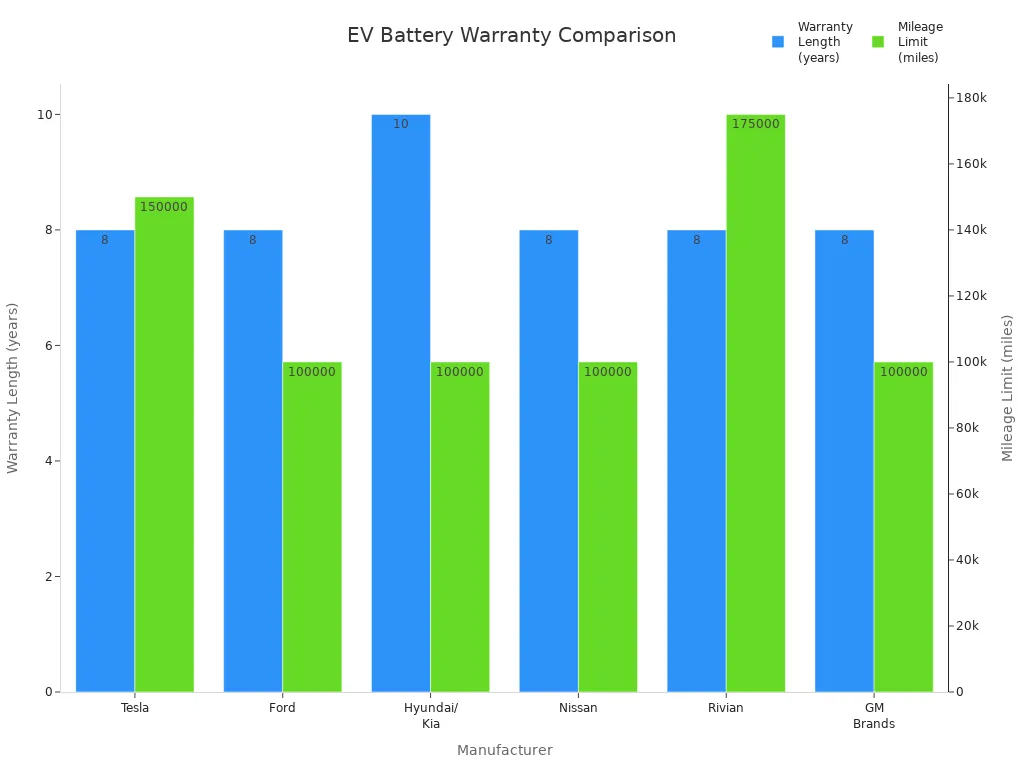
Most warranties promise that your battery will keep at least 70% of its original power during the warranty period. If your battery drops below that, the company will repair or replace it for you.
Here’s what these warranties really mean for you:
The warranty matches how long most electric car batteries last.
Car companies trust their batteries to last a long time.
You get peace of mind because the warranty covers big problems.
Even after 7 to 10 years, most batteries only lose about 20% of their power.
You can feel confident that your electric car battery will last for many years. As battery technology gets better, you can expect even longer life and better performance.
Not all electric car batteries are the same. The type of battery inside your car makes a big difference in how long it lasts. Here’s a quick look at the most common battery types and what you can expect from each:
Battery Chemistry | Energy Density (Wh/kg) | Range (miles) | Lifespan (cycles) | Lifespan (years) |
|---|---|---|---|---|
Lithium-Ion | 150 to 250 | 200 to 400 | 1,000 to 1,500 | 8 to 10 (up to 15) |
Lithium Iron Phosphate (LFP) | 90 to 160 | 150 to 250 | 2,000 to 4,000 | 10 to 15 |
Nickel-Manganese-Cobalt (NMC) | 150 to 220 | 250 to 400 | 1,000 to 2,000 | 8 to 10 |
Nickel-Metal Hydride (NiMH) | 40 to 70 | 100 to 150 | 800 to 1,000 | 6 to 8 |
Solid-State | >300 | 500+ | >2,000 | 15 to 20 |
New technology, like solid-state batteries, helps electric car batteries last longer. These batteries use special materials that slow down wear and tear. You get more years of use and better performance.
How you drive has a big impact on your battery’s health. Here are some habits that help your battery last longer:
Drive smoothly and avoid sudden stops or starts.
Stick to the speed limit. This keeps your battery from working too hard.
Use fewer accessories, like air conditioning, when you can.
If you drive gently and avoid high speeds, you put less stress on your battery. This means your electric car batteries will keep their power for more years.
Tip: Try to avoid aggressive driving. It’s better for your battery and your wallet!
Charging your car the right way can make a big difference. Many people worry about fast charging, but studies show it does not hurt your battery as much as you might think. Still, you can follow these tips to help your battery last:
Keep your battery charged between 30% and 80% most of the time.
Use slower charging methods, like Level 1 or Level 2, when possible.
Try not to let your battery drop below 20%.
Charge often with small top-ups instead of waiting until the battery is almost empty.
If you use these habits, you can help your battery last for many years.
The weather where you live matters, too. Hot and cold temperatures can change how your battery works. High heat speeds up battery wear and can lower your driving range. Cold weather slows down the battery and makes it less efficient.
High temperatures (above 85°F) can cause permanent damage.
Charging in hot weather can stress the battery.
Cold weather slows down battery reactions and can reduce performance.
If you park in a garage or shade, you can protect your battery from extreme temperatures. Most electric cars have systems to help manage heat, but it’s still smart to keep your car cool when you can.
You can help your battery last longer by following a few smart charging habits. Experts suggest these steps:
Try to keep your battery between 20% and 80% for daily driving.
Use Level 2 charging at home when you can. It is easier on your battery than fast charging.
Let your battery cool down for about 30–60 minutes after a long drive before you plug it in.
Precondition your car while it is still plugged in. This means warming or cooling the cabin using power from the grid, not the battery.
If you plan to park your car for several days, leave the battery at about 40–60%. Avoid leaving it at 0% or 100%.
Drive smoothly and use Eco or Chill modes to reduce battery stress.
Tip: Charging a hot battery right after driving can cause extra wear. Give it a little time to cool off first!
Temperature plays a big role in how long your battery lasts. Lithium-ion batteries do not like extreme heat or cold. If your battery gets too hot—over 85°F—it can lose power faster and even suffer permanent damage. Cold weather can also lower your range and slow down charging.
Heat speeds up battery wear and can cause a loss of 20–40% capacity over time.
Cold can make your car less efficient and may damage the battery if it gets too low.
Try to park in the shade or a garage when it is hot outside. In winter, keep your car plugged in so the battery heater can work. Preconditioning your car before you drive helps keep the battery at a healthy temperature.
Taking care of your car and driving gently can make a big difference. Here are some easy ways to help your battery:
Check your battery’s State of Health (SOH) now and then. If it drops below 70–80%, you might notice less range.
Some cars use liquid coolant for the battery. Make sure to check coolant levels as part of regular service.
Avoid draining your battery below 20% or charging above 80% unless you need extra range for a trip.
Use regenerative braking in moderation, especially in hilly areas.
Try “hyper miling”—drive smoothly and avoid hard stops to save energy and reduce battery wear.
If you follow these tips, you can help electric car batteries last longer and keep your car running strong for years.
You may want to know how to spot battery problems early. Over time, batteries lose some power. This is normal. Most batteries keep over 80% of their power after many years. Here are some signs your battery might be getting old:
Your car does not go as far on a full charge.
Charging takes longer than before.
The battery loses more energy while parked.
You feel sudden drops in power when driving.
You hear strange sounds or smell odd things near the battery.
Most changes happen slowly, not all at once. At first, battery power drops faster, then slows down. After about 30,000 kilometers, you may not notice much loss. Car makers use smart systems to help batteries last longer. These systems stop the battery from charging or draining too much.
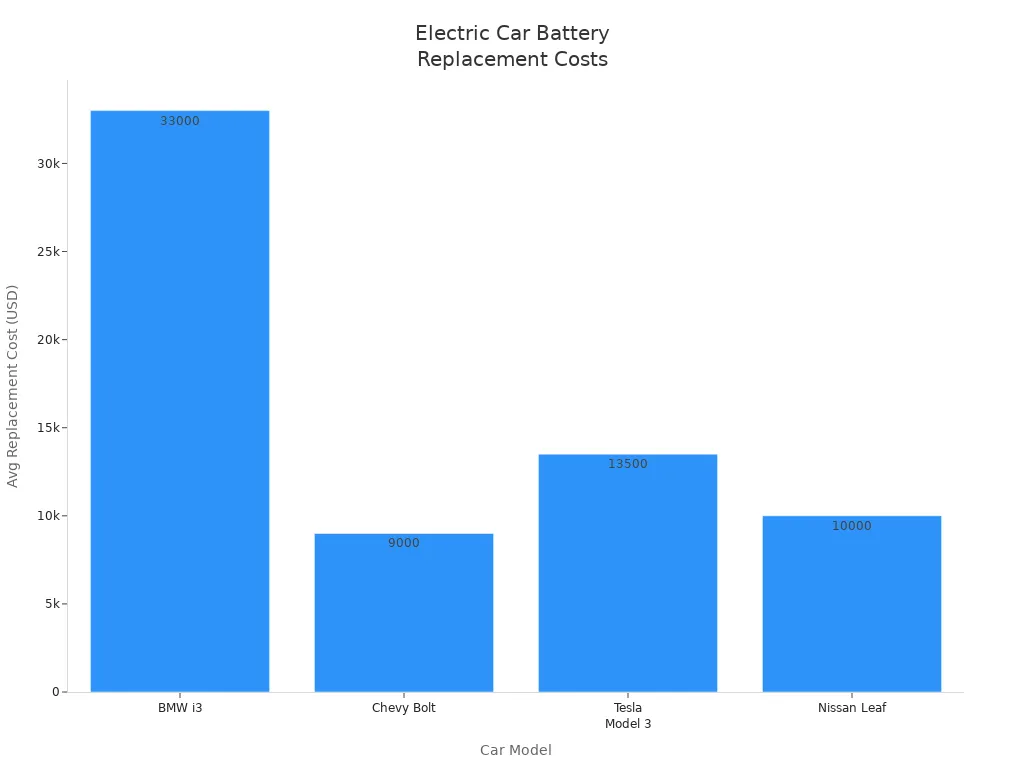
If you need a new battery, you may wonder about the price. The cost depends on your car model. Here is a look at average replacement prices:
Model | Average Battery Replacement Cost | Notes |
|---|---|---|
BMW i3 | $33,000+ (quoted by BMW) | Battery pack available for $2,500 on eBay |
Chevy Bolt | $9,000 | More affordable compared to competitors |
Tesla Model 3 | $13,500 | Significant cost for early versions |
Nissan Leaf | Up to $10,000 | Varies by state |
Most electric car batteries have a warranty for at least 8 years or 100,000 miles. If your battery drops below 70% power during this time, the company will usually replace it. Some brands use 65% or 75% as the limit, so check your warranty.
When a battery is not strong enough for driving, it can still be useful. Many old batteries get used for other things. Here are some ways people reuse them:
Store energy from solar panels at home
Help buildings save power with energy storage
Store energy at charging stations for busy times
Support the grid to keep power steady
Give backup power to homes and businesses
Even after years, these batteries can keep about 70% of their power. Recycling is important too. Companies use special ways to get back materials like lithium, nickel, and cobalt. This helps the environment and lowers costs for new batteries.
You can count on your electric car battery to last 12 to 15 years. Most people only lose about 2 to 3% of power each year. Things like weather and how you charge your car are important. Try to park in the shade when it is sunny. Keep your battery charged between 20% and 80% if you can. Most batteries stay strong for a long time. Just look at this table:
Model | Battery Capacity Retained |
|---|---|
Kia EV6 | 90%+ |
Tesla Model Y | 90%+ |
General EVs | 80–90% |
Car makers are always working to make batteries better. New things like special coatings and wireless checks help batteries last longer. If you use smart habits, your electric car battery will last many years!
You might notice your car does not go as far on a charge. Charging could take longer. You may see warning lights. If you spot these signs, check with your dealer.
Usually, you cannot replace a single cell. Most shops swap out the whole battery pack. This keeps your car safe and working well.
Fast charging does not ruin your battery, but using it all the time can speed up wear. Try to use regular charging at home when you can. Save fast charging for road trips.
Old batteries get a second life as energy storage.
Many get recycled for valuable materials.
Some help power homes or businesses.
♻️ This helps the environment and cuts waste.


