
Views: 0 Author: Site Editor Publish Time: 2026-07-31 Origin: Site


You have moved past casual research. You are now actively evaluating machinery for your farm. This purchase represents a massive capital investment. It directly dictates your operational efficiency and long-term profitability. How do you align equipment capabilities with daily operational demands without overspending? Buying the wrong machine leads to wasted capital or frustrating inefficiency. Undersized machines struggle constantly. Oversized machines drain budgets needlessly.
This guide focuses strictly on matching farm acreage to horsepower. We will dissect critical specifications and outline realistic price tiers. You will learn exactly how to evaluate your next heavy purchase. By understanding the mechanical realities behind the marketing brochures, you can make a highly informed, confident decision.
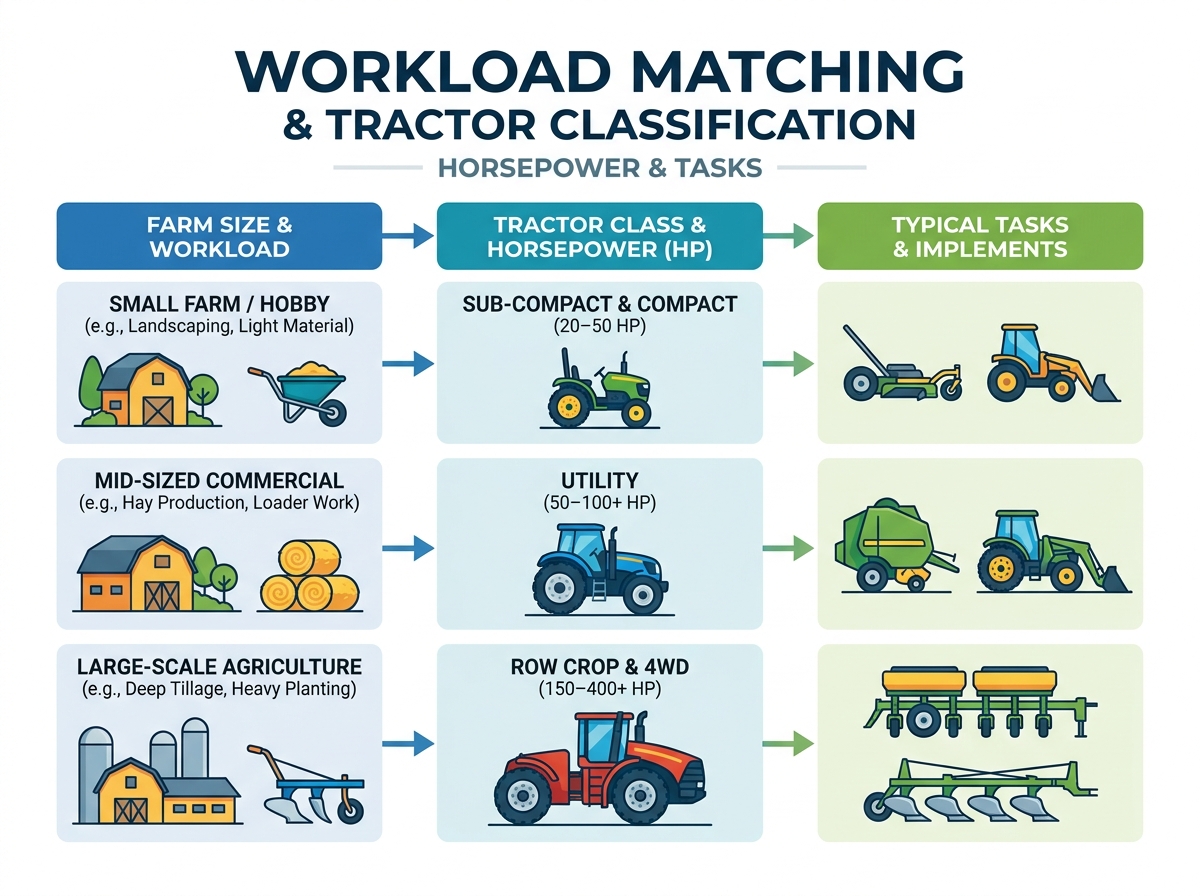
Every farm demands specific operational capabilities. You must define daily tasks clearly before shopping. Do you plan on tilling soil, baling hay, or moving heavy material? Choosing the proper size ensures maximum efficiency. You avoid paying for unused horsepower. Different applications require vastly different mechanical footprints.
These machines excel at small property management. They handle hobby farming, landscaping, and light material handling beautifully. Operators love their nimble maneuverability in extremely tight spaces. They fit perfectly inside standard residential garages. However, severe physical limitations exist. They offer significantly lower ground clearance. Implement capacity remains restricted by lightweight frames. Heavy soil tillage will stall these smaller engines quickly. A compact tractor serves best as a versatile utility machine. It rarely functions well as a primary crop-production tool.
Mid-sized commercial operations rely heavily on this workhorse tier. They easily manage intensive hay production. They handle heavy front-loader work effortlessly. Success depends on pulling wider, heavier implements. This reduces total field time dramatically. They offer superior stability for lifting heavy round bales. Ground clearance improves significantly over compact models. You can navigate deeply rutted fields safely. Farmers often use them for spraying, planting, and feeding livestock daily.
Large-scale commercial agriculture requires massive, unrelenting power. These imposing units handle deep tillage easily. They pull massive, multi-row planters across vast acreage. Implementation realities require careful logistical planning. You need significant, specialized storage space. Advanced maintenance protocols become strictly mandatory. Operating these expensive machines requires highly trained personnel. The tire configurations allow them to straddle crop rows without damaging plants. They represent the pinnacle of agricultural engineering.
Marketing brochures often highlight flashy features and paint colors. You must look far beyond them. Understand how specific mechanical metrics translate directly to field performance.
Evaluating specifications dictates true capability. High engine horsepower means little without proper hydraulic flow. You must match the machine perfectly to your heaviest implement. Buyers often buy too much engine and too little hydraulic capacity. This mistake causes severe operational delays later.
Engine horsepower differs significantly from PTO horsepower. PTO HP typically measures 15 to 20 percent lower than engine HP. Parasitic mechanical losses through the transmission cause this measurable drop. However, PTO HP remains the true, vital metric for field work. It dictates your ability to run balers, mowers, and rotary tillers safely. Always verify the PTO rating before purchasing any power-driven implement.
Assess the gallons per minute (GPM) metric very carefully. Higher GPM guarantees highly responsive loader work. Complex implements demand strong, continuous hydraulic flow to function properly. Slow hydraulics will deeply frustrate any operator during repetitive material handling tasks. A machine might lift a heavy load successfully, but low GPM makes it lift excruciatingly slowly. You must also evaluate the number of rear remote valves available. Extra remotes allow you to operate hydraulic top links or complex folding implements easily.
Hydrostatic (HST): This modern system uses hydraulic fluid to transfer power seamlessly. It shines during loader work and frequent directional changes. Operators enjoy much higher ease of use. You simply press a forward or reverse pedal to move. It behaves much like an automatic car transmission.
Gear-Drive/Shuttle Shift: This traditional type provides superior mechanical power transfer. It excels during heavy, continuous ground-engaging field work like plowing. It offers a slightly lower initial cost. However, it presents a much steeper learning curve for novice operators. You must manually select gears based on desired ground speed and engine RPM.
Verify both front-loader and 3-point hitch lift capacities independently. Ensure strict compatibility with existing or planned attachments. A front loader might reach high, but what can it actually lift safely at the pivot pin? Manufacturers rate these capacities differently. Always check the specifications measured at the actual lift pins.
| Category | Engine HP | Typical PTO HP | Hydraulic Flow (GPM) | Primary Application |
|---|---|---|---|---|
| Sub-Compact | 20-25 | 15-20 | 4-6 | Mowing, Light Landscaping |
| Compact | 25-50 | 20-42 | 7-12 | Hobby Farming, Material Handling |
| Utility | 50-100+ | 42-85+ | 13-20+ | Hay Production, Heavy Loader Work |
| Row Crop | 150-400+ | 120-350+ | 30-80+ | Deep Tillage, Large Planters |
Pricing varies wildly based on brand, geographic region, and included technology. Let us transparently break down expected base costs. These estimates exclude all attachments and implements.
Compact Tier: Expect to spend between $15,000 and $35,000. These units cover essential property maintenance perfectly.
Utility Tier: Prices range widely from $40,000 to $90,000. These machines form the resilient backbone of mid-sized farms.
High-Horsepower/Row Crop: Budgets stretch drastically from $150,000 to well over $500,000. These represent massive industrial investments.
A bare tractor performs zero actual work. You must budget an additional 20 to 30 percent on top of the base price. This essential buffer covers critical loaders, mowers, and backhoes. Buying attachments concurrently often secures much better bundle pricing from dealers. Never exhaust your entire budget on the bare machine.
Modern diesel engines operate under extremely strict federal regulations. Units over 25 HP require complex Tier 4 emissions equipment. This includes Diesel Particulate Filters (DPF) and Diesel Exhaust Fluid (DEF) systems. These sophisticated components add significantly to the initial purchase price. They also introduce mandatory long-term maintenance routines. You must perform regular DPF regeneration cycles. Ignoring these cycles causes severe engine de-rating and costly repairs.
All agricultural machinery depreciates rapidly upon delivery. However, premium legacy brands hold their value much longer. This retained value mitigates long-term capital loss significantly. Strong resale value remains absolutely critical if you plan to upgrade machinery in five years. Well-maintained units often command premium prices on the secondary market.
Deciding between new and used models heavily impacts your available capital. Both purchasing avenues present distinct financial profiles and inherent mechanical risks.
Buying fresh machinery right off the dealer lot delivers profound peace of mind.
The sprawling used market offers substantial savings for savvy, mechanically inclined buyers.
Follow these essential steps when inspecting used machinery:
Assumption check: Many novice buyers assume an older model automatically saves money. A "cheap" used machine with a failing transmission quickly eclipses the cost of a brand-new model. Replacement parts and professional labor rates climb rapidly every single year.
The global marketplace offers dozens of capable manufacturers. Choosing the right brand involves much more than just reading mechanical specifications.
Buyers typically differentiate between two main equipment categories. Tier 1 legacy brands include industry giants like John Deere and Kubota. Value-oriented brands feature names like Mahindra and Kioti. Tier 1 brands offer expansive global dealer networks and very high resale value. Value brands often provide heavy, highly durable frames and very competitive pricing.
Deep brand loyalty means absolutely nothing if your equipment breaks down during harvest. We constantly emphasize dealer proximity over brand color. The best tractor brand is often simply the one with a reputable, well-stocked dealership located within 50 miles. Extended downtime during a critical harvest window costs significantly more than saving five percent on the initial purchase price.
Base your final brand choice on a strict matrix of practical, local factors.
A physical test drive reveals dangerous visibility blind spots instantly. It also highlights control placement comfort. You will spend hundreds of hours sitting in this seat. Ergonomics matter immensely to your daily physical health. Reaching awkwardly for a loader joystick causes severe shoulder fatigue over a long workday.
Purchasing farm machinery requires diligent, focused preparation. Size the machine strictly to your heaviest required implement. Match the mechanical specifications perfectly to your farm's primary daily tasks. Always prioritize responsive local dealer support over generic brand prestige.
Your next step involves immediate, calculated action. List your top three necessary attachments. Define your absolute budget ceiling clearly. Schedule detailed on-site demonstrations with two competing local dealerships. This highly disciplined approach ensures you secure optimal equipment for your unique acreage.
A: A gas engine generally lasts fewer hours than a diesel engine. Well-maintained diesel models can exceed 4,000 to 5,000 hours easily. If service records show regular oil and filter changes, a 2,000-hour diesel model still possesses extensive operational life. Always verify the hour meter against the physical wear on pedals, steering wheels, and seats.
A: Cabs offer superior operator comfort. They provide essential climate control and crucial protection against dust or agricultural chemicals. However, they cost significantly more upfront. Open-station (ROPS) models offer much better ambient visibility. They also fit easily under low barn doors or tight orchard branches. Choose strictly based on your local climate and specific clearance constraints.
A: Most agricultural implements utilize highly standardized physical connections. The industry standardizes 3-point hitch categories and PTO splines globally. A Category 1 hitch fits any brand's Category 1 implement perfectly. However, you must warn operators about potential hydraulic flow mismatches. Always verify your machine provides enough GPM to operate complex hydraulic motors on newer implements.
A: Manufacturer subsidized financing often features excellent zero percent APR promotions. This allows you to preserve precious cash capital for operational expenses like seed or fertilizer. Paying cash avoids stressful monthly obligations entirely. Furthermore, financing or purchasing outright can trigger beneficial tax implications like Section 179 deductions. Consult your accountant to determine which strategy best supports your farm.


