
Views: 0 Author: Site Editor Publish Time: 2026-10-31 Origin: Site


The appeal of a mini electric car is undeniable today. These vehicles beautifully blend iconic, go-kart driving dynamics with zero-emission city mobility. They turn mundane grocery runs into genuinely fun experiences. However, modern buyers face a challenging dilemma. You likely want a compact footprint and a premium cabin feel. Yet, you must balance these desires against strict practical limits. Real-world range, cargo volume, and initial pricing often complicate your final choice.
Our objective below is straightforward. We provide a hype-free, evidence-based evaluation framework. You will learn how to choose the exact model, trim, or generation fitting your lifestyle. Some drivers need an efficient daily commuter. Others seek a fun secondary vehicle for a multi-EV household. We will guide you through the noise. You will walk away ready to confidently purchase the perfect compact electric vehicle.
You must evaluate your daily mileage realities honestly. A smaller battery pack reduces overall vehicle weight. Lighter chassis setups maximize efficiency in dense urban traffic. They also improve cornering agility immensely. However, this same lightweight approach becomes a liability on open highways. Frequent interstate travel demands larger battery reserves. High speeds drain compact EV batteries rapidly. You will experience range anxiety if your commute involves long freeway stretches.
Assess the specific role of the vehicle. Consider the "all-EV family" dynamic carefully. Perhaps you already own a long-range electric vehicle. You might use a Tesla or Rivian for your family road trips. In this scenario, supplementing your garage makes perfect sense. A highly maneuverable mini electric car often becomes the optimal choice. It handles local errands perfectly. You also gain unmatched parking convenience in crowded areas.
Map out your charging infrastructure readiness beforehand. You absolutely need reliable Level 2 home charging. Alternatively, you must secure guaranteed workplace charging access. Vehicles utilizing smaller battery capacities require frequent top-ups. Relying strictly on public fast chargers causes immense frustration over time. Home charging guarantees you start every single morning fully energized.
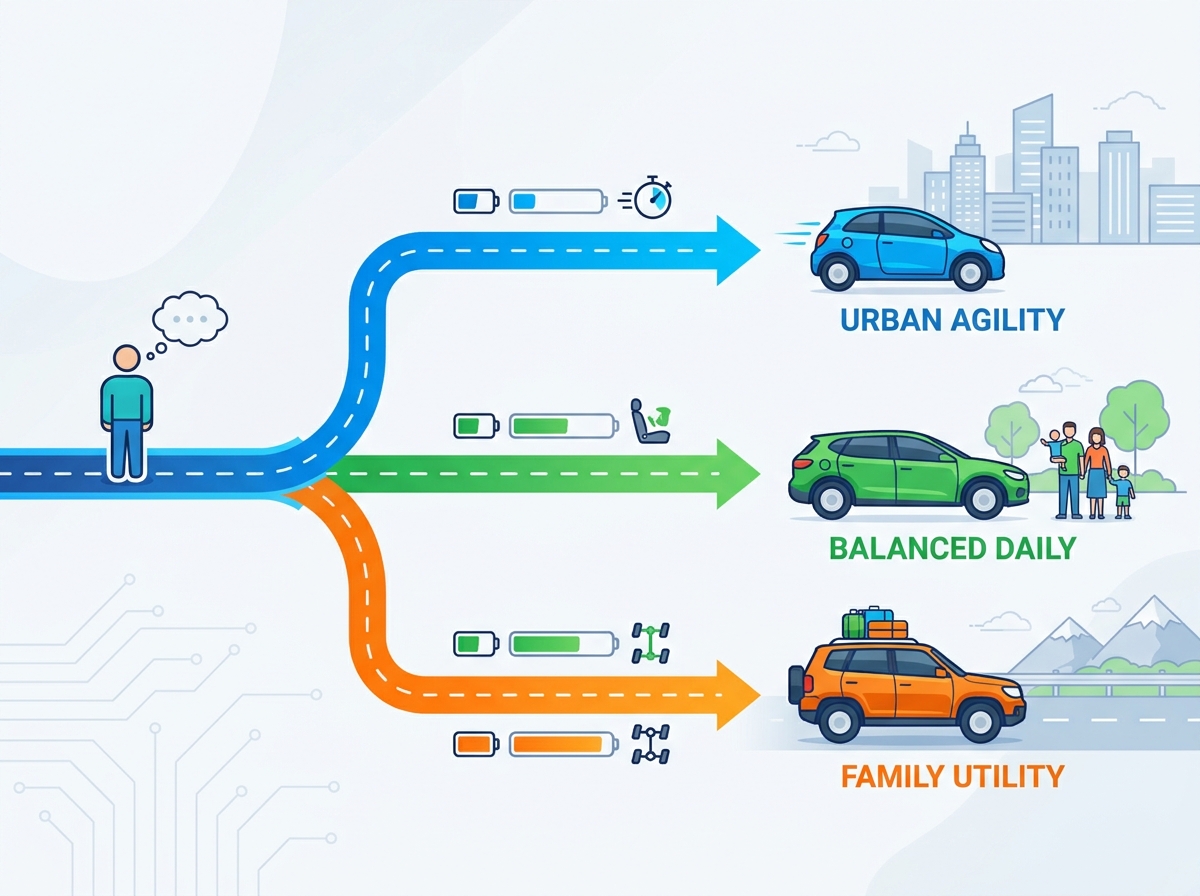
The market no longer offers just one shape. Manufacturers now provide diverse body styles tailored to specific buyer needs. Understanding these categories prevents expensive purchasing mistakes.
Modern iterations separate into distinct performance tiers. You often choose between a standard model and a performance-oriented variant. The entry-level option usually features a modest motor output and a smaller battery. It works beautifully for short hops. The upgraded variant offers roughly 218 horsepower and a larger 54.2 kWh battery pack. This category suits solo drivers and couples best. It heavily prioritizes pure driving dynamics over passenger comfort.
Crossovers evaluate the middle-ground approach successfully. They offer a slightly larger overall footprint. You gain 5-door accessibility. You also receive a modest range bump compared to the classic hatchback. This shape is ideal for urban families. You can access the rear seats easily for child seats. Surprisingly, you never sacrifice tight parallel parking abilities.
Some models shift entirely from "mini" to "compact utility" status. These vehicles typically feature dual-motor all-wheel drive. They provide maximum cargo volume for weekend trips. Their batteries support legitimate highway-capable ranges. This category serves as a fantastic primary household vehicle. It tackles harsher climates requiring AWD easily. It also meets standard luggage capacity needs.
Do not ignore the previous generation models. Buying a lightly used, older mini electric car is highly financially viable. You get a heavily discounted urban commuter. However, you must accept certain trade-offs. Older models feature legacy infotainment systems. They also deliver noticeably lower EPA range figures. If your commute spans just ten miles, these limitations hardly matter.
Electric Lineup Use Case Summary
| Vehicle Category | Primary Benefit | Ideal Use Case | Compromise |
|---|---|---|---|
| 3-Door Hatchback | Maximum agility | Solo city commuting | Minimal rear legroom |
| Urban Crossover | 5-door access | Small family errands | Modest range gains |
| Compact SUV | AWD and cargo space | Primary household car | Larger parking footprint |
Looking past the marketing materials is essential. You need to dissect the actual hardware and software capabilities. Evaluating these three dimensions ensures long-term vehicle satisfaction.
Official EPA and WLTP estimates often mislead new buyers. You must deconstruct these numbers realistically. WLTP figures skew heavily toward slow, urban driving cycles. EPA figures include more highway testing, but they still represent ideal conditions. Provide yourself a conservative calculation. You should factor in 70 mph highway speeds. You must account for heavy HVAC usage during summer. Finally, anticipate a 20% to 30% range drop during winter temperatures. A car boasting 150 miles might only deliver 100 miles on a snowy freeway.
Compare literal cubic volume before signing any paperwork. Battery placement dictates interior space heavily. Converted internal combustion platforms often place batteries awkwardly. This sacrifices rear legroom and raises the cabin floor. Dedicated EV platforms push the wheels out to the corners. They embed the battery flat inside the floorboard. This approach maximizes rear passenger comfort. It also provides a much deeper trunk space for groceries.
Compare trim levels meticulously. Manufacturers bundle various advanced driver assistance systems (ADAS) differently. You should identify which upgrades actually improve your daily routine. Surround-view parking cameras provide immense value in the city. High-resolution head-up displays keep your eyes on the road. Conversely, automated lane-change features might just inflate the sticker price unnecessarily. Stick to the tech upgrades solving your specific driving pain points.
You might wonder why buyers choose premium compacts over budget-friendly alternatives. The answer lies in the fundamental design philosophy. We focus here on the qualitative driving experience.
Spec sheets do not tell the whole story. You could easily buy a cheaper, higher-range alternative like a Nissan Leaf. However, driving enthusiasts crave specific mechanical feelings. Premium compact EVs focus heavily on chassis tuning. They deliver a satisfying steering weight. Their suspension setups manage body roll expertly through corners. They feel planted and engaging. Budget alternatives often feel numb and disconnected from the pavement.
Interior material quality separates these categories drastically. Premium brands utilize soft-touch plastics, metal switchgear, and vegan leather. They invest heavily in cabin noise insulation. You enjoy a surprisingly quiet ride even at highway speeds. You also pay for brand cachet and unique aesthetics. Economy urban EVs often suffer from excessive wind noise. They utilize harder, cheaper plastics to keep base prices low.
Purchasing this type of vehicle is rarely a strictly mathematical decision. You should not judge it purely on "cost per mile of range." If you do, standard economy EVs will always win. Instead, view it as a lifestyle and aesthetic choice. It combines premium materials with highly capable urban utility. You pay for the joy of ownership, not just basic transportation.
Adopting a compact EV requires slight lifestyle adjustments. Acknowledging these risks upfront prevents buyer remorse later.
Relying solely on DC Fast Charging is a mistake. Vehicles featuring smaller battery packs usually possess lower peak charging curves. They might max out at 75 kW or 95 kW. Furthermore, charging speeds throttle dramatically after reaching an 80% state of charge. This makes public charging stops feel lengthy and tedious. This bottleneck emphasizes why overnight L2 home charging remains absolutely critical to your satisfaction.
We must transparently address physical battery limitations. Lithium-ion batteries struggle in sub-zero temperatures. Cold weather increases internal cell resistance. It also forces the cabin heater to consume massive amounts of energy. Pre-conditioning becomes your best defense mechanism. You should heat the cabin while the car remains plugged into the wall. Additionally, seek out models equipped with efficient heat pumps. Heat pumps drastically reduce winter range loss.
Acknowledge the rapid evolution of EV technology. Engineers improve battery density and charging speeds every single year. This rapid progress heavily impacts depreciation curves. Current low-to-mid-range electric vehicles often lose value quickly on the used market. If you buy new, plan to keep the vehicle for several years. Alternatively, leasing shields you from this unpredictable depreciation.
You now possess a clear evaluation framework. The final step involves narrowing down your precise selection.
Do not simply drive around the block. Use this actionable checklist during your dealership visit to test critical EV features.
Always verify your local dealership stock before committing. Check exact trim availability online. Inventory fluctuates rapidly based on regional demand. Furthermore, research regional EV tax rebate eligibility thoroughly. Local municipalities often offer secondary rebates alongside federal programs. These incentives drastically improve the final financial equation.
The "best" vehicle is entirely dependent on your localized infrastructure. It also depends on your specific daily routine. A compact electric hatchback is brilliant for a city dweller. However, it might frustrate a rural commuter.
Compact EVs certainly require more deliberate trip planning than standard gas cars. Yet, they offer unparalleled urban convenience. They also provide incredible operating economy when matched to the correct driver profile. They make driving inherently fun again.
Take action today. Audit your actual weekly mileage using your smartphone's map history. Calculate your true driving needs objectively. Then, schedule a comprehensive test drive. You must experience these unique EV driving dynamics firsthand to truly understand their appeal.
A: A standard Level 1 wall outlet adds roughly 4 miles of range per hour. It takes over 24 hours for a full charge. A dedicated Level 2 home charger speeds this up drastically. It usually replenishes the battery from 0% to 100% in about 4.5 to 6 hours.
A: They are generally not recommended for frequent long road trips. Their smaller battery packs limit highway range. You will need to stop frequently for DC fast charging. These charging stops add significant travel time compared to gas cars or long-range EVs.
A: Modern battery thermal management systems prevent severe degradation. Most manufacturers offer an 8-year or 100,000-mile battery warranty. You can typically expect the battery to retain 80% to 85% of its original capacity after five to eight years of normal daily usage.
A: Eligibility fluctuates based on strict battery sourcing rules and final assembly locations. Many imported models currently do not qualify for federal purchase credits. However, leasing loopholes and regional state rebates often still apply. Always check current local guidelines before signing.


