
Views: 0 Author: Site Editor Publish Time: 2026-08-02 Origin: Site


Purchasing agricultural equipment represents a high-stakes capital expenditure for any modern farming operation. Choosing the wrong machine often leads to severe operational bottlenecks. It can cause excessive downtime or strand your valuable capital completely. Navigating complex horsepower ratings routinely confuses even experienced operators. Understanding implement compatibility metrics and sprawling dealer networks takes serious effort. You cannot rely solely on brand loyalty. Superficial specifications will jeopardize your entire harvest schedule.
You need a reliable, objective method to analyze your equipment options. We must match machine capabilities directly to your daily physical demands. This guide delivers a precise, specification-driven evaluation framework. We will help you assess agricultural machinery effectively. You will learn to align essential operational limits directly to specific farm requirements. Our goal is to ensure you select the perfect tractor for maximum daily productivity.
Always evaluate your physical operating environment first. Start by mapping out your total workable acres. You must analyze the local soil type carefully. Heavy clay requires entirely different traction profiles than loose sandy loam. Terrain gradients directly dictate your drivetrain requirements. Steep hills demand a four-wheel-drive (4WD) front axle. Front-wheel assist provides essential braking power on downhill slopes. It prevents dangerous jackknifing when pulling heavy wagons.
You must also consider specific tire ballasting carefully. Liquid tire ballast lowers the center of gravity effectively. It significantly improves overall hillside stability. Cast iron wheel weights offer another excellent ballasting option. You must also account for rigid spatial restrictions across your property. Measure your barn door heights closely. Ensure adequate Roll-Over Protective Structure (ROPS) clearance. Measure your existing gate widths accurately. Note any tight turning radius limitations. Orchards and narrow pastures leave little room for error. A massive machine becomes useless if it cannot physically enter your field safely.
You must map the machine directly to the task. Differentiate clearly between ground-engaging tasks and basic material handling. Plowing and tilling demand heavy chassis weight for traction. Front-end loader work requires agile hydraulics and a reinforced front axle. Power Take-Off (PTO) tasks include mowing and baling. These require sustained rotational power output.
E-E-A-T Tip: Always size your equipment for the most demanding recurring task. Do not fall into the trap of buying for a "once-a-year" job. You can easily contract out rare, heavy-duty land clearing jobs. This approach keeps your daily operating machinery lean and efficient. It prevents you from overcapitalizing on unused engine capacity.
These units excel on small hobby farms and commercial landscaping sites. They handle light material handling tasks brilliantly. Operators love their nimble maneuverability in tight spaces. However, they carry distinct physical limitations. Their lower chassis weight severely reduces traction. Heavy ground-engaging work will cause excessive wheel slip. Furthermore, they typically offer limited hydraulic flow rates. Do not expect them to power heavy-duty hydraulic motors continuously.
Utility models serve as the ultimate multi-purpose agricultural workhorses. They handle daily hay production easily. You can rely on them to pull heavier implements smoothly. A key feature is their standardized Category 2 rear hitches. They also provide robust rear hydraulic remotes. This makes them highly versatile for mid-sized commercial operations. They strike a perfect balance between robust power and physical footprint.
These massive machines are built strictly for commercial-scale farming operations. They dominate large-scale planting and heavy tillage tasks. Operators can cover massive acreage quickly and efficiently. However, they require a staggering capital investment. They also demand strict adherence to maintenance protocols. You must manage Tier 4 emissions systems diligently. This includes handling Diesel Exhaust Fluid (DEF) constantly. Proper maintenance is entirely non-negotiable for these industrial giants.
| Equipment Category | Horsepower Range | Primary Applications | Key Limitations |
|---|---|---|---|
| Sub-Compact / Compact | 20 – 60 HP | Landscaping, light loader work, estate mowing | Low chassis weight limits traction; low GPM flow. |
| Utility | 60 – 100+ HP | Hay production, pulling medium implements, feeding livestock | Too large for tight barns; lacks heavy draft capacity. |
| Row Crop / Articulated | 100 – 400+ HP | Commercial planting, deep tillage, heavy draft work | High initial cost; complex emissions maintenance required. |
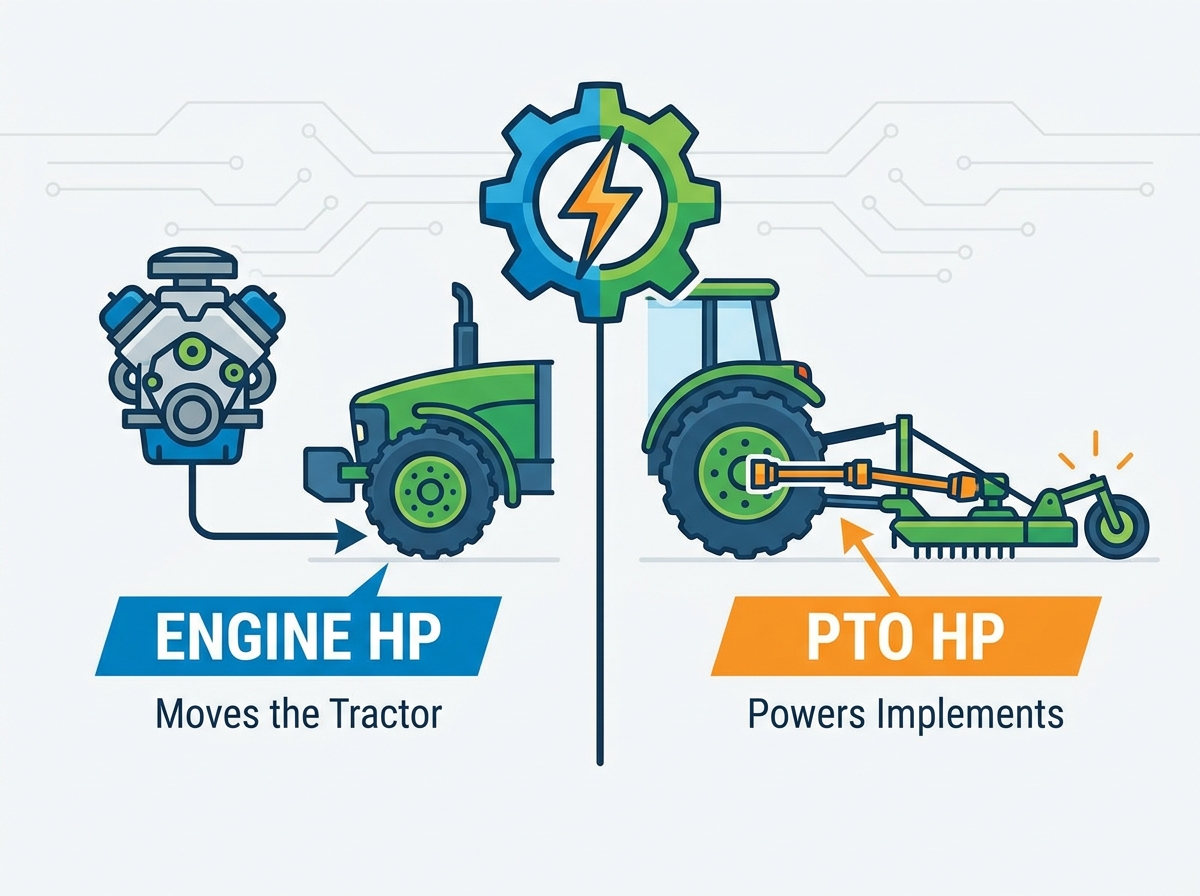
You must understand this critical distinction clearly. Engine horsepower simply moves the machine across the ground. PTO horsepower actually runs your attached implements. Power is inevitably lost through the internal transmission system. Therefore, PTO horsepower is always lower than engine horsepower. Buyers must check the implement manufacturer's minimum PTO requirement carefully. Never base your purchase on the engine horsepower alone. If your baler requires 60 PTO HP, a 65 Engine HP unit will likely fail. You need sufficient rotational force to prevent stalling under heavy crop loads.
Assess the hydraulic system's Gallons Per Minute (GPM) meticulously. High GPM is absolutely non-negotiable for running complex implements. It ensures highly responsive front-end loader cycle times. Low flow rates result in sluggish, frustrating loader operation. Next, you must verify the 3-point hitch lift capacity accurately. Always check the capacity measured at exactly 24 inches behind the lift pins. This represents the true industry standard measurement defined by agricultural engineers. Do not rely on the measurement taken directly at the pin. The 24-inch metric reflects real-world implement leverage far more accurately.
Your chosen transmission type drastically affects daily operational efficiency. Hydrostatic (HST) transmissions offer infinite speed control smoothly. They use specialized hydraulic fluid to transfer power efficiently. They are absolutely ideal for intensive loader work. However, they sacrifice some raw pulling power to the ground.
Gear or Collar Shift transmissions maximize raw power transfer perfectly. They are best suited for sustained draft work like plowing. They also deliver superior fuel efficiency during long field days.
Power Shuttle transmissions offer an excellent middle ground. They allow seamless, clutchless forward and reverse direction changes. Operators find them highly popular for varied utility tasks. They bridge the gap between heavy pulling and repetitive loading.
Deciding between new and used models shapes your entire sourcing strategy. New equipment comes directly with comprehensive factory warranties. They feature modern emissions compliance systems standard. This can be a pro or con depending on your shop's capabilities. Dealers also offer highly attractive financing packages on new units. You get peace of mind knowing the machine is perfectly pristine.
Used equipment offers a significantly lower initial depreciation curve. However, buying used requires a rigorous mechanical inspection process. You must verify hydraulic hours carefully. Check the drivetrain for excessive clutch wear. Scrutinize the previous owner's daily service logs meticulously. Always avoid models relying on obsolete or discontinued replacement parts. A cheap used tractor becomes entirely worthless if you cannot source basic filters.
E-E-A-T Tip: Your chosen dealer network is arguably your most vital operational partner. The best engineered equipment on paper quickly becomes a severe liability. It is useless if the nearest authorized service technician sits three hours away.
You must evaluate the dealer's local parts inventory closely. Ask them directly about their average service lead times during peak harvest. Check if they offer robust on-farm repair capabilities regularly. Mobile service trucks save you the immense hassle of hauling broken equipment. Prioritize strong local dealer support over a slightly cheaper upfront price tag. Reliable aftermarket support determines your long-term success entirely.
Use this systematic framework to finalize your equipment decision confidently. Skipping these steps often results in expensive buyer's remorse.
Choosing the ideal agricultural equipment requires careful, objective balancing. You must weigh raw technical specifications against long-term operational supportability. Every farm presents uniquely distinct physical and mechanical demands. Remember, over-buying needlessly traps your valuable operating capital. Conversely, under-buying places dangerous mechanical stress on both the machine and the operator. Take the necessary time to evaluate your real daily needs accurately. We highly encourage you to inventory your current implements immediately. Calculate your absolute minimum PTO horsepower requirements before ever visiting a local dealership. This thorough preparation guarantees you will drive away equipped for absolute success.
A: Engine horsepower simply measures the power generated at the engine crankshaft. It moves the vehicle itself. PTO (Power Take-Off) horsepower measures the actual power available at the rear shaft to run your attachments. PTO HP is typically 10-15% lower than Engine HP due to power lost through the internal transmission.
A: Cabs offer superior climate control and operator comfort. They also provide excellent safety from flying debris, dust, and harsh chemicals. However, cabs add significant upfront cost to the machine. They also create height clearance issues in older barns or low-hanging orchards. Open-station models offer better visibility and lower costs.
A: Apply a simple baseline rule of thumb. Match the machine's Gallons Per Minute (GPM) to the most demanding hydraulic implement you plan to use. Ensure the system provides enough flow to run that implement simultaneously with basic steering and drive functions without stalling.
A: No. Compact models face strict physical limitations regardless of their horsepower. They utilize smaller Category 1 hitches that will not fit Category 2 farm implements. Furthermore, their lightweight chassis lacks the mass required to safely stabilize or pull heavy, full-size agricultural tools.


