
Views: 0 Author: Site Editor Publish Time: 2026-07-27 Origin: Site


Material handling currently stands at a massive transitional inflection point. Fleet managers and procurement directors face unprecedented pressure today. They must modernize their active fleets, reduce greenhouse gas emissions, and tightly control daily operating costs. The ongoing industrial debate between a New energy forklift truck—primarily powered by advanced lithium-ion batteries or hydrogen fuel cells—and traditional internal combustion forklifts is no longer simple. You cannot view this purely through the lens of environmental compliance. It has evolved into a core operational decision shaping warehouse agility.
We provide an objective, evidence-based evaluation framework below. You will discover exactly how to determine which powertrain best aligns with your specific facility infrastructure. We evaluate daily throughput demands alongside strict capital constraints. We will give you the practical insights necessary to make a highly informed equipment choice.
Traditional internal combustion mechanics rely heavily on fossil fuels. These aging machines utilize highly complex mechanical drivetrains. You will find massive radiators, mechanical alternators, and heavy transmissions inside them. The mechanics involve thousands of moving metal parts grinding together daily. They generate intense physical heat. They produce significant internal friction. This makes them highly vulnerable to aggressive wear-and-tear.
Mechanics must perform frequent preventative maintenance on diesel fleets. They must execute routine oil changes. They constantly replace dirty air filters and fuel lines. This physical downtime halts your daily productivity.
Contrast this directly against modern electric architectures. A New energy forklift truck fundamentally simplifies the entire propulsion system. It completely ditches the heavy engine block. Instead, it relies on three core electrical components. These include the battery pack, the electric drive motor, and the centralized electronic control system. They feature almost no moving mechanical parts.
The following chart illustrates the fundamental component differences between the two architectures.
| Component Category | Traditional IC Forklift | New Energy Architecture |
|---|---|---|
| Primary Power Source | Diesel, LPG, or Gasoline | Lithium-Ion or Hydrogen Fuel Cell |
| Drivetrain Complexity | High (Engine Block, Transmission) | Low (Electric Motor, Inverter) |
| Routine Servicing | Frequent oil changes, filter swaps | Visual inspections, basic software updates |
| Thermal Output | Intense heat generation | Minimal thermal footprint |
The Battery Management System acts as the absolute brain of the machine. It continuously monitors individual battery cell health. It dynamically prevents dangerous overcharging scenarios. It optimizes power output based on real-time load demands. It enables a crucial operational feature called regenerative braking. When you lift your foot off the accelerator, the motor reverses its electrical function. It instantly acts as an active generator. It captures forward kinetic energy. It sends this precise power delivery straight back into the battery pack. You recover lost energy effortlessly. This extends daily operational run times significantly.
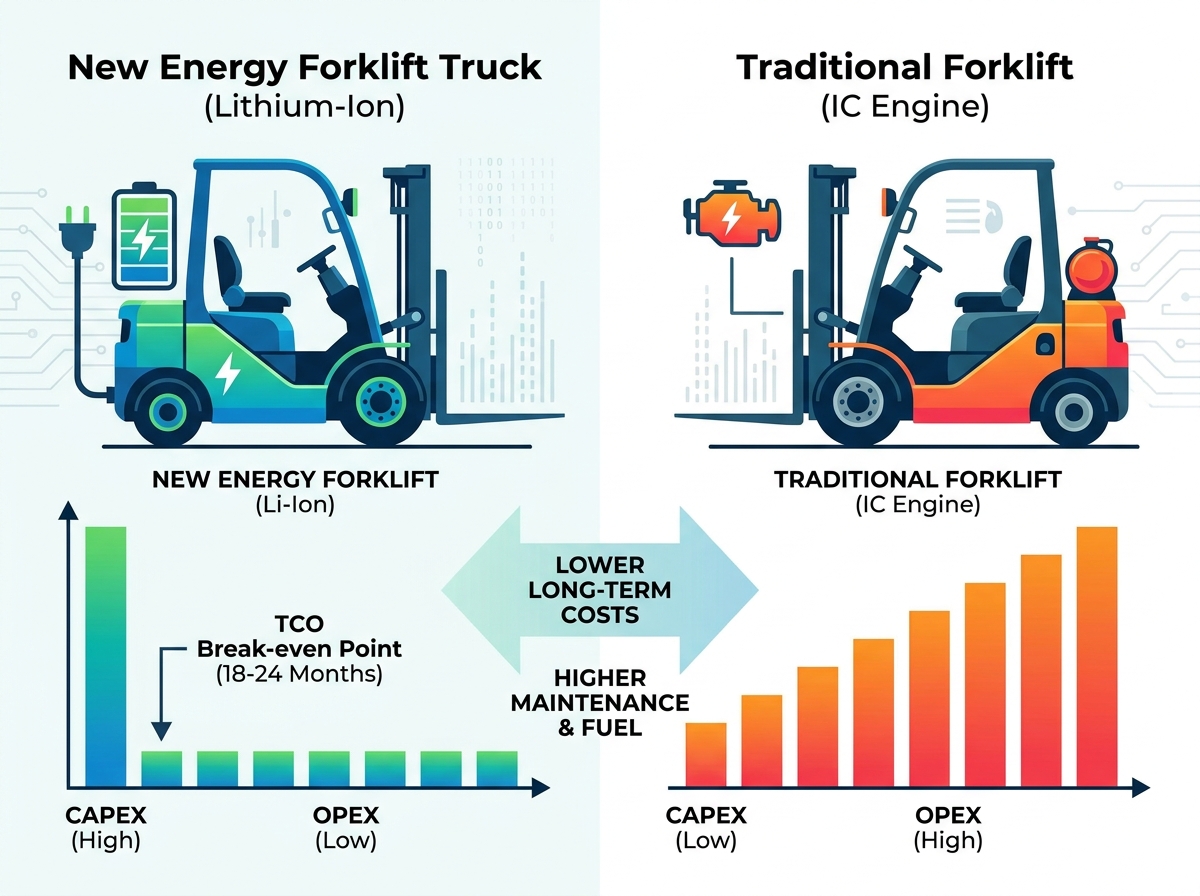
Acquiring a modern electric fleet requires deliberate financial planning. You must acknowledge the initial capital expenditure (CAPEX) realities immediately. A new electric model commands a noticeable price premium upfront. You typically pay 20% to 40% more compared to a traditional diesel or LPG equivalent. You are essentially pre-paying for years of future energy fuel.
However, your operating and energy costs (OPEX) drop rapidly over time. Electricity offers a highly stable, predictable per-hour energy cost. You completely escape the volatile, fluctuating prices of the global diesel and LPG markets. You completely eliminate on-site fuel storage infrastructure costs. You bypass expensive hazardous materials handling fees entirely.
Maintenance labor transforms completely under an electric model. Electric drivetrains eliminate massive mechanical maintenance burdens. You no longer buy bulk engine oil. You stop replacing fragile spark plugs. You forget about transmission fluid leaks completely. You eliminate fragile exhaust sensors from your inventory. We highly recommend calculating your reclaimed operational hours. Facilities previously lost hundreds of hours to routine internal combustion servicing. You now convert that lost downtime into active, revenue-generating material movement.
Where do these new battery models excel? Indoor warehousing and food-grade facilities absolutely demand them. They produce zero toxic tailpipe emissions. They operate at exceptionally low ambient noise levels. They represent mandatory equipment for unventilated warehouse spaces. Food and beverage processing plants require them to prevent product contamination. Pharmaceutical storage facilities enforce strict clean-air policies.
Multi-shift operations also thrive on these electric architectures. Opportunity charging changes the entire facility workflow. Operators simply plug the equipment in during short lunch breaks. They grab a quick 15-minute charge during shift handovers. This allows lithium-ion trucks to run continuously around the clock. You completely avoid tedious, dangerous battery swapping routines in the battery room.
Where do traditional engine models remain relevant? Extreme off-road environments often dictate internal combustion. Logging sites rely on heavy diesel power. Remote construction sites lack robust electrical grid infrastructure. Agricultural settings require instant refueling capabilities far from active power lines. Diesel heavily dominates these rough terrain applications.
Low-utilization fleets also favor traditional setups. Some facilities use a forklift for less than two hours daily. The high upfront electric premium makes less financial sense here. You simply cannot recoup the initial capital investment fast enough on such remarkably low operational hours.
Regulatory pressures continually reshape the global logistics landscape. Environmental, Social, and Governance (ESG) goals actively drive corporate purchasing decisions. Global agencies rapidly tighten indoor air quality regulations. OSHA actively enforces strict carbon footprint limits. They penalize excessive exhaust particulate emissions indoors. Electrifying your fleet proactively solves these tightening compliance headaches.
Ergonomics directly impact daily operator fatigue. A traditional diesel engine vibrates violently throughout the chassis. It produces massive, damaging decibel levels. It exhausts drivers physically long before their shift ends. Contrast this directly against an electric motor. It offers near-silent operation. It delivers a smooth, vibration-free ride across the warehouse floor. Operators experience drastically less physical fatigue. They maintain much higher concentration levels. This directly reduces dangerous warehouse accident rates.
Safety considerations also evolve rapidly during electrification. You completely eliminate pressurized LPG tank swaps. You remove dangerous, combustible fuel storage from your commercial property. However, you must transparently address new electrical safety protocols. High-voltage charging stations introduce different operational risks.
Facility electrical capacity remains the largest hidden adoption hurdle. You must evaluate your existing warehouse grid thoroughly. Can your older building support multi-truck fast charging? Many legacy facilities simply lack the required electrical amperage. Upgrading facility transformers often adds significant, unexpected capital costs. Pulling new heavy-duty wiring across a massive distribution center demands serious budget allocations.
Change management represents another significant hurdle. Drivers naturally resist sudden operational changes. They operate on a deeply ingrained run-to-empty mindset. They traditionally drive until the machine physically stops. You must abruptly shift them toward an opportunity-charging mindset. They must plug the machine in during every single scheduled break. Failure to train your staff on these new charging habits will drastically degrade battery performance.
Cold storage environments introduce complex degradation variables. Extreme freezing temperatures aggressively alter internal battery chemistry. They reduce lithium-ion discharge rates heavily compared to traditional fuels. You lose overall run time in a deep freeze environment. However, modern heated battery technology mitigates this hurdle brilliantly. Integrated thermal management systems keep internal cells consistently warm. They ensure optimal power delivery even in sub-zero freezer applications.
We must clearly acknowledge the final verdict. There is no universal better option. You only find the optimal fit for your specific operational parameters. However, the global industry trajectory heavily favors electric integration. It offers unmatched long-term operational efficiency. It easily satisfies strict regulatory compliance laws governing indoor air quality.
Use a straightforward shortlisting logic for your next procurement cycle. Are you operating indoors primarily? Do you run intensive multi-shift operations? Do you possess adequate electrical grid infrastructure? If you answer yes, electric models represent your definitive choice. Are you operating entirely off-grid? Do you have very low daily utilization rates? If so, traditional internal combustion remains highly viable.
Take immediate action today. Request a comprehensive site audit from an engineering team. Let industry experts conduct a thorough fleet electrification consultation. They will accurately forecast your specific financial returns. They ensure you make the most profitable, secure equipment decision possible.
A: Lithium-ion batteries typically offer impressive longevity. You can expect them to endure 3,000 to 5,000 full charging cycles before their maximum capacity drops below 80%. In a standard operational environment, this translates to roughly 7 to 10 years of reliable daily use. They vastly outlast older lead-acid alternatives.
A: Yes, modern electric models handle outdoor environments effectively. Manufacturers build them with high Ingress Protection (IP) ratings, such as IP54 or IP65. These fully sealed designs protect the motor and battery from heavy rain, dust, and mud. They confidently perform standard outdoor yarding tasks alongside traditional diesel models.
A: Swapping an LPG tank takes approximately five minutes. Electric opportunity charging requires a different operational habit. Instead of stopping to refuel, operators plug the machine in during natural downtime. A brief 15-minute break replenishes 20% to 30% of the battery. This seamless integration ultimately reduces dedicated maintenance downtime.


