
Views: 0 Author: Site Editor Publish Time: 2026-08-03 Origin: Site


Operating an Oil-electric hybrid presents a unique mechanical paradox. The internal combustion engine operates far less frequently than a traditional vehicle, yet it constantly faces harsh, intermittent cold-start cycles. Standard lubrication assumptions simply do not apply to these advanced drivetrains. The constant switching between electric propulsion and gasoline power prevents the engine from consistently reaching optimal operating temperatures. This frustrating dynamic ultimately accelerates specific types of internal component wear.
You need a highly targeted maintenance strategy to protect your investment. This guide provides a technical evaluation framework for selecting the exact right motor oil for your vehicle. We balance strict OEM compliance and long-term engine protection without falling for slick marketing hype. You will learn how to decode ultra-low viscosity grades, evaluate dispersive additive packages, and confidently schedule your fluid maintenance intervals for maximum engine reliability.
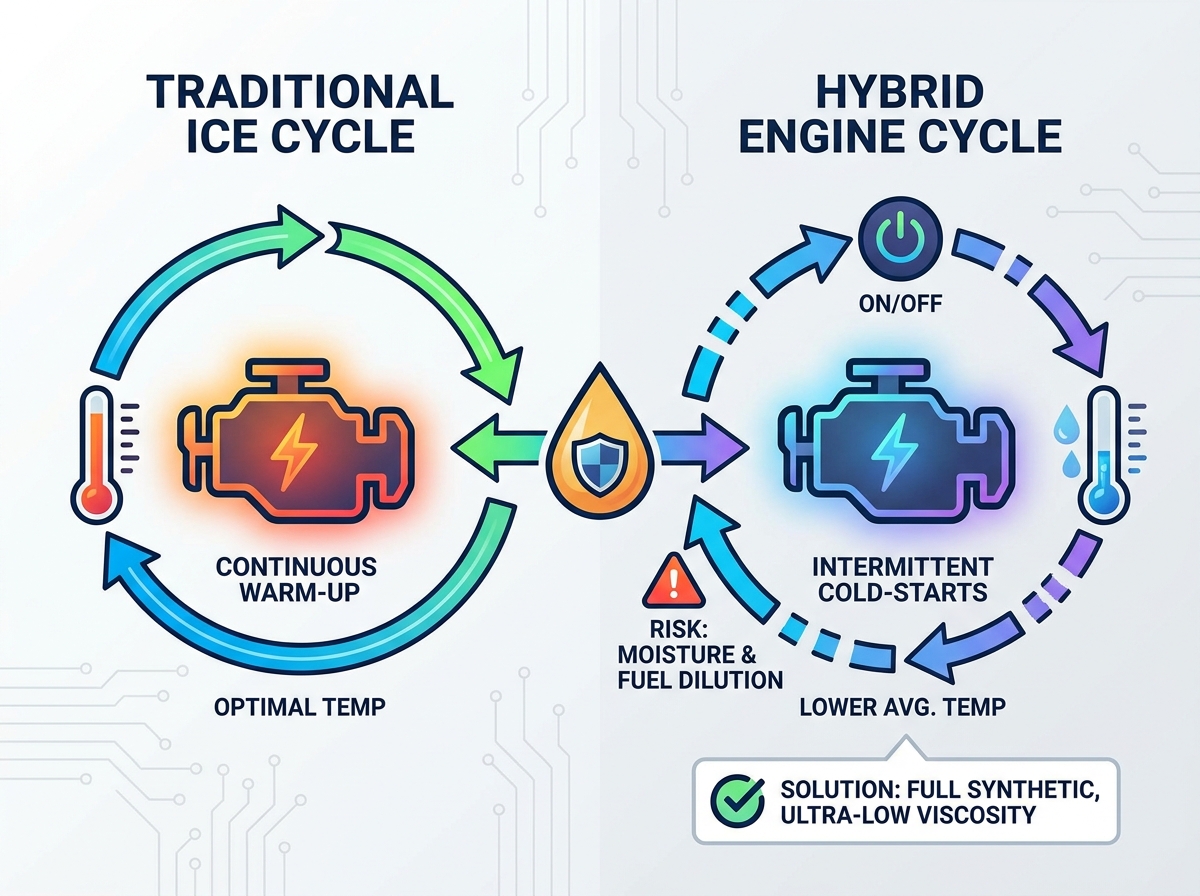
Traditional internal combustion engines start cold once in the morning. They quickly reach a steady operating temperature and stay warm. An oil-electric hybrid behaves entirely differently. The engine constantly turns on and off at traffic lights. It shuts down during highway coasting. Every time the engine reignites to assist the electric motor, it undergoes a perpetual "cold start." The oil pump stops when the engine stops. Gravity pulls the lubricant down into the oil pan. When the engine suddenly fires up, critical metal components momentarily lack a protective fluid barrier.
You must select oils engineered for rapid flow and superior surface adhesion.
Do not rely on marketing claims about "cold start protection." You should verify the oil's cold cranking simulator (CCS) viscosity numbers. Oil manufacturers publish these metrics in their technical data sheets. Lower CCS values indicate drastically superior pumpability at startup.
Thermal efficiency requires consistent, high heat. Internal combustion engines naturally evaporate internal condensation when they surpass 212°F (100°C). Hybrid engines frequently run well below this critical thermal threshold. Because the engine cycles on and off, it rarely gets hot enough to boil off accumulated water. Furthermore, cold combustion chambers prevent fuel from atomizing properly. Unburned gasoline washes past the piston rings. It mixes directly into the crankcase oil.
You must prioritize formulations designed specifically to combat severe fluid contamination.
Failing to account for fuel dilution leads to catastrophic consequences. Thin, diluted oil cannot maintain adequate film thickness. This directly causes premature timing chain stretching and camshaft wear. Used Oil Analysis (UOA) data frequently highlights this exact issue in hybrids.
| UOA Metric | Healthy Hybrid Oil Range | Warning Signs of Fuel Dilution |
|---|---|---|
| Fuel Percentage (%) | Under 1.5% | Above 2.5% (Requires immediate change) |
| Viscosity @ 100°C (cSt) | Stays within OEM grade limits | Drops by a full viscosity grade |
| Flash Point (°F) | Above 380°F | Drops below 350°F |
| Water Content (%) | 0.0% | Visible trace amounts or higher |
Heavy oils fundamentally resist rapid flow. They act like thick syrup inside a cold engine. Hybrid drivetrains demand instantaneous, unimpeded lubrication. The gasoline engine often engages abruptly at high highway speeds to assist the electric motor. Thick oil simply cannot reach the complex valvetrain fast enough during these high-RPM engagements.
The automotive industry currently uses 0W-20 as the standard baseline for hybrid vehicles. However, major manufacturers like Toyota and Honda increasingly mandate thinner fluids. Ultra-low viscosities like 0W-16 and even 0W-8 are becoming the new standard. These specialized fluids flow instantly upon engine engagement. They eliminate critical dry-running periods.
Many traditional mechanics mistakenly believe thicker oil automatically offers better wear protection. You must not second-guess OEM viscosity limits to "protect" your hybrid engine. Pouring thicker oil into a modern hybrid causes immediate mechanical disruptions.
Obsolete motor oil standards simply cannot protect modern hybrid drivetrains. Most modern hybrids utilize advanced Gasoline Direct Injection (GDI) technology. GDI engines are notoriously susceptible to Low-Speed Pre-Ignition (LSPI). This phenomenon causes premature, explosive fuel detonation inside the cylinders. LSPI easily shatters pistons and destroys engines.
You must verify the certification shields on the back of the oil bottle.
| Certification Standard | LSPI Prevention | Timing Chain Protection | Hybrid Suitability |
|---|---|---|---|
| API SN / ILSAC GF-5 (Older) | Weak | Minimal | Not Recommended |
| API SN Plus | Moderate | Minimal | Acceptable in older models |
| API SP / ILSAC GF-6 | Excellent | Mandatory testing passed | Highly Recommended |
Many boutique oil brands make incredible marketing claims regarding friction reduction. Yet, they sometimes lack formal API or ILSAC certification badges. If a boutique oil lacks official certification, it introduces a massive warranty risk. Dealerships will void engine claims if they discover uncertified lubricants. Always prioritize certified compliance over clever marketing claims.
When servicing an Oil-electric hybrid, you might wonder if specialized fluids are necessary. Lubricant manufacturers eagerly charge premium prices for bottles explicitly labeled "Hybrid." Is this extra cost genuinely justified, or is it just clever segmentation?
We must evaluate the specific chemical dimensions of these competing products.
You can easily narrow down your choices based on your specific driving habits. Choose the specialized "Hybrid" labeled oil if you operate your vehicle in extremely cold climates. You should also choose it if you primarily take short, low-speed city trips. Under these conditions, the engine rarely warms up. The extra moisture-fighting additives prove highly valuable.
Conversely, standard premium full synthetics are highly viable for high-mileage highway drivers. Long highway drives allow the hybrid engine to reach standard operating temperatures. This naturally burns off moisture, making specialized hybrid additives less critical.
Hybrid owners frequently misunderstand maintenance schedules. They assume the electric motor handles fifty percent of the driving load. Therefore, they mistakenly believe they can double the time between oil changes. They look at the odometer and assume the internal combustion engine is practically brand new.
This dangerous assumption leads to severe internal engine sludge. Oil degrades chronologically regardless of mileage. It continuously absorbs ambient moisture from the air. It suffers from relentless chemical oxidation. It succumbs to the fuel dilution we discussed earlier. This chemical degradation happens even if the gasoline engine barely runs during your daily commute.
You cannot rely solely on the vehicle odometer. You must strictly adhere to the OEM's time-based interval.
Following this strict chronological framework prevents un-evaporated moisture from turning into destructive acidic sludge.
Selecting the proper oil for a hybrid vehicle requires understanding its unique mechanical environment. This process is an exercise in managing harsh cold-start wear and preventing severe fluid contamination. It goes far beyond simply minimizing internal friction. The constant cycling of the engine demands ultra-responsive lubrication and robust additive packages capable of neutralizing moisture and fuel dilution.
To ensure maximum reliability and mechanical longevity, follow these actionable steps:
A: No. Conventional oils completely lack the advanced cold-flow properties required for hybrid engines. They also lack the additive stability needed to survive relentless start-stop engine cycles. A high-quality full synthetic oil is absolutely required to prevent premature wear.
A: Not necessarily. While hybrid-specific oils feature optimized additive packages for fighting moisture and smoothing cold starts, they are not mandatory. Any top-tier premium full synthetic meeting the correct API SP/ILSAC GF-6 standards and OEM viscosity will provide excellent protection.
A: The hybrid engine often shuts off before reaching optimal operating temperatures. Because the engine remains cold, small amounts of unburned liquid fuel easily slip past the piston rings. This fuel mixes directly into the oil, causing fuel dilution. Regular, time-based oil changes mitigate this risk.
A: Always follow your specific manufacturer's manual. Most OEMs typically recommend oil changes every 5,000 to 10,000 miles, or every 6 to 12 months. Do not ignore the time-based recommendation. Motor oil degrades from moisture absorption and oxidation even when the gasoline engine isn't running.


