
Views: 0 Author: Site Editor Publish Time: 2026-07-30 Origin: Site


Forget the outdated image of a simple farm vehicle slowly rolling through a dusty field. Today, a highly advanced tractor serves as a critical, multi-purpose industrial prime mover. Mis-specifying this powerful equipment carries severe operational risks. Choose the wrong machine, and you face wasted fuel, inadequate Power Take-Off (PTO) capacity, severe soil compaction, or costly non-compliance with strict emission standards. Selecting the right prime mover is no longer a simple guessing game. It requires a precise understanding of your exact operational needs.
In this guide, we will explore how to evaluate these machines based on their technical capabilities and application suitability. You will learn how to navigate complex engineering trade-offs and match implement requirements to machine specifications. We will help you ensure your procurement strategy aligns perfectly with your industrial goals.
Engineers define this machine specifically as a vehicle designed to deliver high tractive effort at slow speeds. Tractive effort refers to raw pulling torque. This torque allows the machine to pull heavy loads across uneven, unpaved terrain. However, modern operations require much more than raw pulling force. You need a mobile power station.
The real magic happens through the Power Take-Off (PTO) and hydraulic systems. The PTO is a spinning driveshaft at the rear or front of the machine. It takes energy directly from the engine and transfers it to attached implements. Hydraulics use pressurized fluid to lift, lower, and angle heavy attachments. These two systems completely transform the vehicle. They turn a simple towing machine into a versatile multi-tool.
This versatility directly drives business value. You invest in one primary mover. You then attach different implements for different jobs. You might use a loader bucket in the morning and a heavy rotary cutter in the afternoon. This modular approach maximizes equipment utilization. It prevents machines from sitting idle.
Manufacturers design specific machine configurations to achieve distinct operational outcomes. You must match the machine's architecture to your exact working environment.
Utility models dominate general landscaping, light agriculture, and estate management. They feature smaller footprints and tight turning radii. This makes them highly maneuverable in confined spaces. You will often see them working inside barns, maneuvering through narrow orchard rows, or navigating busy construction yards.
These models offer excellent fuel efficiency. They usually feature standard Category 1 three-point hitches. This standardization ensures compatibility across a vast range of aftermarket implements. Operators benefit from user-friendly controls, making these models accessible to newer staff members.
Large-scale commercial agriculture relies heavily on row-crop models. Operators use them for planting, chemical spraying, and harvesting. These machines feature tall tires and elevated chassis designs. The high clearance allows them to pass directly over growing crops without causing damage.
Engineers design them with adjustable tread widths. You can widen or narrow the wheels to match specific crop row spacing. These machines pack immense horsepower to pull multi-row implements. They also feature heavily integrated GPS and telematics systems. This technology enables centimeter-level precision farming.
Construction, mining, and forestry applications demand extreme durability. Industrial models abandon agricultural features in favor of pure structural strength. You will rarely find a standard agricultural three-point hitch here. Instead, these machines utilize heavy-duty industrial drawbars.
Manufacturers reinforce the chassis specifically to handle massive front-end loader stresses. The front axles feature heavy cast-iron construction. These machines withstand continuous impacts and abrasive environments. When you need to move tons of earth or tow heavy mining equipment, this tractor variant provides the necessary resilience.
High-tech commercial farming and repetitive industrial tasks now deploy autonomous machines. These units utilize LiDAR, radar, and complex software algorithms to navigate without a human operator. They excel at highly repetitive tasks like plowing massive fields or towing material carts across factory campuses.
The primary benefit is reduced labor dependency. They offer extreme precision and can operate safely around the clock. However, buyers must prepare for high initial capital expenditure. These systems also require robust software infrastructure and reliable wireless networks to function properly.
| Equipment Category | Ideal Environment | Core Attachment Strategy | Primary Business Benefit |
|---|---|---|---|
| Utility / Compact | Landscaping, Estates | Category 1 Three-Point Hitch | Maximum maneuverability |
| Row-Crop | Commercial Agriculture | Drawbar, High-Flow Hydraulics | Precision and crop protection |
| Industrial | Construction, Mining | Heavy Industrial Drawbar | Extreme structural durability |
| Autonomous | Repetitive Fieldwork | Digitally Integrated Implements | Labor reduction |
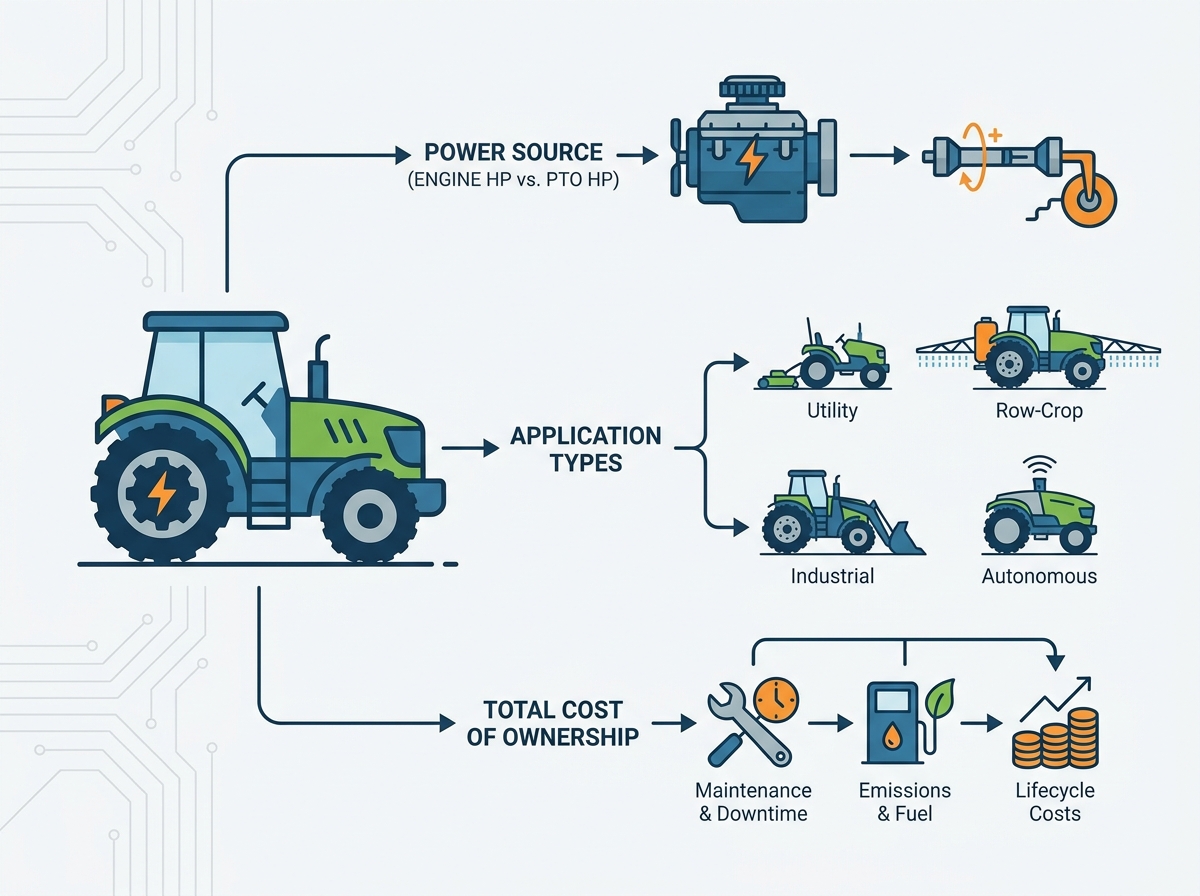
Buying the wrong equipment severely hinders your daily operations. You need a structured evaluation framework to objectively assess different models. Focus strictly on these technical specifications.
Procuring the machine is only the first step. You must prepare your organization for the realities of implementing modern heavy equipment. Modern machines operate more like rolling computers than traditional mechanical workhorses.
Maintenance downtime looks very different today. You can no longer fix every problem with a wrench and a grease gun. Advanced engines and electronic transmissions require specialized OEM diagnostic tools. When a sensor fails, the machine might throw an error code and enter "limp mode". Your maintenance team will likely need laptop-based diagnostic software to read and clear these codes. Establish a strong relationship with your dealer's service department to minimize this technical downtime.
Operator training demands significant attention. The learning curve for utilizing advanced telematics is steep. Modern implements often use ISOBUS connections. ISOBUS is a standardized digital communication protocol. It allows the tractor terminal to talk directly to the implement. Operators must learn how to navigate these touchscreen menus effectively. They cannot simply pull levers anymore. They must program flow rates and set precise drop depths.
Safety protocols also require rigorous training. You must enforce the use of Roll-Over Protection Structures (ROPS). Operators must wear their seatbelts at all times when the ROPS is deployed. If they fold the ROPS down to clear a low doorway, they must raise it immediately afterward. A machine is only as effective as the safety and competence of its operator.
You need a logical filter to narrow down your choices. Avoid walking onto a dealer lot without a clear, documented strategy. Follow these three sequential steps to guarantee successful procurement.
Selecting the right machine requires strict alignment between mechanical specifications and operational goals. You cannot rely on brand loyalty or raw engine horsepower alone. You must dissect your daily workflows, measure your site constraints, and prioritize PTO power over general engine metrics. Modern equipment acts as a modular power plant. Treat its procurement as a strategic engineering decision.
Your next step is to clearly document your heaviest implement requirements. Once you know your required hydraulic flow and PTO horsepower, consult with an application engineer. Request an on-site demonstration to test turning radii and operator visibility. Always review the detailed capacity sheets before signing any purchase agreements. Proper preparation ensures you acquire a machine capable of driving real industrial productivity.
A: Engine HP measures the raw power generated at the engine flywheel. PTO HP measures the actual power available at the Power Take-Off shaft to run implements. You lose power as it travels through the transmission and hydraulic pumps. Always use PTO HP to determine implement compatibility.
A: Base your choice on terrain and travel needs. Tracks spread the machine's weight, significantly reducing soil compaction and improving traction in wet, slippery conditions. Wheels are better if you require higher speeds, frequently drive on paved roads, or want lower maintenance costs.
A: ISOBUS is a standardized digital communication protocol for heavy equipment. It allows tractors and implements from different brands to communicate seamlessly. An ISOBUS-compatible machine provides plug-and-play functionality. You can control complex attachments using a single universal terminal inside the cab.
A: Regulatory compliance for autonomous machinery varies heavily by region. Most industrial sites require strict geofencing to keep the machine within defined boundaries. You also typically need human oversight, either on-site or remote, to intervene during emergencies. Always consult local occupational safety authorities before deploying autonomous units.


