
Views: 0 Author: Site Editor Publish Time: 2026-11-01 Origin: Site


Urban roads grow more congested every year. Drivers face mounting frustrations alongside unpredictable fuel costs. Enter the micro-EV. A mini electric car offers an enticing solution to city gridlock and expensive gas station visits. They slip into tiny parking spots effortlessly. They use energy highly efficiently. However, these compact vehicles demand specific lifestyle compromises. You cannot treat them exactly like standard passenger vehicles. They excel in narrow streets but struggle on long highway trips. We wrote this guide to provide an objective framework. You will learn how to evaluate these vehicles properly. Making an informed choice protects your wallet and your daily schedule. We will examine daily driving realities, charging access, and practical limitations. By the end, you will know if a tiny EV fits your life or if you need a different solution entirely.
Every successful vehicle purchase starts by establishing baseline criteria. Micro-EVs shine in highly predictable environments. They handle low-speed daily routes exceptionally well. If you drive under 40 miles round trip daily, a tiny EV fits perfectly. The average urban commute falls well within this range. Stop-and-go traffic actually benefits electric motors. Internal combustion engines waste fuel while idling. Electric motors consume almost zero energy while stopped at traffic lights. Regenerative braking captures energy usually lost during deceleration. This extends your driving range significantly. High-speed highway driving drains small batteries quickly. Therefore, city-dwellers reap the biggest rewards here.
Can this serve as your household's sole vehicle? Usually, the answer is no. A single-car household demands flexibility. You need cargo space for large grocery runs. You need highway range for weekend getaways. Imagine coordinating morning school runs and evening errands. If partners work across town, a single tiny vehicle creates logistical bottlenecks. A mini electric car struggles to meet these diverse demands. Instead, they function best as dedicated commuter supplements. Families often pair them alongside a larger gas or hybrid car. You drive the small EV to work daily. You save the larger vehicle for family trips. This dual-car strategy maximizes efficiency while maintaining lifestyle flexibility.
You must have reliable charging access. Level 1 (120V) or Level 2 (240V) charging at home or work is mandatory. Public fast-charging infrastructure rarely helps micro-EV owners. Small batteries usually have slower onboard acceptance rates. They cannot utilize high-speed public chargers effectively. You might spend hours waiting at a public station. Having a dedicated plug changes the experience completely. Treat your EV like a smartphone. You plug it in before going to sleep. You wake up to a full battery every morning. This convenience eliminates the need for public charging entirely.
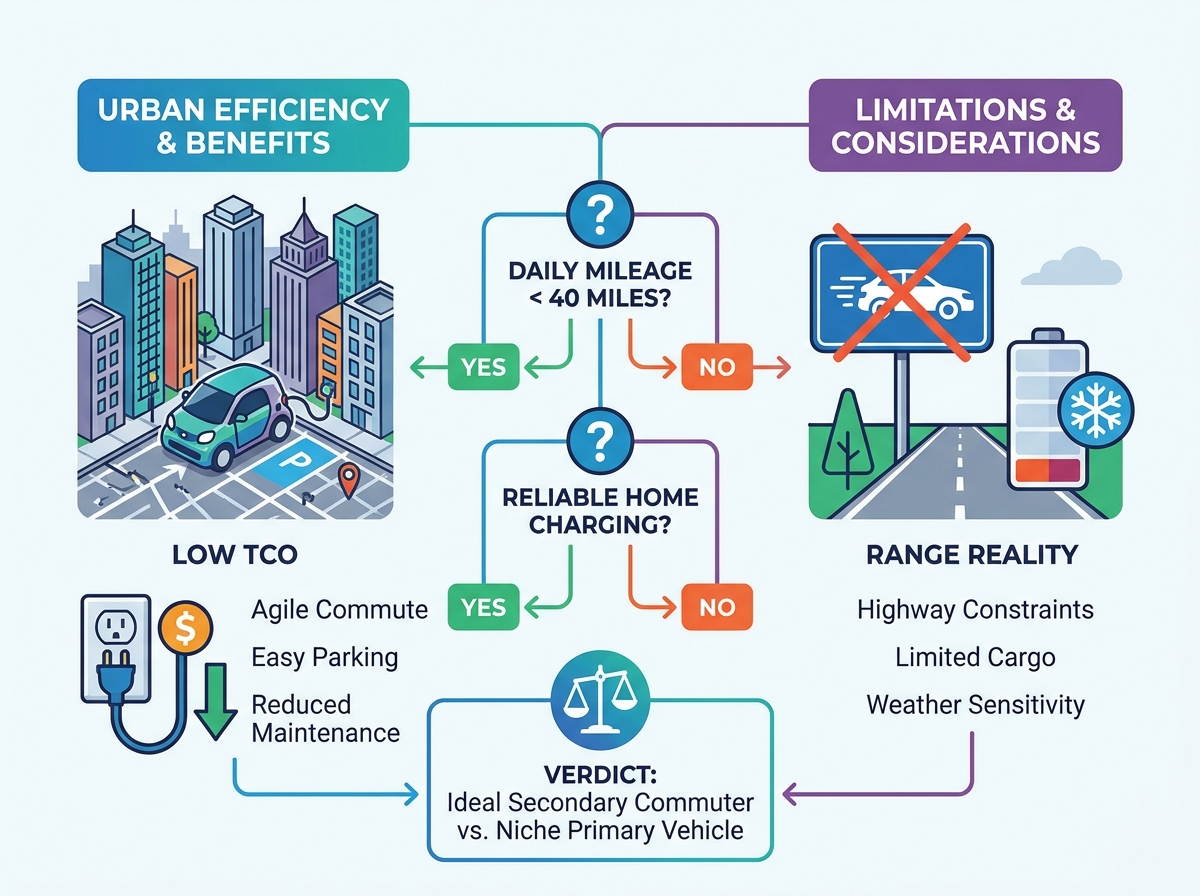
Buyers choose micro-EVs primarily for the financial benefits. These vehicles offer a much lower upfront MSRP. They cost a fraction of what mid-size EVs demand. Insurance premiums frequently drop as well. Repair costs stay manageable because replacement parts cost less. Maintenance expenses virtually disappear compared to traditional engines. You have fewer moving parts to service. Electric motors lack complex transmissions, exhaust systems, and timing belts. You bypass expensive mechanical failures entirely. You never buy oil changes or spark plugs. Even consumable items save you money. The smaller tires cost less to replace. Regenerative braking systems do most of the stopping. This saves your brake pads from rapid wear.
Weight dictates energy efficiency in electric vehicles. Heavy SUVs require massive batteries just to move their own bulk. A lightweight EV operates far more efficiently. A lower curb weight translates directly to higher miles-per-kWh. Your cost per mile drops significantly. Charging a small battery costs very little. You might spend only a few dollars to "fill up" completely. This energy economy makes daily commuting incredibly cheap. Over several years, these small daily savings compound into massive financial retention.
Automotive designers use micro-dimensions to create tangible urban advantages. Large SUVs struggle in high-density city environments. A small EV turns narrow streets into open playgrounds. Parallel parking becomes effortless. You can utilize "compact only" spaces easily. Some drivers even fit two small cars in a single driveway. Maneuverability gives you a distinct edge during rush hour. You can navigate tight alleys to bypass gridlock. The lack of size transforms from a limitation into your greatest leverage.
Urban Commuter vs. Highway Cruiser Characteristics
| Feature | Mini EV | Mid-Size EV |
|---|---|---|
| Ideal Environment | City streets, tight parking | Highways, long road trips |
| Energy Efficiency | High (4+ miles per kWh) | Moderate (2.5 - 3.5 miles per kWh) |
| Cold Weather Impact | High range degradation | Moderate range degradation |
| Maneuverability | Excellent | Average |
| Upfront Price | Very Low | High |
Advertised range and real-world performance often differ. EPA estimates represent ideal conditions. You rarely drive in perfect weather continuously. Small capacity batteries react dramatically to environmental changes. HVAC usage drains power rapidly. Running the heater in winter can slash your range severely. If a brochure claims 100 miles, expect 60 miles during a cold snap. Aerodynamic drag also increases exponentially at higher speeds. Driving 75 mph drains the battery significantly faster than driving 45 mph. Buyers must plan for this discrepancy. Never buy a micro-EV based strictly on its maximum advertised range. Always calculate your needs using the worst-case winter scenario.
Physical limitations become obvious at highway speeds. A short-wheelbase vehicle feels different at 70 mph. Lightweight cars struggle against crosswinds. Wind noise often penetrates the cabin noticeably. Stability decreases compared to mid-size sedans. Safety remains a common concern for potential buyers. Many micro-EVs lack the structural mass to absorb high-speed impacts effectively. Crash-test ratings often trail behind larger vehicles. They protect occupants well in low-speed urban collisions. However, they are simply not designed for aggressive highway environments.
Battery technology evolves rapidly. Early-generation, low-range EVs faced steep historical depreciation. A car offering only 60 miles of range ages quickly. Buyers want newer models featuring better battery chemistry. This creates a fluid and sometimes challenging resale market. You risk the technology aging out before you finish paying off the vehicle. We recommend evaluating your long-term plans carefully. Leasing might offer better protection against rapid depreciation. If you buy, plan to keep the car for a long time to extract maximum value.
How do you evaluate a small EV properly? Look beyond standard automotive metrics. Horsepower and top speed matter very little here. Focus heavily on Battery Thermal Management Systems (BTMS). Active liquid cooling matters more than sheer battery size. Liquid cooling preserves battery health over time. It ensures consistent performance during hot summers. Air-cooled batteries degrade faster. Early air-cooled models faced rapid battery degradation in hot climates. Modern active liquid systems circulate coolant around battery cells to maintain an optimal temperature window. They also charge faster when they get warm. Always verify if the vehicle utilizes active liquid cooling before purchasing.
Understand your vehicle's AC charging limit. Every EV has an onboard charger dictating how fast it accepts AC power. A 6.6 kW charger refills the battery slower than an 11 kW charger. This speed determines how quickly you recover range at home. Next, check if it supports DC Fast Charging (DCFC). Manufacturers frequently omit this feature in micro-EVs to save costs. If you never plan to leave your city, you might not need DCFC. If you want occasional regional flexibility, DCFC becomes essential.
Ignore unnecessary premium add-ons. Focus on evaluation criteria impacting daily driving directly. You want standard Apple CarPlay or Android Auto for seamless navigation. Pre-conditioning apps are absolute necessities. They allow you to warm the cabin while still plugged into the wall. This saves battery capacity for actual driving. Examine the regenerative braking profiles. You want adjustable settings so you can customize the driving feel. Good regenerative braking makes one-pedal driving possible in heavy traffic.
Follow these specific steps during your evaluation:
Sometimes a micro-EV simply proves too restrictive. Standard compact EVs offer a logical step up. Consider models similar to the Nissan Leaf or Chevy Bolt. You pay a marginal increase in upfront cost. In return, you gain significant upgrades. Range often doubles compared to micro models. You receive advanced safety features and highway stability. Cargo space increases dramatically. Folding the rear seats down in a compact hatchback opens up enough room for small furniture or large luggage. A standard compact EV handles weekend errands effortlessly. They strike a better balance for single-car households needing versatility.
Many drivers feel anxious about transitioning entirely to battery power. Plug-in Hybrid Electric Vehicles (PHEVs) represent the perfect transitional compromise. A PHEV provides a small battery for daily commutes. You can drive to work using zero gasoline. On weekends, the gas engine activates automatically. You experience zero highway range anxiety during long road trips. PHEVs require more maintenance due to the gas engine. However, they eliminate the strict geographical boundaries of a tiny EV.
What if your commute is incredibly short? If you travel under 5 miles daily, evaluate micromobility solutions. High-quality e-bikes and cargo scooters handle short distances perfectly. Buying a car for a 3-mile commute represents over-investment. An e-bike costs a fraction of a car. It requires zero parking space. You still bypass traffic jams effortlessly. Cargo bikes can even haul groceries or small children. Assess your actual mileage before committing to a four-wheeled vehicle.
A mini electric car serves a highly specific purpose. It is exceptionally practical as a secondary commuter vehicle. Buyers with guaranteed home charging will love the efficiency and savings. However, it falls short as a "do-it-all" primary car for most households. You must respect its limitations regarding highway speeds and cargo space.
Before you schedule a test drive, audit your typical week's mileage carefully. Track exactly how far you drive daily. Next, simulate a home-charging scenario. Ensure you have a dedicated outlet available where you park. Mapping your reality against the car's capabilities ensures a successful, frustration-free purchase.
A: Prioritize battery thermal management systems (BTMS) to ensure long-term battery health. Active liquid cooling is superior to air cooling. Next, check the onboard AC charging speed to understand how fast it refills overnight. Finally, look for adjustable regenerative braking profiles. Good regenerative braking enables smooth one-pedal driving, which reduces driver fatigue in heavy city traffic.
A: Yes, but you must plan for significant battery range degradation. Cold temperatures and cabin heater usage can reduce range by up to 40%. To succeed in winter, you must use a pre-conditioning app. This allows you to warm the vehicle's cabin using grid power while it remains plugged in, preserving your battery capacity for the road.
A: While legal, they are rarely ideal for extended highway use. Lightweight frames and short wheelbases compromise stability against high winds. Furthermore, running at highway speeds depletes small batteries incredibly fast. They meet legal minimum speeds and basic safety requirements, but automotive engineers optimize them primarily for low-speed urban environments, not aggressive interstate travel.
A: Charging times depend heavily on your equipment. A standard Level 1 (120V) wall outlet adds about 3 to 5 miles of range per hour, taking roughly 12-16 hours to fill a small battery. Upgrading to a Level 2 (240V) charger speeds this up dramatically. Level 2 can easily refill batteries under 40kWh in just 4 to 6 hours.


