
Views: 0 Author: Site Editor Publish Time: 2026-11-02 Origin: Site


You have decided an oversized electric SUV is unnecessary. You are now evaluating the practical, compact electric vehicle market. Finding the right vehicle requires a precise match between daily driving habits, home charging realities, and battery capacities. Without careful planning, you might purchase a vehicle entirely unsuited for your routine.
This guide bypasses typical marketing hype. We ignore theoretical maximum ranges and aggressive sales pitches. Instead, we focus heavily on engineering realities and functional urban limitations. You will learn how to accurately categorize your mobility needs. We will cover charging infrastructure limits, HVAC penalties, and battery degradation factors. By the end of this guide, you will know exactly how to test and select the ideal vehicle.
You must first define your primary business or life use case. Ask yourself how this vehicle fits into your daily routine. Is it your primary urban commuter? Perhaps it serves as a secondary household vehicle for running errands. Sometimes, buyers only need a hyper-local neighborhood runner. Clarifying this primary role prevents you from overbuying battery capacity.
We highly recommend following the 80/20 Rule of EV commuting. You should size the car for 80% of your daily needs. Do not buy a massive battery for the 20% edge cases. Annual road trips or occasional long-distance drives fall into this edge-case category. You can manage those rare events easily via short-term rentals. Hauling heavy, unused battery cells around town wastes energy daily.
Smaller footprints offer significant parking advantages in dense cities. However, you must carefully evaluate safety ratings and structural crash compliance. Mixed-traffic environments feature large commercial trucks and heavy SUVs. Navigating these roads requires robust safety cages. Subcompacts provide these structural guarantees, while micro-variants do not.
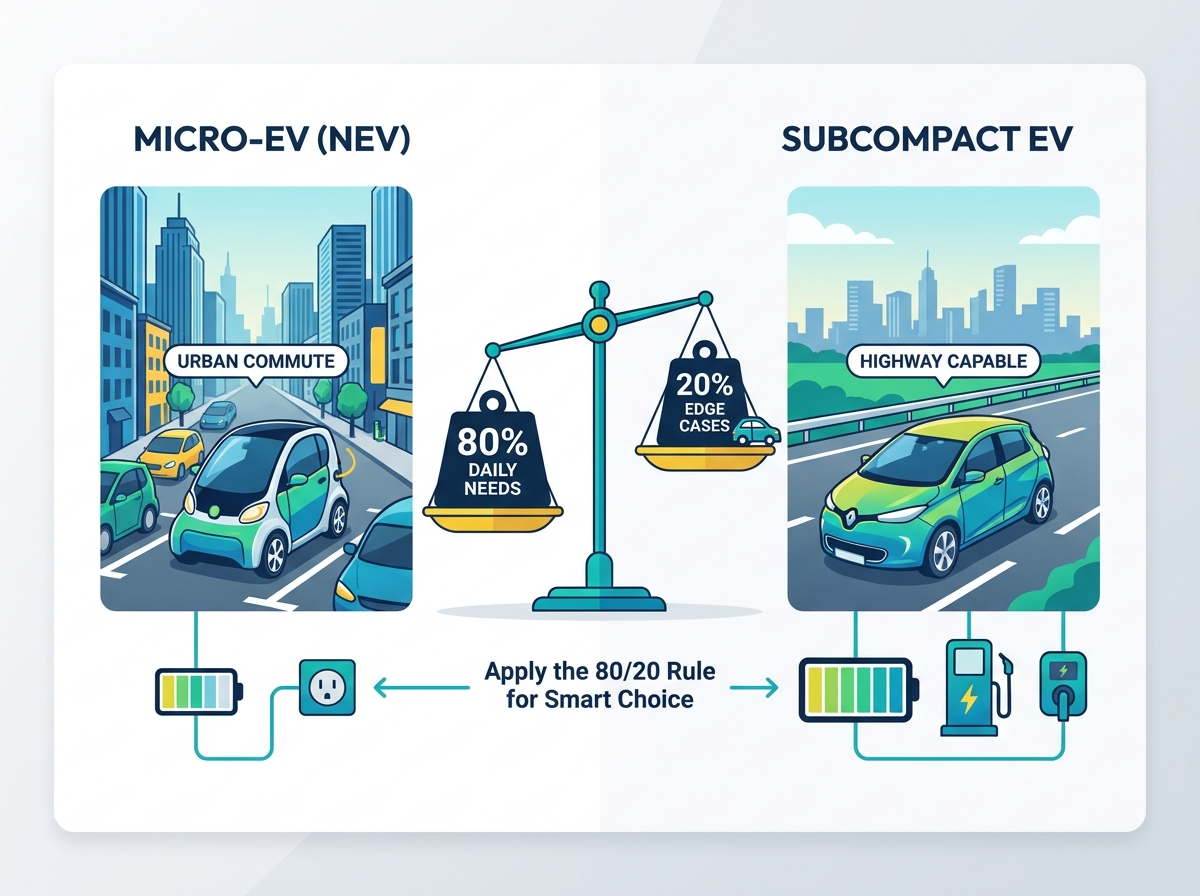
Buyers often confuse distinct vehicle classes. We must separate street-legal golf carts from actual passenger cars. Understanding these two categories ensures you stay legal and safe on your local routes.
Micro-EVs are ultra-lightweight, electronically speed-limited vehicles designed purely for dense urban centers. Manufacturers engineer them for low-speed environments. They typically max out around 25 to 30 mph.
These vehicles offer exceptional energy efficiency and low purchase costs. You can often charge them completely on a standard wall outlet. However, local laws restrict them from highways. They lack standard automotive safety features like airbags and reinforced crash structures. They work perfectly in gated communities, but they struggle in heavy, fast-moving traffic.
Highway-capable subcompact EVs are traditional passenger cars engineered with smaller battery packs. Familiar models include the Fiat 500e and the MINI Cooper SE. They feel exactly like normal cars behind the wheel.
These models provide standard crash safety features. They are legally capable of short highway stints. Unfortunately, they carry a higher upfront cost. They also possess a heavier curb weight due to the reinforced safety structures and larger motors. If your commute includes brief highway segments, you must choose this category.
Comparison: Micro-EVs vs. Subcompact EVs
| Feature | Micro-EVs & Quadricycles | Highway-Capable Subcompact EVs |
|---|---|---|
| Top Speed | Electronically limited (typically 25-30 mph) | Highway speeds (70+ mph) |
| Highway Legal | No | Yes |
| Safety Features | Minimal (No standard airbags or crash structures) | Standard (Airbags, crumple zones, ABS) |
| Price Range | Very Low | Moderate to High |
| Ideal Environment | Dense urban centers, gated communities, campuses | Mixed urban routes, short highway commutes |
Engineering reality dictates how small battery packs behave. Battery packs under 40 kWh remain highly sensitive to external variables. A massive heavy-duty truck barely notices a 3 kW draw from a heater. Conversely, a compact pack drains rapidly under the same load.
The HVAC penalty severely impacts daily drivability. Cabin heating and cooling disproportionately affect a mini electric car's range. Standard resistive heating acts like a giant toaster oven, pulling massive amounts of electricity. We instruct buyers to prioritize models equipped with a heat pump. Heat pumps operate much more efficiently, preserving precious winter miles.
You must look past EPA or WLTP estimates. Advised usable capacity rarely matches laboratory test cycles. Always subtract 20-30% from the advertised range immediately. This mental math accounts for temperature fluctuations and battery degradation buffers. It also factors in aerodynamic drag when you push the vehicle to highway speeds.
You must evaluate home charging capabilities before focusing on public networks. Level 1 charging utilizes a standard 120V household outlet. A mini electric car is one of the few vehicle categories where Level 1 might actually suffice. A 12-hour overnight charge easily replenishes 40 to 50 miles of range for these highly efficient vehicles. This avoids expensive Level 2 electrical upgrades.
Examine the onboard charger (OBC) limits closely. The OBC determines the maximum AC acceptance rate. Some vehicles max out at 7kW, while others accept 11kW. A faster OBC maximizes the utility of public Level 2 destination chargers. You can grab meaningful range during a quick grocery run if your vehicle accepts higher AC power.
We challenge the assumption regarding DC Fast Charging (DCFC). Do you really need it? For a strict city commuter, DCFC represents a massive waste of money. Paying a premium for 100kW+ DCFC capabilities yields a poor return on investment. You will likely charge at home overnight 95% of the time. Save your budget and skip expensive fast-charging options.
You must map out federal, state, and local tax incentives carefully. These subsidies disproportionately improve the value proposition of lower-priced vehicles. A $4,000 rebate on a $25,000 vehicle shifts the financial math much faster than the same rebate on an $80,000 luxury model.
Consider depreciation and residual value tracking. Industry standards, such as J.D. Power valuation metrics, note specific trends for small EVs. Initial depreciation can be remarkably steep. Early technology adoption often results in rapid value loss over the first three years. This makes off-lease used models highly attractive for budget-conscious buyers.
Establish strong insurance and maintenance baselines. The subcompact class typical commands lower insurance premiums compared to high-performance electric sedans. Additionally, you will experience significantly reduced brake wear. Regenerative braking systems handle most stopping duties. This preserves traditional brake pads for years, virtually eliminating standard brake maintenance intervals.
You should build your vehicle shortlist using strict, non-negotiable filter criteria. Narrow down your options using this hierarchical logic:
We heavily recommend the Rental Test. Utilize major rental agencies like Hertz to book a short-listed model for a 48-hour period. A 15-minute dealer test drive hides critical usability limits. A weekend rental exposes poor app connectivity, uncomfortable seats, and true energy consumption.
Follow this implementation checklist during your trial run:
Choosing the best compact electric vehicle requires prioritizing daily efficiency over theoretical maximums. You must embrace the 80/20 rule to avoid paying for excess battery capacity. Focus heavily on practical charging solutions and functional urban limitations.
Always finalize your home charging setup plan before signing the final vehicle purchase agreement. Discovering electrical panel constraints after taking delivery causes unnecessary stress. Start booking your 48-hour rental test this weekend to experience the vehicle in real-world conditions.
As your clear next step, direct your attention to local utility programs. Compare available EV charging rebates to finalize your budget accurately. Taking action on these infrastructure checks guarantees a seamless ownership experience.
A: Highway-capable subcompact EVs meet all mandatory structural safety standards. They feature reinforced crash structures, standard airbags, and ABS. However, micro-EVs and quadricycles lack these reinforcements. You must check NHTSA or Euro NCAP ratings to confirm highway safety compliance.
A: Modern thermal management systems protect battery longevity exceptionally well. Most manufacturers provide a standard 8-year or 100,000-mile warranty. While smaller packs experience more charge cycles, active cooling preserves their health. You can expect reliable daily performance for a decade.
A: It is possible, but we remain skeptical of this approach. Relying solely on public infrastructure demands dense local networks. This strategy also eliminates much of the financial savings associated with cheap overnight residential rates.
A: Small EVs often face steep early depreciation curves. Advancing battery technology rapidly impacts secondary market pricing. This trend makes purchasing a slightly used, off-lease model incredibly attractive. Retained value generally stabilizes after the initial three-year drop.


