
Views: 0 Author: Site Editor Publish Time: 2026-11-03 Origin: Site


The automotive landscape is undergoing a massive transformation. You are no longer just buying a vehicle running on an electric motor; you are evaluating a software-defined vehicle (SDV). This shift fundamentally changes how we interact with daily transportation. Buyers often struggle to distinguish between standard EVs and a true smart electric car. This confusion leads to mismatched expectations regarding connectivity, automation, and long-term value. Many assume a large touchscreen automatically makes a vehicle intelligent. We need to look deeper into the underlying architecture. This article provides an objective, hype-free breakdown of the hardware specifications and software features you need to know. You will learn how to assess real-world ownership realities to make an informed purchasing decision. We will explore everything from compute power metrics to data privacy risks, ensuring you choose a platform built for the future.
Understanding the difference between basic electrification and true vehicular intelligence requires looking beneath the sheet metal. The foundation of modern mobility lies in the software-first architecture. Traditional vehicles rely on dozens of isolated electronic control units (ECUs). One ECU manages the wipers, another controls the brakes, and a third handles the climate. These siloed systems rarely communicate effectively. A modern intelligent vehicle replaces this fractured setup using centralized compute architectures. Powerful domain controllers act as the brain of the operation, allowing seamless integration across all vehicle functions.
Over-the-Air (OTA) updates represent the most visible benefit of this centralized architecture. Standard EVs might receive occasional infotainment tweaks or map updates at the dealership. True deep-system OTA updates fundamentally alter the driving experience over time. Manufacturers can push software packages modifying regenerative braking strength, acceleration curves, and battery thermal management. Your vehicle physically improves months or years after leaving the dealership lot.
Furthermore, these vehicles feature bi-directional communication. They function as active nodes on the power grid and connected devices within the broader Internet of Things (IoT) ecosystem. They are no longer standalone transport machines. They communicate with smart home systems, utility providers, and surrounding infrastructure.
When establishing your evaluation criteria, you must verify if a brand's "smart" label represents native intelligence or mere marketing. Relying entirely on Apple CarPlay or Android Auto projection does not qualify a vehicle as intelligent. Native, system-level software integration ensures the vehicle understands its own battery state, calculates charging stops automatically, and manages internal hardware efficiently.
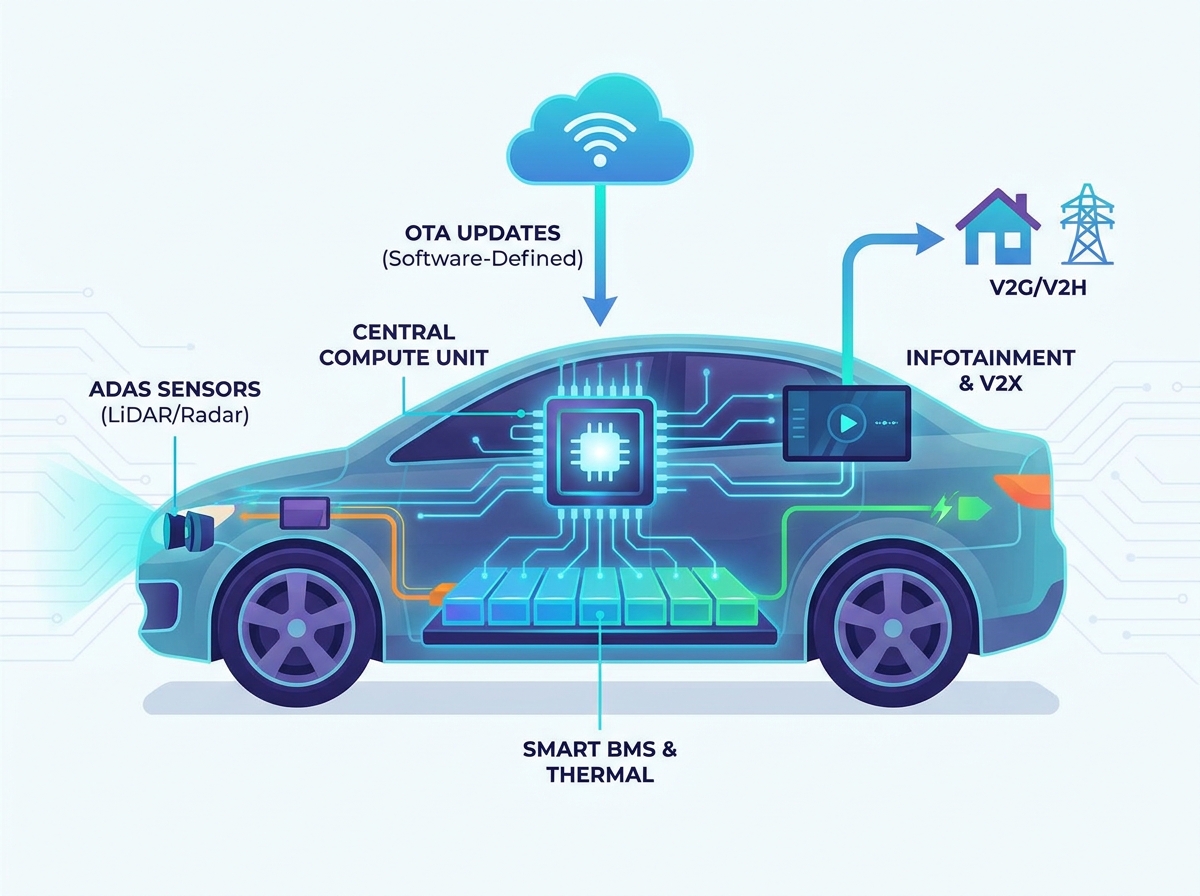
Navigating the spec sheet requires focusing on features directly impacting daily usability and future-proofing. Prioritize these four core categories during your evaluation process.
Many buyers fixate entirely on maximum range. While important, range alone paints an incomplete picture of daily drivability. You must analyze deeper technical specifications to understand true performance.
Table 1: Traditional EV Metrics vs. Smart EV Metrics
| Specification Category | Traditional Focus | Smart Focus | Why It Matters |
|---|---|---|---|
| Charging Speed | Peak kW Intake | Sustained Charging Curve | A high peak speed dropping quickly wastes time. Sustained speeds from 10% to 80% dictate actual road trip convenience. |
| Processing Power | Screen Resolution | Compute Power (TOPS) | High TOPS ensures the vehicle can process complex autonomous driving algorithms released years later. |
| Battery Size | Gross Capacity (kWh) | Usable Capacity (kWh) | Software buffers protect the battery from degrading. Usable capacity reflects the actual energy available for driving. |
| Energy Use | Total Range (Miles) | Efficiency (mi/kWh) | High efficiency means faster charging recovery and less reliance on massive, heavy battery packs. |
Charging curves matter significantly more than advertised peak speeds. A vehicle boasting a 250kW peak might only hold that speed for three minutes before throttling down to protect the battery. Sustained charging speeds—the curve maintained between 10% and 80% state of charge—determine how long you actually wait at a highway rest stop.
Compute power introduces a new critical metric: TOPS (Tera Operations Per Second). This measures the processing capability of the onboard computers. A vehicle possessing high TOPS can handle massive data streams from cameras and radar simultaneously. This dictates the vehicle's capacity to handle future autonomous driving updates safely.
When reviewing battery specifications, distinguish between usable and gross battery capacity. Intelligent vehicles utilize software buffers, locking away the top and bottom percentages of the battery pack. This prevents extreme voltage states and severe battery degradation. Buyers should always base their range calculations on the usable capacity metric.
Finally, prioritize efficiency metrics like miles per kWh (mi/kWh) or kWh/100km. Aerodynamic software modeling and smart torque distribution heavily affect real-world efficiency. A highly efficient vehicle extracts more miles from a smaller battery, reducing weight and improving handling compared to EPA or WLTP estimates.
Transitioning to an intelligent vehicle ecosystem unlocks numerous practical advantages extending far beyond avoiding the gas station. These benefits streamline daily routines and provide long-term value retention.
Optimized charging economics transform how you fuel your commute. Native integration between the vehicle, smart home chargers, and dynamic utility tariffs creates a seamless energy strategy. The car automatically schedules its charging sessions when electricity rates hit their lowest overnight points. You wake up to a full battery without ever manually calculating peak grid hours.
Reduced maintenance downtime represents a massive shift in the ownership experience. These vehicles leverage remote diagnostics and predictive failure alerts. The software monitors component wear and flags anomalies before a physical breakdown occurs. Service centers can often diagnose issues remotely, ordering parts before you even arrive. In many cases, software glitches resolve themselves overnight via OTA patches, eliminating the dealership visit entirely.
Insurance and safety dividends provide ongoing financial relief. Active safety features powered by advanced ADAS prevent collisions before they happen. Integrated dashcams and telemetry data provide indisputable evidence during accident claims. Many insurance providers now offer reduced premiums for vehicles equipped with these active monitoring systems in certain jurisdictions.
Residual value retention behaves differently in the software-defined era. Standard vehicles depreciate rapidly as their technology ages. Intelligent vehicles receive range-boosting algorithms and feature-adding OTA updates. A three-year-old car might suddenly gain a new user interface or improved acceleration. This continuous evolution keeps the vehicle relevant longer, supporting stronger resale values on the secondary market.
Despite the impressive technological leaps, buyers must navigate several emerging risks. The transition to software-defined mobility introduces new challenges requiring careful consideration.
The subscription model creep stands out as a primary frustration. Manufacturers increasingly lock physical hardware features behind monthly software paywalls. You might purchase a vehicle containing the physical heating elements for the seats, but activating them requires an ongoing subscription. Advanced navigation routing and maximum acceleration unlocks often face similar monetization strategies. Buyers must clarify exactly which features are permanently included in the purchase price.
Data privacy and telemetry generate significant concerns. These vehicles act as rolling data centers. They constantly record location tracking, driving habits, and even cabin camera footage. You must address concerns regarding who owns the data the car generates. Read the privacy agreements carefully to understand if manufacturers sell your anonymized telemetry to third-party brokers or insurance companies.
Hardware obsolescence mirrors the smartphone industry. You face the risk of buying into an ecosystem whose internal processors cannot support software updates released three to five years post-purchase. If the central computer lacks sufficient RAM or processing overhead, your vehicle will eventually stop receiving the latest features, freezing its technological evolution.
App dependency and connectivity deadzones expose the practical realities of digital integration. Relying on smartphone-as-a-key (PAAK) technologies feels futuristic until you park in an underground garage. Areas possessing poor cellular reception can disrupt remote climate pre-conditioning or live traffic routing. Always ensure the vehicle provides robust Bluetooth fallbacks and physical keycard alternatives for daily operation.
Evaluating modern electric vehicles requires a fundamental shift in priorities. You must look past traditional horsepower figures and focus on digital architecture.
A: Yes. Local computing handles all primary driving and safety systems. Brakes, steering, and collision avoidance remain fully functional. You will experience degraded performance in cloud-dependent features. Live traffic routing, voice assistants, and remote app controls usually pause during outages. Once cellular reception returns, these secondary systems automatically resync.
A: The vehicle handles onboard battery management, thermal regulation, and navigation routing. A smart charger mounts to your wall and manages household electrical loads. It communicates directly with your local utility grid. The charger dictates when electricity flows based on dynamic pricing, while the car dictates how fast its battery can safely accept that energy.
A: Any connected device carries cybersecurity risks. Manufacturers isolate critical driving systems from infotainment networks to minimize these threats. This separation prevents a compromised web browser from affecting the steering column. Prompt installation of OTA security patches remains your best defense against emerging vulnerabilities.
A: Early-generation EVs suffered heavy degradation from frequent fast charging. Modern smart battery management systems (BMS) drastically reduce this issue. They actively cool or heat individual battery cells to prevent thermal stress during high-speed sessions. However, prioritizing daily AC home charging remains the best practice for maximizing long-term battery health.


