
Views: 0 Author: Site Editor Publish Time: 2026-11-04 Origin: Site


Transitioning from traditional internal combustion micro-cars to a modern smart electric car represents a fundamental shift in urban mobility. It is not just a simple engine swap. Historically, the gas-powered Smart car offered incredible parking convenience. Drivers loved squeezing into tiny curbside spaces. However, they often complained about severe transmission lag. Highway stability also remained a persistent issue. Electrification directly solves many of these legacy problems. It replaces clunky gearboxes using smooth, instant power delivery. Buyers face a major decision today. Should you buy a late-model gas micro-car or invest in a newer battery-powered alternative? This article provides a clear, unbiased framework. We will help you weigh performance, daily utility, and maintenance differences. You will learn exactly which powertrain matches your driving habits. We aim to clarify the realities of daily ownership.
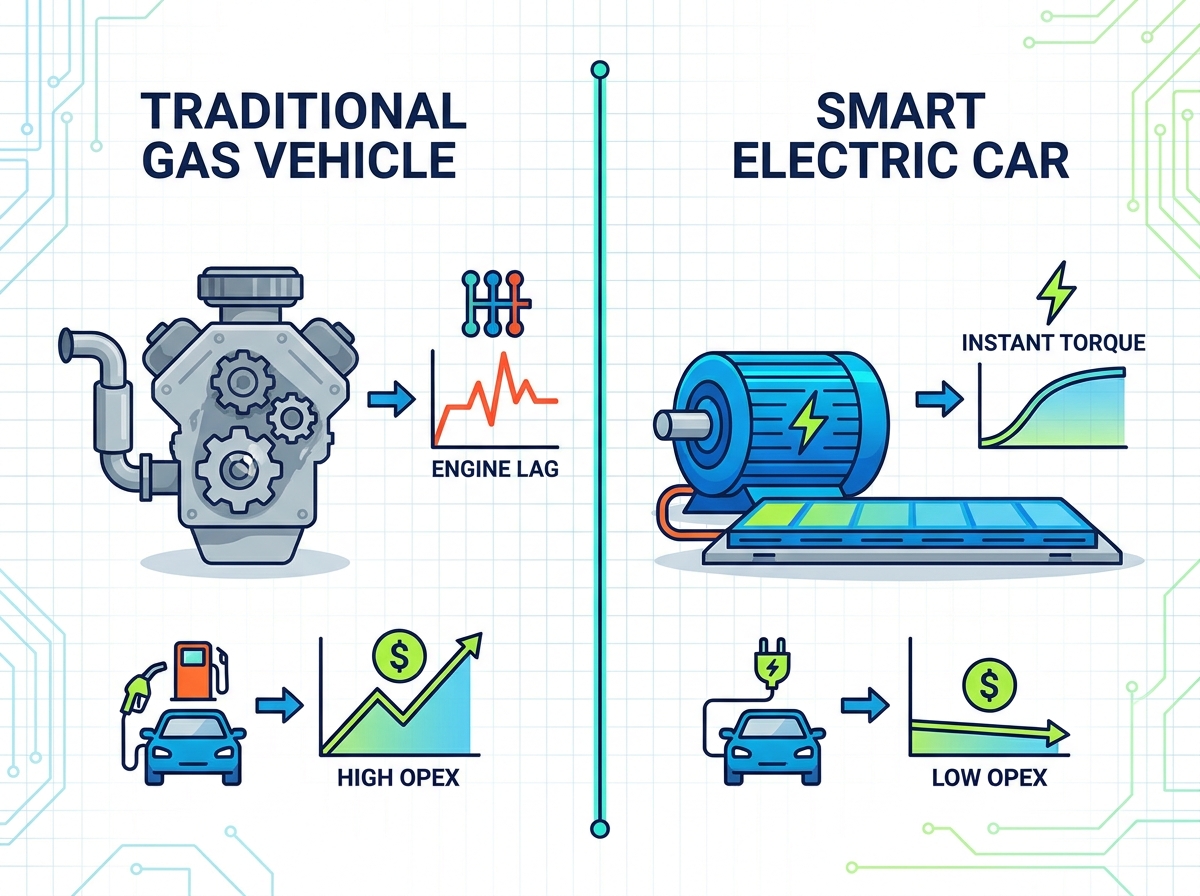
A smart electric car uses a single-speed transmission. This setup delivers seamless, instant torque. You press the pedal, and the vehicle quickly accelerates without hesitation. Traditional gas models utilize automated manual transmissions. Drivers frequently criticize these older gearboxes. They produce clunky, unpredictable shifting during stop-and-go traffic. The internal combustion engine pauses to let mechanical actuators change gears. The electric upgrade completely eliminates this frustrating urban driving element. You glide forward smoothly instead of lurching between gears.
Battery placement fundamentally changes vehicle dynamics. Engineers mount heavy battery packs low in the chassis floor. This design drastically lowers the center of gravity. Better weight distribution improves cornering stability significantly. Traditional micro-cars often feel tippy during abrupt lane changes. Crosswinds easily push them around on open roads. The electric variant feels firmly planted on the pavement. It hugs corners much better. However, you must accept an increase in overall curb weight. The suspension works harder to manage this extra mass over deep potholes.
Always approach highway travel realistically. Both variants perform best inside city limits. Internal combustion counterparts handle sustained highway speeds reasonably well. They maintain momentum despite stability concerns. EV variants experience exponential efficiency drops above 65 mph. Aerodynamic drag drains the battery rapidly. High-speed commuting quickly depletes your available driving range. Electric motors consume massive energy pushing air aside at high velocities. Keep expectations grounded if you regularly commute on freeways. You will watch the battery percentage drop surprisingly fast.
Never rely solely on optimistic WLTP or EPA estimates. Real-world range demands evidence-based scrutiny. Freezing temperatures degrade range severely. Cabin heating and cold battery chemistry reduce travel distance. You can expect a 20-30% drop in maximum range during harsh winters. Do not sugarcoat this reality. Lithium-ion cells resist releasing energy when cold. Heating the cabin draws power directly from the traction battery. Plan urban routes carefully during January and February. You must plug the vehicle in overnight to precondition the cabin.
Gas stations offer a quick three-minute fill-up. EV charging introduces distinct logistical challenges. A smart electric car thrives when you possess dedicated home or workplace charging. Relying entirely on public charging creates high friction. You wait longer and navigate broken chargers frequently. Finding an available plug in a crowded city often causes frustration. Consider these three charging tiers:
Certain advantages remain completely unchanged across powertrains. Both versions retain class-leading turning radiuses. They parallel park effortlessly into remarkably tight spaces. They define urban agility perfectly. Navigating crowded city centers remains the absolute best feature of the brand. You can perform U-turns on narrow streets without reversing. Finding parking takes minutes instead of hours. The tiny footprint ensures you fit where larger sedans simply cannot.
Internal combustion engines require constant upkeep. The electric model removes exhaust systems, alternators, and multi-gear transmissions. You no longer worry about oil leaks or failing spark plugs. Timing belts and water pumps disappear from your maintenance schedule. Mechanics see far fewer mechanical breakdowns. Moving parts decrease dramatically inside an electric drivetrain. This structural simplicity boosts day-to-day reliability considerably. You spend less time sitting inside dealership waiting rooms.
Buyer skepticism regarding battery lifespan remains high. Understand the manufacturer warranty baseline clearly. Most brands guarantee 8 years or 100,000 miles. They usually promise 70% capacity retention over this period. Chemical degradation happens gradually over years. Total battery failure occurs rarely. Replacing a degraded pack takes specialized labor. It involves sophisticated diagnostic processes. You should view the battery as a long-term consumable component. Proper charging habits extend its usable life dramatically.
Braking systems experience much less stress on EVs. Regenerative braking uses the motor to slow down. This mechanism captures kinetic energy and returns it to the battery. It extends brake pad life significantly beyond traditional vehicles. Many EV drivers go years without replacing brake pads. Conversely, tires wear out much faster. Instant torque and heavier curb weights stress rubber severely. You accelerate faster, stripping tread off the tires. You must buy EV-specific tires. They feature reinforced sidewalls. They handle the extra load safely.
| Component Area | Traditional Gas Model | Smart Electric Car |
|---|---|---|
| Braking System | Standard wear. Requires frequent pad and rotor replacement. | Low wear. Regenerative braking extends pad life significantly. |
| Tires | Standard wear based on typical lightweight urban driving. | High wear. Extra weight and instant torque demand EV-specific tires. |
| Powertrain Wear | High complexity. Features belts, spark plugs, and oil filters. | Low complexity. Features sealed electric motors and minimal fluids. |
| Routine Servicing | Frequent dealership visits for oil changes and fluid checks. | Infrequent visits. Primarily consists of cabin filter and wiper replacements. |
RV owners love traditional manual or gas micro-cars. You can easily flat-tow them behind motorhomes. This practice is widely known as dinghy towing. However, you absolutely cannot flat-tow any smart electric car safely. Turning the wheels physically spins the electric motor. Doing this without active cooling damages the drivetrain severely. Internal components overheat quickly. You must use a flatbed trailer instead. This requirement changes travel logistics considerably. Towing a trailer adds weight and complicates campsite parking.
Evaluate these minimal vehicles objectively. They excel purely as secondary household commuters. You should not treat them as primary household workhorses. Families use them for local grocery runs and short work commutes. They handle school drop-offs perfectly. They reduce wear and tear on larger primary SUVs. They fit perfectly into controlled, predictable, urban-only duty cycles. Treating them as regional road-trip vehicles leads to intense frustration. Their limited range restricts spontaneous long-distance travel.
Choosing the right version requires honest self-assessment. Review your daily habits closely.
The electric variant perfects the original vision of the ultimate city vehicle. It removes the clunky gas powertrain completely. You gain smooth, quiet, and responsive acceleration. However, it demands a specific lifestyle to succeed truly. You need predictable local routes and reliable home charging. The technology shines brightest inside dense urban boundaries.
Take practical steps before making a final decision. Audit your driving mileage over the last 30 days carefully. Check your home electrical panel for 240-volt charging readiness. Contact a local dealer soon. Schedule a test drive and experience the instant torque firsthand. Transitioning requires careful preparation. Make sure your daily routine aligns perfectly alongside battery-powered limitations.
A: Modern electric batteries follow industry-standard degradation curves. Manufacturers typically provide an 8-year or 100,000-mile warranty protecting against severe capacity loss. Realistically, you can expect the battery to retain about 70% to 80% of its original capacity after a decade of normal urban use. Avoid frequent aggressive fast-charging to maximize lifespan.
A: No. You cannot flat tow them safely. Towing an EV with its drive wheels on the ground spins the electric motor. This action generates heat and causes severe drivetrain damage because the cooling pumps remain off. You must transport them using a flatbed trailer to ensure mechanical safety.
A: Electric models often carry slightly higher insurance premiums. Insurance companies assess them differently due to specialized collision repair requirements. Replacing damaged battery packs or sourcing high-voltage technicians costs body shops significantly more. Potential collision repair complexities push insurance rates higher than those for older traditional gas models.
A: Freezing temperatures reduce driving range by 20% to 30%. Cold weather slows battery chemistry and forces the climate control system to work harder. You must precondition the battery. Warm up the cabin while the vehicle remains plugged into the charger. This simple habit preserves your maximum driving distance during winter.


