
Views: 0 Author: Site Editor Publish Time: 2026-08-04 Origin: Site


Operating a hybrid vehicle introduces unique mechanical stresses. Standard internal combustion engines rarely face these rapid, intense pressure changes. You might think engine oil works the same way across all cars. However, modern hybrid powertrains completely change the rules. While the electric motor handles low-speed driving, the gas engine engages intermittently. It often fires up at highway speeds without a proper warmup sequence. This abrupt transition requires specialized lubrication to prevent premature wear. Conventional fluids simply cannot keep up with these sudden shifts.
This guide breaks down exactly what to look for when purchasing oil for an Oil-electric hybrid. We filter out the confusing marketing noise surrounding premium lubricants. Instead, we focus deeply on strict OEM requirements. You will learn how to decode industry certifications and understand actual performance realities. By the end, you will know exactly how to protect your engine and maximize its operating lifespan.
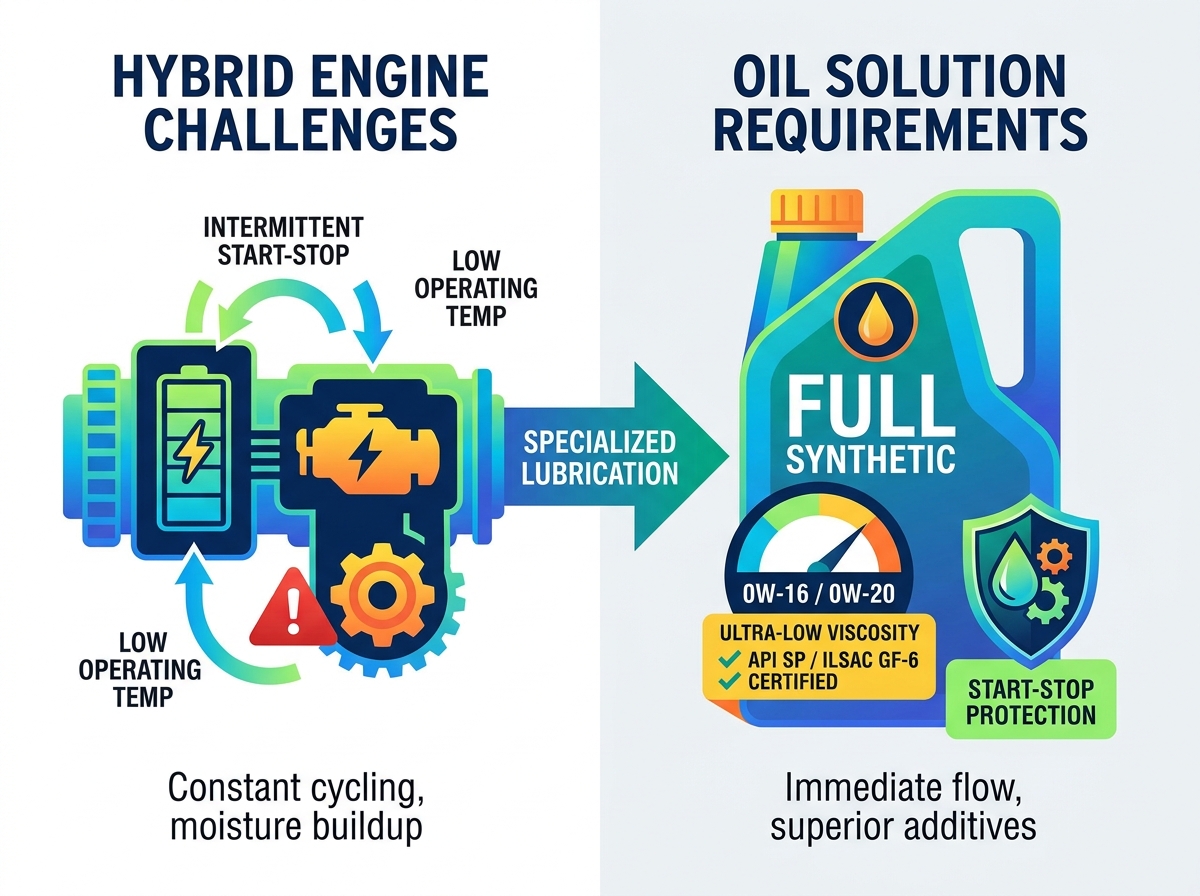
You must understand how these vehicles operate differently from traditional cars. Traditional engines start once per trip. They gradually warm up and maintain a stable operating temperature. Hybrid powertrains behave erratically by design. This erratic behavior creates three distinct engineering challenges.
An internal combustion engine (ICE) inside a hybrid rests while the electric motor works. Imagine cruising on battery power at forty miles per hour. You suddenly press the accelerator to merge onto a busy highway. The gas engine instantly wakes up. It jolts from zero to several thousand RPMs in a fraction of a second. The engine has no time to warm up. Oil must flow immediately to coat the moving metal parts. If the fluid hesitates, metal scrapes against metal. Over time, this friction destroys bearings and cylinder walls.
Engines need heat to burn off internal moisture. Standard vehicles easily reach this thermal sweet spot. Hybrid engines frequently fail to reach optimal operating temperatures. They shut off too quickly during short city trips. When an engine runs cold, moisture condenses inside the crankcase. Water mixes into the engine oil. Additionally, cold engines suffer from poor combustion efficiency. This allows unburned fuel to wash past the piston rings. The fuel dilutes the oil mixture. Diluted oil loses its protective film strength. It becomes dangerously thin and fails to lubricate effectively.
These specific mechanical realities create a massive lubrication gap. Failing to use precisely engineered oil introduces serious ownership risks. You cannot rely on legacy automotive knowledge. The tight manufacturing tolerances demand immediate protection. Using incorrect fluids directly translates to accelerated engine wear. You will eventually face degraded performance. Ultimately, poor oil selection reduces your vehicle's lifespan.
The automotive industry responded to these challenges by formulating highly advanced lubricants. You will encounter several options on the shelf. Let us decode which ones actually work.
You should completely ignore conventional oils. Synthetic blends also fall short. Full synthetic oil serves as the only viable option for hybrids. Engineers create full synthetics in a lab. They build uniform molecular structures. This uniformity provides superior molecular stability under extreme stress. More importantly, full synthetic oil retains exceptional cold-flow properties. It remains highly fluid even in freezing weather. When your engine suddenly engages on the highway, full synthetic oil instantly shoots up to the valvetrain. It provides the crucial barrier your moving parts desperately need.
Many lubricant manufacturers now sell bottles prominently labeled "For Hybrids." This sparks understandable market skepticism. You might wonder if these products offer actual mechanical advantages. The truth remains quite simple. These hybrid-branded oils usually contain excellent additive packages. However, you do not strictly need them. Any high-quality full synthetic oil works perfectly if it meets OEM specifications. You pay a premium for the word "Hybrid" on the label. Focus on the actual chemical ratings rather than the marketing terminology.
Viscosity refers to fluid thickness. Older vehicles used thick 10W-30 or 5W-30 grades. Modern hybrids shifted aggressively toward ultra-low viscosity weights. You will commonly see 0W-20 and 0W-16. Some cutting-edge engines now require 0W-8. The "0W" stands for the winter rating. It dictates how the fluid behaves when cold. A zero rating guarantees rapid flow. It prevents dry starts by instantly coating bare engine parts.
Viscosity Grade Evolution Comparison
| Viscosity Grade | Primary Application Era | Cold Flow Speed | Fuel Economy Impact |
|---|---|---|---|
| 5W-30 | Pre-2010 Traditional ICE | Moderate | Baseline |
| 0W-20 | Early to Modern Hybrids | Fast | High |
| 0W-16 | Current Generation Hybrids | Ultra-Fast | Very High |
| 0W-8 | Emerging Advanced Hybrids | Instantaneous | Maximum |
Choosing the correct product requires looking past the brand name. You must inspect the back of the bottle. We evaluate engine oils based on strict chemical formulas and industry standards.
The American Petroleum Institute (API) and the International Lubricants Standardization and Approval Committee (ILSAC) set the rules. You must verify these certifications before pouring anything into your engine.
Base oil alone cannot protect a hybrid engine. Manufacturers blend chemical additives into the fluid. You need robust anti-wear additives. Compounds like molybdenum and zinc coat the metal parts. They create a sacrificial layer that prevents metal-to-metal scraping. You also need powerful detergents. Detergents fight the low-temperature sludge that plagues cold-running engines. They suspend contaminants until the oil filter catches them.
Many drivers hold strong loyalties to specific oil brands. You should abandon brand loyalty when maintaining an Oil-electric hybrid. Prioritize the manufacturer’s exact specifications above all else. Toyota, Honda, and Ford engineer their engines around highly specific fluid dynamics. A premium aftermarket oil might boast incredible performance claims. However, if it lacks the specific OEM approval code listed in your manual, do not buy it.
Best Practice: Always photograph the exact specification page from your owner's manual before visiting the auto parts store. Compare the codes character by character.
Some vehicle owners try to save money by purchasing incorrect fluids. Others rely on outdated advice from well-meaning mechanics. Deviating from the required specifications introduces severe mechanical consequences.
Using a thicker oil creates immediate problems. Imagine pouring thick syrup on a cold morning. It flows incredibly slowly. If your manual requires 0W-16, and you use 5W-30, you invite dry start damage. When the gas engine suddenly fires up, the oil pump struggles to move the thick fluid. Crucial engine parts operate completely dry for several seconds. This delayed lubrication scars the camshaft and grinds the bearings. The damage accumulates silently over thousands of miles.
Incorrect viscosity ruins your fuel economy. Thicker oil increases internal fluid friction. The engine must work significantly harder to push heavy oil through narrow passages. This wasted energy burns more gasoline. People buy hybrids primarily to achieve exceptional gas mileage. Using the wrong fluid directly degrades this primary selling point. You will notice fewer miles per gallon almost immediately.
Automakers strictly monitor powertrain failures. If your engine suffers catastrophic damage, the dealership will investigate. They frequently pull oil samples for laboratory analysis. The lab will identify the wrong oil weight instantly. They will also notice missing API or ILSAC standards. This discovery completely voids your powertrain warranty. You accept massive financial risk by ignoring the required specifications. The cost of a replacement hybrid engine heavily outweighs any savings gained from cheaper oil.
You now understand the mechanics and the risks. Let us turn this knowledge into an actionable purchasing plan. Follow these specific steps to ensure perfect maintenance.
Your owner's manual serves as the ultimate authority. Open it and locate the maintenance section. Note the specific viscosity requirement. Some newer models prefer 0W-16. Interestingly, some manuals allow 0W-20 temporarily if you cannot find 0W-16. However, they explicitly dictate a return to 0W-16 at the very next change. Do not treat temporary exceptions as permanent rules.
Counterfeit automotive fluids flood third-party online marketplaces. Scammers pour cheap conventional oil into convincing synthetic bottles. Never buy discounted oil from unverified online sellers. You risk destroying your powertrain. We highly recommend purchasing from authorized auto parts retailers. You can also buy directly from dealership parts departments. The slight price increase guarantees product authenticity.
Standard change intervals typically range from 5,000 to 10,000 miles. However, you must honestly evaluate your driving habits. "Severe driving conditions" necessitate more frequent changes. If you take frequent short city trips, your engine never truly warms up. This maximizes oil dilution from fuel and moisture. Under severe conditions, you should change the fluid every 5,000 miles or six months. Fresh fluid restores the depleted additive packages.
Common Mistake: Relying solely on mileage tracking. Oil degrades over time through oxidation, even if the car sits parked. Always respect the time-based intervals (usually 12 months) regardless of low mileage.
Maintaining a hybrid engine requires discipline. Buying oil for these advanced powertrains remains a strict compliance exercise. You cannot treat this as an area for budget-cutting or mechanical experimentation. The rapid start-stop cycles demand immediate fluid flow. The cold-running tendencies require robust chemical detergents. Your engine depends entirely on the precision of the fluid you choose.
Next Steps:
A: No. Conventional oil cannot flow quickly enough during the sudden engine engagements typical of hybrids, leading to severe engine wear.
A: Despite the gas engine running less often, the oil still degrades due to moisture and fuel dilution from cold cycles. Follow the OEM schedule (usually 7,500–10,000 miles or every 12 months, whichever comes first).
A: They use similar ultra-low viscosity synthetic oils, but PHEVs may suffer even more from fuel dilution because their gas engines run even less frequently. Strict adherence to time-based (annual) oil changes is critical for PHEVs.
A: Not necessarily. As long as a high-quality full synthetic oil meets the exact viscosity, API SP, and ILSAC GF-6 requirements specified in your owner's manual, it will perform perfectly.


