
Views: 0 Author: Site Editor Publish Time: 2026-11-05 Origin: Site


Transitioning commercial vehicles to electric is no longer just an ESG (Environmental, Social, and Governance) talking point. It is a strict operational and financial calculation. Companies are rapidly adopting these vehicles to stay competitive. While consumer EVs focus heavily on aesthetics and acceleration, choosing a smart electric car for business demands rigorous scrutiny. Fleet managers must carefully evaluate telematics, charging logistics, and long-term financial viability. You cannot simply buy a fleet off the lot and hope for the best. Buying a fleet without a data-driven strategy will inevitably cause severe operational delays. We aim to provide fleet managers and business owners a skeptical, evidence-backed framework. You will learn how to evaluate, shortlist, and pilot the right vehicle for your specific commercial use case. We will break down infrastructure risks and software integration needs to ensure a highly successful operational transition.
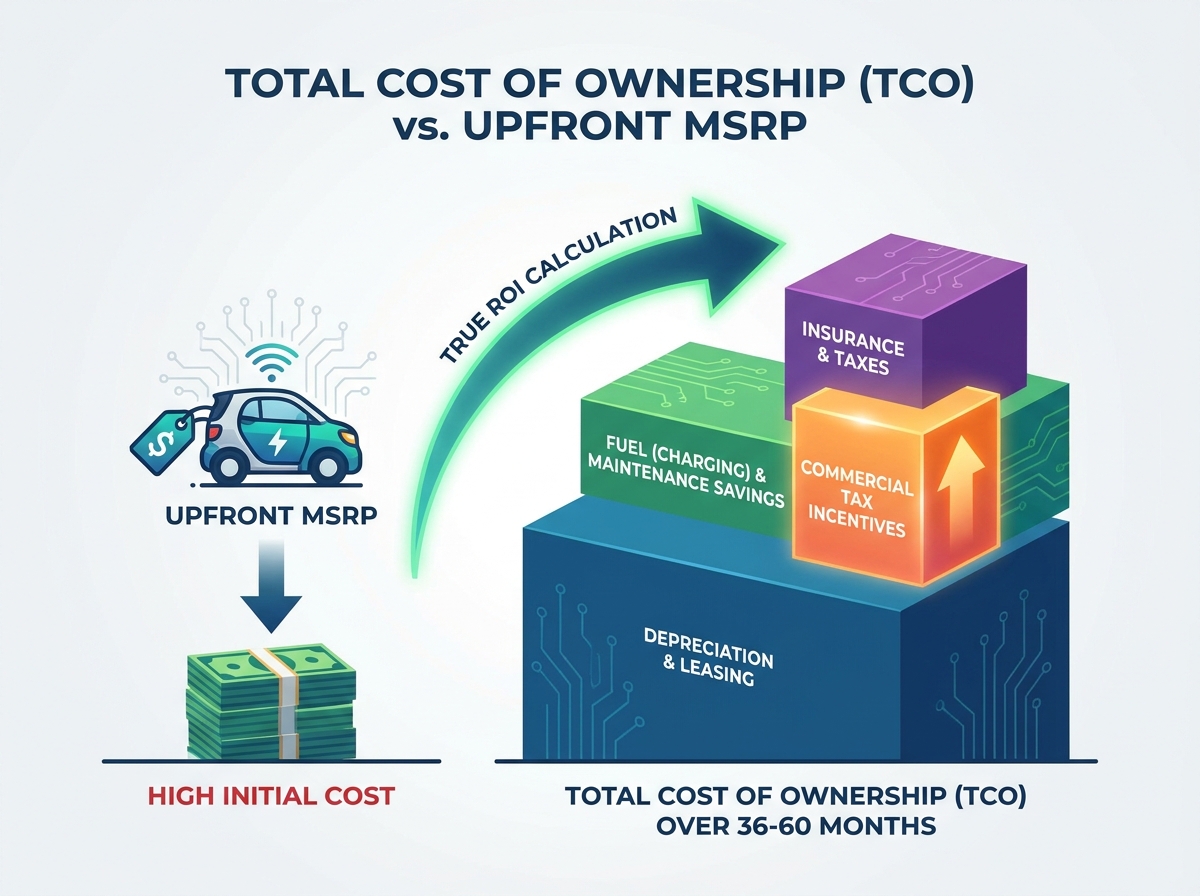
You must move beyond the Manufacturer's Suggested Retail Price (MSRP). Fleet managers should frame the financial model around cost-per-mile and lifecycle expenses rather than the initial purchase price. The initial sticker shock often deters buyers. However, commercial operations rely heavily on long-term data. You must analyze maintenance reductions and fuel savings over a standard 36 to 60-month cycle. This extended timeline reveals the true financial return.
Federal and state-level commercial clean vehicle credits drastically alter your ROI calculations. In the US, Section 45W provides substantial commercial vehicle credits. You must navigate specific compliance requirements carefully. Gross Vehicle Weight Rating (GVWR) limits dictate your exact credit tiers. Battery sourcing stipulations also affect your overall eligibility. The IRS requires specific domestic battery component percentages. You must verify these details directly before signing any vehicle contract.
Commercial leasing offers distinct advantages for emerging electric fleets. Dealerships can seamlessly absorb complex tax credits into the lease rate. This strategy mitigates battery degradation risks entirely. It also allows for much easier fleet cycling every three years. You simply return the asset and upgrade. Contrast this approach directly with traditional purchasing. Purchasing provides long-term asset ownership. It removes restrictive mileage caps for high-use delivery fleets. You maintain absolute control over the asset lifecycle.
You must acknowledge potential shifts in your insurance premiums. Commercial insurance rates for EVs often run higher initially. Specialized repair costs and parts scarcity drive these rate increases. Advanced sensor calibrations add further expense after minor collisions. We weigh this carefully against the near-elimination of routine powertrain maintenance. Oil changes and transmission services disappear completely. Your financial model must balance both realities accurately.
| Strategy | Tax Credit Handling | Battery Risk | Mileage Limits | Best Use Case |
|---|---|---|---|---|
| Commercial Lease | Absorbed by dealer to lower payments | Zero (returned at lease end) | Strictly capped | Executive transport, sales teams |
| Direct Purchase | Claimed directly by business entity | Held by the business | Unlimited | High-mileage last-mile delivery |
Define your exact success criteria by the specific employee role. Break down vehicle selection based entirely on the employee's operational reality. Do not buy a single model for every department. A single vehicle model rarely fits an entire company effectively. You must tailor the hardware to the daily mission.
Focus heavily on maximum EPA range for this category. Fast-charging curves matter significantly here. Look for strong 10% to 80% charge speeds. Professional presentation remains crucial for client meetings. Your evaluation lens must ask a hard question. Does the vehicle require drivers to alter client schedules? Avoid forcing employees to accommodate slow public charging. Time spent at a charger equals wasted labor hours.
Focus entirely on stop-and-go efficiency. Cargo volume and a tight turning radius define a good urban delivery vehicle. Heavy traffic drains fuel rapidly in traditional delivery vans. Apply your evaluation lens to energy recovery systems. You must maximize regenerative braking benefits in dense urban environments. The constant stopping feeds energy back into the battery continuously.
Focus on Vehicle-to-Load (V2L) capabilities. These systems power heavy diagnostic tools directly on-site. The payload capacity dictates how much equipment technicians can carry safely. Heavy equipment impacts suspension and overall efficiency. The evaluation lens focuses strictly on auxiliary power draw. You must calculate how running tools impacts the vehicle's effective daily range. Running a heavy compressor will drain the main battery faster.
The true value of a smart electric car lies deep in its software. Hardware matters, but data drives operational efficiency. You must evaluate the digital ecosystem.
Evaluate how seamlessly it integrates into your existing fleet management software. Legacy software often relies on physical OBD-II dongles. Modern EVs feature robust native API integrations instead. They feed rich, accurate data directly to your dashboard. This native approach prevents annoying hardware compatibility issues entirely. Dongles frequently fail to read proprietary battery metrics accurately.
Assess the manufacturer's track record carefully. Over-the-Air updates deploy software fixes remotely. They can improve battery management efficiency overnight. You avoid costly, time-consuming dealer visits for simple digital bugs. A strong OTA infrastructure keeps your fleet on the road. It essentially future-proofs the vehicle against rapid software obsolescence.
Use native vehicle data to protect your assets actively. Modern telematics allow you to manage safety and maintenance simultaneously. Implement the following best practices for maximum efficiency:
Fleet electrification introduces entirely new categories of operational risk. You must confront the physical limitations of battery chemistry directly.
Address the stark discrepancy between EPA-rated range and real-world commercial use. Highway driving at high speeds severely drains battery efficiency. Aerodynamic drag increases exponentially past 65 miles per hour. Carrying heavy cargo compounds this problem significantly. Do not plan long routes based purely on marketing brochures. You will strand your drivers if you ignore high-speed efficiency losses.
Transparently model the cold weather range degradation. Expect a 20-30% range drop in freezing temperatures consistently. The battery must use immense energy just to heat itself. Heat pumps help mitigate this loss efficiently. However, they do not eliminate the winter penalty entirely. You must dispatch shorter routes during extreme cold snaps.
Your fleet is entirely useless without reliable electrons. Develop a rigorous charging protocol.
Do not transition your entire fleet overnight. You must validate the technology in your specific operational environment first.
Advocate for a modest 1-to-2 vehicle pilot program. Test these vehicles thoroughly before committing to fleet-wide electrification. Start small to expose operational friction safely. You will discover unexpected charging hurdles quickly. This controlled environment protects your core business operations.
Assign the pilot vehicle to a highly tech-savvy employee. They must be willing to document charging friction daily. They will help identify confusing software bugs early on. Their honest feedback guides the larger rollout strategy. A frustrated driver will sink a pilot program instantly.
Track your actual cost-per-mile strictly. Measure this exact data over 90 days. Record every single instance of public charging downtime. Evaluate the software integration reliability constantly. Compare these figures directly against your baseline internal combustion vehicles.
Contact B2B-specific dealer liaisons for commercial quotes. Avoid speaking to retail salespeople on the showroom floor. Commercial teams help secure proper extended test drives. They also provide highly accurate fleet pricing models. They understand tax compliance better than retail staff.
| Metric Category | Specific Data to Track | Target Benchmark |
|---|---|---|
| Financial | Actual cost-per-mile (energy + maintenance) | 20% lower than ICE equivalent |
| Operational | Public charging downtime (hours per week) | Less than 2 hours weekly |
| Software | Telematics API uptime and sync accuracy | 99% successful data transfer rate |
Adopting a smart electric car is highly complex. It is a software and infrastructure decision as much as a vehicle purchase. You must look far past the initial hardware appeal. Run your own lifecycle calculations based on local utility rates. Use bespoke daily mileage data rather than relying on manufacturer marketing claims. Start by initiating a thorough infrastructure audit at your commercial facility today. Finalize your exact charging strategy before signing any vehicle lease. Finally, secure employee buy-in by selecting an eager champion driver first. These calculated steps ensure a profitable transition.
A: Utilize automated telematics software designed specifically for fleet management. These digital systems track the exact kilowatt-hours used during home charging sessions. They automatically reimburse the employee based on local utility rates. This ensures accurate, tax-compliant expense reporting without relying on manual driver estimates.
A: Current market volatility and battery degradation concerns have accelerated depreciation for some models. Electric technology evolves rapidly, making older versions obsolete faster. Closed-end commercial leasing often provides the best hedge against these unpredictable residual values. The leasing company absorbs the depreciation risk completely.
A: Apply the "rule of 1.5x" for commercial operations. Calculate your absolute worst-case daily mileage requirement. Multiply that number by 1.5. This mathematical buffer accounts for severe winter weather, long-term battery degradation, and inefficient highway driving speeds. It guarantees your fleet avoids mid-day charging stops.
A: Yes, they feature built-in GPS and robust geofencing capabilities. Fleet managers can monitor vehicle locations in real-time easily. However, you must establish clear company privacy policies beforehand. Define strict rules regarding tracking during off-hours or personal vehicle use to maintain vital employee trust.


