
Views: 0 Author: Site Editor Publish Time: 2026-11-06 Origin: Site


Every vehicle buyer faces a difficult dilemma today. You want the benefits of zero-emission mobility. However, you also worry about high upfront pricing and ongoing range anxiety. Balancing these priorities requires a careful look at the current market. This comparison evaluates the ultra-compact electric segment against traditional mid-market options. We also examine budget-friendly electric vehicles to see how they stack up. Our evaluation framework moves beyond the basic Manufacturer’s Suggested Retail Price. We assess long-term expense realities and strict use-case alignment. We also analyze the long-term depreciation risks associated with different battery sizes. You will learn how to match your daily driving habits to the right vehicle class. You will also discover how hidden variables impact your actual wallet over the life of the vehicle.
Comparing base sticker prices between micro-EVs and standard models creates a dangerous false equivalency. Dealerships often highlight the lowest MSRP to get you through the door. This practice masks the actual financial commitment required to keep the vehicle on the road. The initial price tag only represents a fraction of your overall spending. You must consider the entire lifecycle of the vehicle to understand true affordability.
You need to calculate your true cost-per-mile. This calculation depends heavily on local utility rates versus public charging dependencies. Charging at home during off-peak hours keeps your energy costs incredibly low. Relying on public fast chargers can easily double your per-mile driving expenses. Furthermore, you must factor in the cost of installing Level 2 home charging. This infrastructure investment typically runs between $500 and $2,000. Upgrading an older home electrical panel can push this number even higher. These installation fees apply regardless of the vehicle's base price.
Actuarial realities play a huge role in your monthly budget. Compact models sometimes carry higher insurance premiums relative to their purchase price. Insurance companies analyze collision data and parts availability when setting rates. Urban driving environments naturally see more frequent minor accidents. This data pushes premiums higher for city-focused vehicles. Additionally, you must navigate complex federal, state, and local tax credits. These incentives disproportionately impact the final financial modeling of lower-priced vehicles. A $7,500 tax credit represents a massive discount on a $30,000 car compared to a $60,000 luxury model.
We must define the ultra-compact segment clearly. These vehicles are designed specifically for high-density urban environments. They typically feature two to four seats and an incredibly tight turning radius. A smart electric car excels when parking space is limited. This segment targets a specific lifestyle rather than general-purpose utility. You will generally see a $20,000 to $30,000 entry point before incentives. This low price makes them highly attractive to first-time buyers.
Lower prices always come with engineering compromises. Manufacturers utilize smaller battery packs to keep costs down. These packs usually sit under 40 kWh in capacity. As a result, range limits often fall under 100 to 150 miles per charge. You will also experience lower top speeds. Limited highway viability makes long road trips highly impractical. These vehicles are built for stop-and-go city traffic, not cross-country interstate travel. You must accept these physical limitations before purchasing.
Certain situations make these compact models incredibly valuable. They yield the highest return on investment for multi-car households. You can use the compact model for daily commuting while keeping a gas car for weekends. Gig-delivery drivers in dense cities also benefit massively. They can navigate tight alleys and secure small parking spots easily. Users with guaranteed workplace charging can operate these vehicles almost for free. If your employer provides complimentary electricity, your daily commute costs virtually nothing.
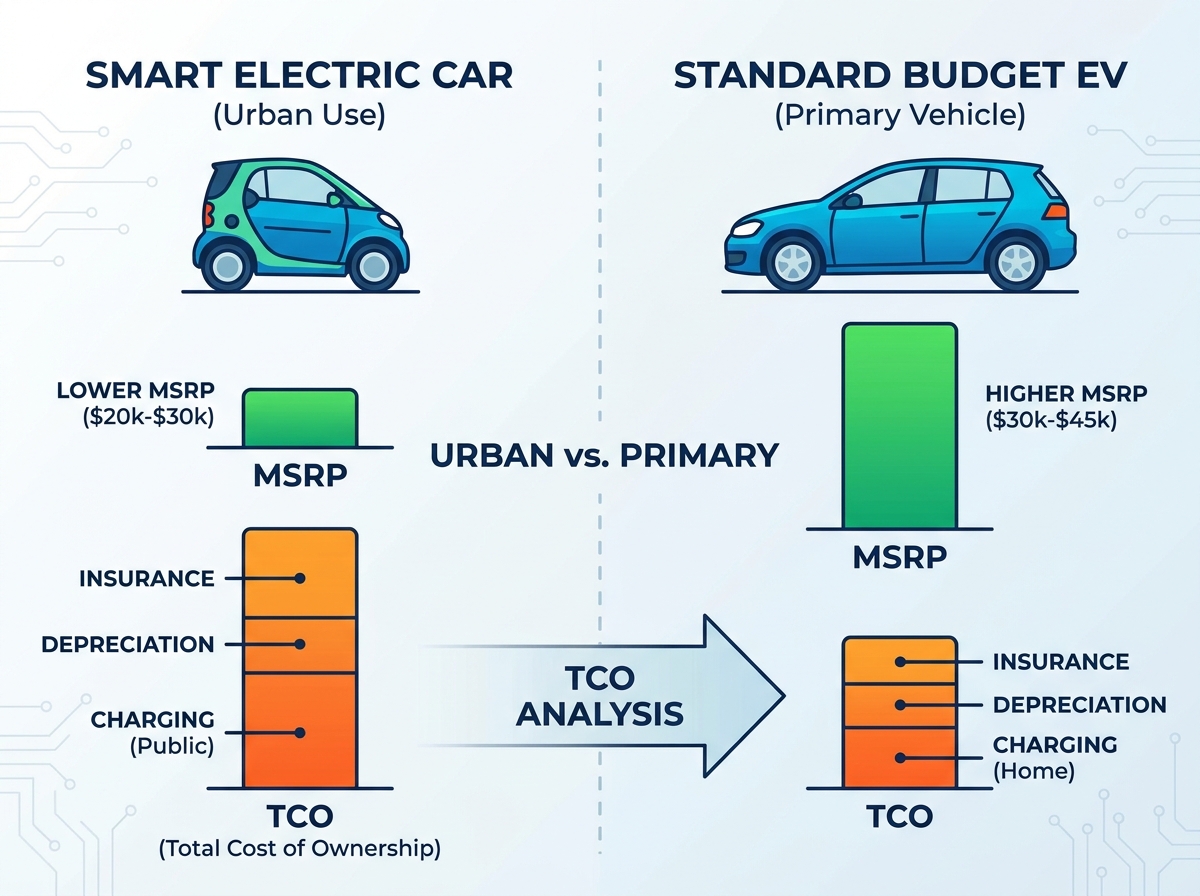
The affordable standard segment offers a distinctly different value proposition. We generally look at the $30,000 to $45,000 pricing tier here. This category includes popular models like the Nissan Leaf and Chevy Bolt. You will also find the entry-level Tesla Model 3 and Hyundai Kona in this bracket. Upgrading from a micro-EV to a standard model requires significant upfront capital. You typically pay a $10,000 to $15,000 premium. However, this premium usually doubles your battery capacity and significantly increases range.
Standard models provide much greater daily utility. They offer superior passenger capacity for families. You gain substantial cargo space for groceries, sports equipment, or luggage. These features allow a standard model to serve as a household's primary vehicle. You do not need to rely on a secondary gas car for normal activities. The suspension systems and noise insulation also provide a much better highway driving experience.
The secondary market heavily favors longer-range vehicles. Historical evidence shows that standard-range models hold their value better over time. Buyers on the used market experience intense range anxiety. They naturally gravitate toward vehicles with larger batteries. Ultra-compact city cars often face steeper depreciation curves. Their specialized nature limits the pool of interested second-hand buyers.
| Feature Category | Ultra-Compact EVs | Standard Budget EVs |
|---|---|---|
| Estimated MSRP (Before Incentives) | $20,000 - $30,000 | $30,000 - $45,000 |
| Average Battery Capacity | Under 40 kWh | 60 kWh - 75 kWh |
| EPA Estimated Range | 100 - 150 miles | 200 - 300+ miles |
| Primary Use Case | Urban Commuting / Delivery | General Purpose / Highway |
| Resale Value Retention | Low to Moderate | Moderate to High |
Evaluating electric options requires a systematic approach to range and infrastructure. You should use a range-to-price ratio framework to compare models. This formula calculates exactly how much you pay per mile of EPA-estimated range. It reveals the true financial efficiency of different vehicle classes. A $40,000 vehicle with 250 miles of range often provides better per-mile value than a $25,000 vehicle with 100 miles of range.
You must understand the different charging architectures available today. DC Fast Charging capabilities remain non-negotiable for standard models. You need fast charging to complete interstate travel efficiently. However, this expensive technology might be entirely unnecessary for a strict city commuter. A smart electric car used only for local driving can rely purely on overnight home charging. You must avoid the hidden time-cost of slow charging speeds on road trips. Waiting three hours to charge a small battery at a public station ruins travel plans.
Historical data on battery depreciation provides crucial insights. We see a high risk of rapid value loss in vehicles with sub-150-mile ranges. Consumer expectations change quickly as technology advances. The industry standard for battery capacity now sits comfortably at 250+ miles. Older models with limited range look obsolete to modern buyers. This obsolescence drives down trade-in values dramatically. You must factor this projected loss into your initial purchasing decision.
The decision to lease or buy dramatically alters your financial exposure. Leasing shields you against battery degradation worries. It also protects you from rapid technological obsolescence. If a better battery hits the market in three years, you simply return the vehicle. You can also exploit the current commercial lease loophole. Commercial tax credits are often passed down as capitalized cost reductions. This artificially lowers your monthly payments on compact models, making them highly affordable.
Buying makes sense under very specific conditions. You secure long-term financial advantages if you keep the vehicle for seven to ten years. After paying off the loan, you enjoy years of payment-free driving with low fuel costs. Buying works best for drivers whose daily mileage is highly predictable. If your commute stays well within the vehicle's maximum range, range anxiety disappears. You also avoid mileage penalty fees associated with strict lease contracts.
You must match your financing method to the vehicle class. Leasing serves as the safer financial vehicle for experimental or ultra-compact models. The technology evolves too fast to risk ownership of a limited-range car. Conversely, buying remains justifiable for a standard, long-range model. These larger vehicles offer enough baseline utility to remain useful for a decade. They adapt better to lifestyle changes like moving to the suburbs or having children.
Selecting the right vehicle profile requires brutal honesty about your driving habits. Many buyers overpay for capabilities they use only once a year. Others under-buy and suffer daily frustration. You can use these common mobility scenarios to guide your final decision.
You drive under 40 miles on a typical day. You face severe parking constraints at your apartment or office. You have reliable access to charging at home or work. You rarely take impromptu highway road trips. Recommendation: Lease an ultra-compact model. It handles tight spaces perfectly and keeps your monthly expenses minimal.
You mix highway commuting with city driving. You take occasional weekend trips to neighboring towns. You need ample cargo space for large grocery runs or family gear. You rely on this one vehicle for everything. Recommendation: Buy or lease a standard budget model. The larger battery and extra cabin space justify the higher initial price.
Do not visit a dealership until you complete this preparation phase. Follow these exact steps to protect your finances:
An ultra-compact electric model operates as a highly specialized financial tool. It excels brilliantly in tight urban environments and predictable daily commutes. However, it often fails when forced to act as a general-purpose household vehicle. You must respect its design limitations to enjoy its financial benefits. The cheapest option on paper easily becomes the most expensive choice in reality. If you constantly rely on pricey public fast-charging networks, your savings vanish. If you frequently rent a gas car for weekend trips, you negate your monthly fuel savings.
We encourage you to use a comprehensive expenses calculator before making a choice. Map your specific local utility rates against your exact commute distances. Compare those long-term operational numbers against the MSRP of your shortlisted vehicles. Taking these calculated steps ensures you buy the perfect vehicle for your actual lifestyle, rather than a speculative dream.
A: Eligibility depends heavily on battery sourcing and assembly requirements, not just vehicle size. Many compact models miss federal purchase credits because of foreign battery components. However, lease incentives often bypass these strict sourcing restrictions, allowing dealers to pass the credit to you.
A: Yes, physically smaller battery packs cost significantly less to manufacture and replace. However, because ultra-compact cars have lower overall residual values, replacing a battery out of warranty often costs more than the car is worth, leading to a total financial loss scenario.
A: You should expect a realistic range of $500 to $2,500 for a Level 2 setup. This covers the charger hardware and professional electrical labor. This is a sunk infrastructure cost that applies equally regardless of which vehicle size you eventually purchase.
A: They can be. Despite having lower base MSRPs, specialized replacement parts and unique frame designs can inflate repair costs. Furthermore, since these vehicles operate primarily in dense urban areas, actuaries associate them with higher minor-collision risks, which drives up premium rates.


