
Views: 0 Author: Site Editor Publish Time: 2026-11-19 Origin: Site


Procurement teams face a constant challenge when upgrading material handling fleets. Transitioning to modern equipment requires balancing steep upfront capital expenditure against long-term operational savings. Without a clear financial baseline, buyers risk overspending on capacity or getting blindsided by hidden installation and maintenance fees. This guide provides an objective, data-backed approach for evaluating vendors and comparing prices efficiently. You will learn how to dissect pricing across different equipment classes and fully understand battery technology impacts. We will explore exactly where your budget goes, from the initial chassis purchase to essential infrastructure upgrades. Warehouse managers, procurement officers, and operational directors can use these direct insights to confidently shortlist vendors and request accurate quotes. Equip yourself with the right knowledge to navigate charging requirements, maintenance factors, and daily operational demands effortlessly.
Let's look at the upfront reality of your purchase. Base chassis prices only represent about 30% of your entire financial picture. When you buy an electric forklift truck, the initial sticker shock often deters buyers. Internal combustion models seem cheaper initially. However, operational savings rapidly offset this premium within a few years. We frame this evaluation entirely around reduced maintenance and eliminated fuel dependency. Electric motors utilize significantly fewer moving parts than their gas counterparts. They require no engine oil, spark plugs, fan belts, or transmission fluid. You also eliminate traditional fuel costs entirely. Paying for grid electricity costs drastically less than buying propane or diesel fuel regularly.
To evaluate your investment accurately, use a standard evaluation framework. First, calculate your true cost per hour of operation. Compare your facility's commercial electricity rates against local fuel delivery prices. Next, factor in maintenance frequency and routine downtime costs. Internal combustion engines break down more often and require longer servicing windows. Finally, map out the expected asset lifespan. Electric lift equipment typically runs efficiently for 10,000 to 14,000 hours. Proper maintenance protocols can push this lifespan even further. Ignoring these long-term operational savings leads to short-sighted purchasing decisions.
Let's break down pricing across different equipment classes. The lifting capacity and chassis design directly influence your final invoice. Every warehouse operates differently, so choosing the correct equipment class prevents massive budget waste.
| Equipment Class | Average Price Range | Primary Application |
|---|---|---|
| Class I: Standard Sit-Down Rider (3-Wheel) | $20,000 – $35,000 | Narrow indoor aisles and tight corner turning. |
| Class I: Standard Sit-Down Rider (4-Wheel) | $25,000 – $45,000+ | Heavy lifting and intense loading dock operations. |
| Class II: Narrow Aisle Trucks (Reach/Picker) | $25,000 – $50,000+ | Maximizing vertical high-density warehouse storage. |
| Class III: Motor Hand Trucks / Pallet Jacks | $4,000 – $8,000 | Short-distance staging and light horizontal transport. |
You can expect a price range of $20,000 to over $45,000 for these workhorses. Evaluating these models involves choosing between 3-wheel and 4-wheel designs carefully. A 3-wheel configuration offers an incredibly tight indoor turning radius. It navigates narrow warehouse aisles beautifully. A 4-wheel model provides higher stability for uneven surfaces. Use it for heavy lifting and demanding loading dock usage. Buyers often default to 4-wheel models unnecessarily. If your facility features smooth concrete and tight corners, a 3-wheel unit saves space and money.
Pricing for Class II models ranges from $25,000 to $50,000 or more. This specialized category includes reach trucks and order pickers. The higher cost is justified entirely by storage efficiency. They allow you to maximize vertical warehouse storage space easily. Facilities handling high-density storage find these units absolutely essential. Instead of expanding your warehouse footprint, these machines help you build upward. The real estate savings alone justify the premium equipment price tag.
These compact units fall within an affordable $4,000 to $8,000 range. They serve as exceptional low-cost alternatives for busy staging areas. Use them for short-distance transport across flat warehouse floors. Investing in full ride-on equipment for simple pallet movement is overkill. A Class III electric forklift truck handles light warehouse duties perfectly. They keep your primary operators focused on high-level tasks rather than horizontal transport.
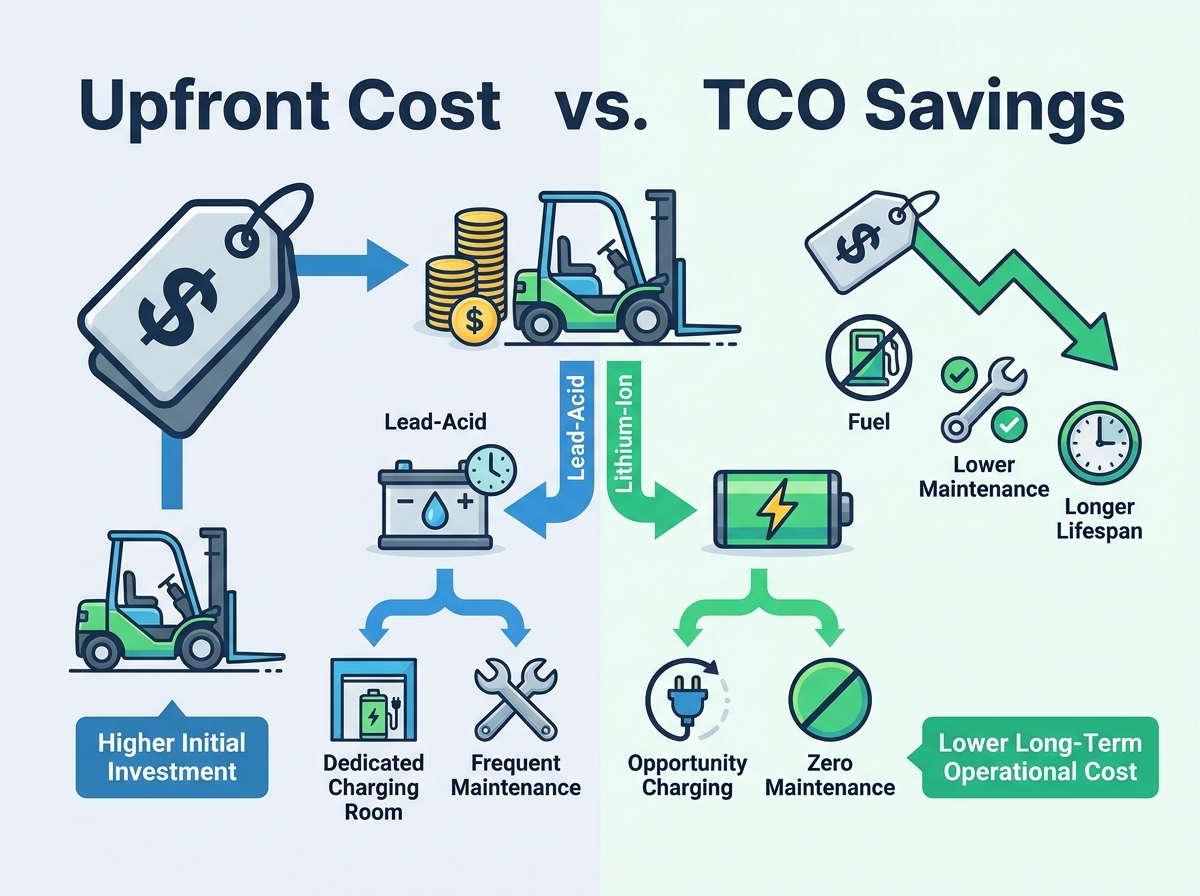
Your choice of battery technology massively impacts the initial purchase price. It also completely dictates your daily operational workflows and facility infrastructure requirements.
These traditional power sources feature a much lower initial purchase price. Buyers typically spend $4,000 to $6,000 per battery. However, they carry significant implementation risks and hidden facility costs. Lead-acid batteries require dedicated, heavily ventilated charging rooms. You must perform regular watering routines to maintain cell health. They also demand strict 8-hour charge and 8-hour cool-down cycles. Multi-shift operations require purchasing two or three batteries per machine. Swapping these heavy batteries mid-shift consumes valuable warehouse labor time. You effectively pay less upfront but sacrifice long-term productivity.
Modern power solutions command a high initial purchase price. Expect to pay $12,000 to $18,000 or more per battery. Despite this hurdle, the business outcome proves highly lucrative. They require absolutely zero maintenance and support opportunity charging seamlessly. Operators can plug them in during lunch breaks or short 15-minute pauses. They also last two to three times longer than traditional units. Over a five-year horizon, lithium-ion setups are often cheaper for multi-shift facilities. They eliminate dangerous battery swapping rooms entirely. This frees up profitable storage space for actual product inventory.
Deciding how to acquire your fleet is just as important as selecting the model. Each procurement path serves a distinct operational reality and budget constraint.
Purchasing new equipment works best for high-utilization facilities. Daily, multi-shift operations demand peak reliability. Warranty coverage and maximum battery life remain strict success criteria here. Buying new also allows for fully customized mast and attachment configurations. You can spec the exact machine your unique warehouse layout requires. You benefit from the latest safety features and energy efficiency improvements.
Refurbished units offer massive capital savings. Buyers typically secure 30% to 50% off the manufacturer's suggested retail price (MSRP). However, you must apply a strict evaluation lens. Used equipment is only viable for single-shift operations running under four hours per day. Buyers must verify battery health reports rigorously before committing. Always check hour-meter accuracy and ask for detailed maintenance logs. A cheap used unit quickly becomes a liability if the battery fails in month two.
Leasing preserves your working capital effectively. It shifts the ongoing maintenance burden directly to the dealer. This route is ideal for companies wanting predictable, fixed monthly operational expenses. You also get to upgrade your fleet every few years automatically. Renting operates entirely differently. Reserve renting strictly for seasonal demand spikes or emergency replacements. It carries the highest overall cost per hour. However, it requires zero long-term financial commitment. Return the equipment immediately once your peak season concludes.
Many buyers focus solely on the equipment sticker price. They forget to budget for facility preparation, infrastructure upgrades, and critical workforce adjustments.
High-frequency chargers require specific 3-phase electrical inputs. Most standard commercial spaces lack this heavy-duty industrial wiring. Facilities may need a comprehensive grid assessment before taking delivery of a new electric forklift truck fleet. Upgrading electrical panels and pulling new copper wire easily adds thousands to your deployment budget. Ignore this step, and your new equipment will sit uselessly on the loading dock.
Drivers accustomed to internal combustion engines need professional retraining. Transitioning to battery power requires adapting to aggressive regenerative braking systems. Electric motors also deliver instant torque differently than gas engines. Dedicated training ensures safe operation and prevents costly warehouse product damage.
Here are common mistakes to avoid during deployment:
Federal regulations dictate strict warehouse safety standards. OSHA mandates specific rules regarding battery handling and charging stations. If you use lead-acid batteries, you must install emergency eyewash stations nearby. Proper ventilation systems are legally required to disperse explosive hydrogen gas safely. Acid spill containment kits must remain accessible at all times. These mandatory compliance upgrades add substantially to your true deployment cost.
Making a smart purchasing decision requires a highly structured sequence. Follow these actionable steps to secure the best deal:
Separate the chassis price from batteries, chargers, and delivery fees. Encourage your procurement team to demand demonstration periods from shortlisted dealers. Validating performance claims in your own facility prevents costly mistakes before finalizing the purchase. Take action today by scheduling a facility power audit. This ensures your building can actually support the equipment you plan to buy.
A: A standard 5,000 lb electric forklift truck typically costs between $25,000 and $35,000. This base price includes a standard mast and carriage. If you add specialized attachments or opt for a lithium-ion battery package, the price will increase significantly. Always request an itemized breakdown to understand exactly what you are paying for.
A: Battery lifespan depends entirely on the chemistry you choose. Traditional lead-acid batteries last approximately 1,500 charging cycles when maintained correctly. Modern lithium-ion batteries easily exceed 3,000 cycles. Lithium-ion options require zero maintenance and support partial charging, making them last much longer in high-demand environments.
A: Yes, they perform exceptionally well outdoors. Modern electric models feature sealed components with high IP ratings to resist rain and dust. You must specify pneumatic tires for uneven outdoor yard operations. The myth that electric equipment belongs strictly indoors is outdated and factually incorrect.
A: Most facilities hit their breakeven point within 18 to 24 months. The higher upfront purchase price is rapidly offset by eliminating expensive fuel deliveries. Charging equipment on the electrical grid costs a fraction of buying propane. Drastically reduced maintenance requirements further accelerate this impressive return on investment.


