
Views: 0 Author: Site Editor Publish Time: 2026-11-15 Origin: Site


The shift from internal combustion engines to electric material handling equipment is accelerating rapidly. Stringent indoor air quality standards drive this change across many industries today. Long-term operational efficiency also plays a major role in modern fleet upgrades.
Operations directors face a distinct business problem. You must determine if higher upfront capital expenditures for these battery-powered models make sense. Facilities must match equipment capabilities against specific use cases, daily duty cycles, and building constraints. You need confidence before authorizing major infrastructure changes.
This article defines five industrial applications where electric forklifts offer the strongest operational alignment. We outline the exact implementation realities required for successful deployment. You will learn how to navigate facility audits, battery chemistry choices, and peak performance metrics.
Warehouse managers constantly look to maximize available storage space. You often achieve this by utilizing narrow racking aisles. However, maintaining safe indoor air quality remains a massive challenge. You want to avoid expensive ventilation system overhauls entirely. Zero tailpipe emissions make a massive difference in these environments. You eliminate the severe risk of carbon monoxide buildup inside enclosed spaces. Improved air quality keeps operators alert and compliant.
Compact chassis designs provide another distinct operational advantage here. Three-wheel electric models offer much tighter turning radii. They easily outperform their internal combustion counterparts in tight spots. This agility allows facilities to compress aisle widths significantly. You can often squeeze additional racking rows into the same building footprint. Maximizing pallet positions per square foot defines success in modern order fulfillment.
Success in these environments requires measuring specific daily outcomes. You need increased storage density without sacrificing movement speed. Sustained compliance with OSHA indoor air quality standards remains mandatory. Lower vibration and noise levels directly reduce operator fatigue over long shifts. Less fatigue translates directly into fewer accidents and higher pick rates.
You must also evaluate implementation risks carefully before proceeding. Assess whether your existing floor loading can handle concentrated weights. Heavy batteries act as counterweights but add significant mass to the chassis. This concentrated weight can stress floors in older, multi-story warehouse facilities. You need an engineering review before deploying heavy fleets on suspended concrete slabs.
Chart: Performance Metrics in High-Density Warehousing
| Operational Metric | Internal Combustion Engine (ICE) | Battery-Powered Equipment |
|---|---|---|
| Turning Radius | Wide (Requires wider aisles) | Tight (Optimized for narrow aisles) |
| Emissions Output | High (Requires heavy ventilation) | Zero (Safe for enclosed spaces) |
| Vibration & Noise | High (Causes operator fatigue) | Low (Improves operator comfort) |
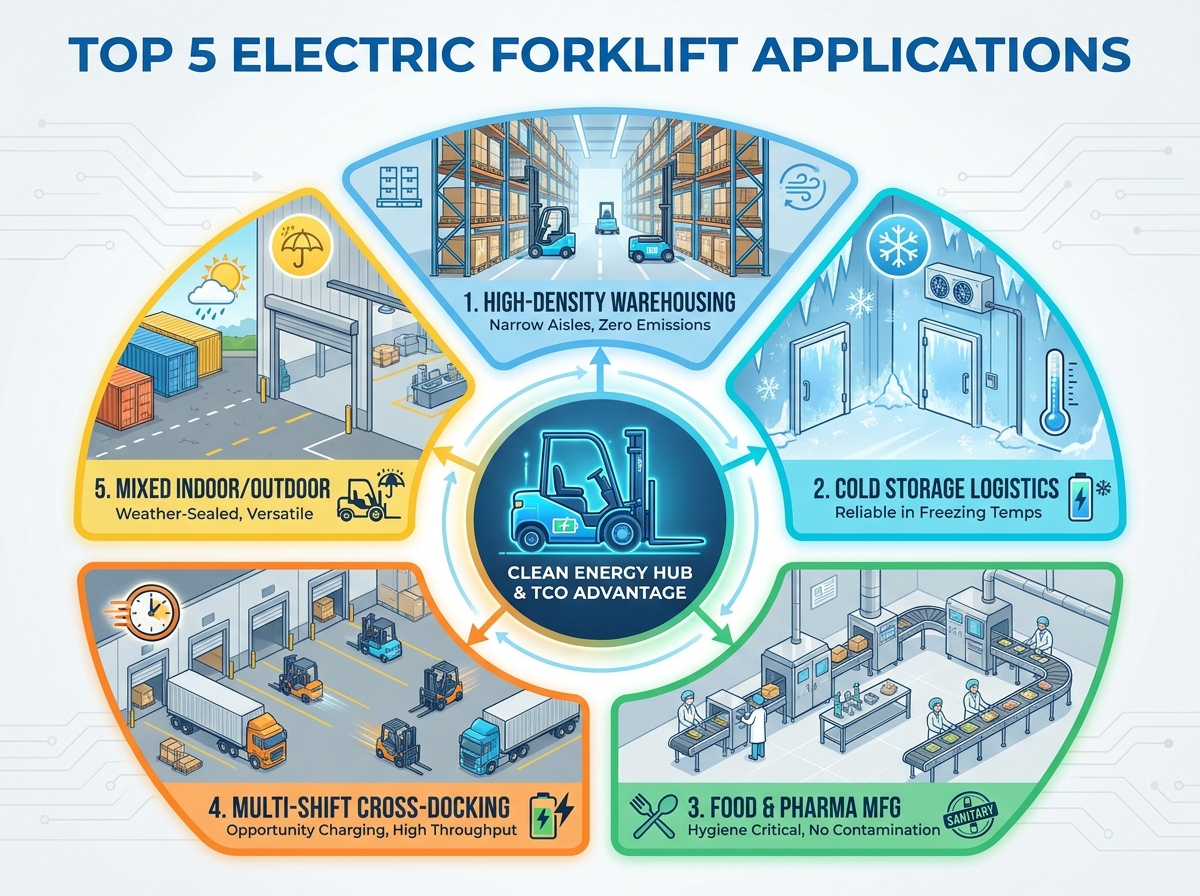
Operating material handling equipment in sub-zero environments is notoriously difficult. Engine stalling and fluid freezing cause massive headaches for facility managers. Excessive maintenance downtime ruins productivity schedules in fast-paced cold chains. Thickening engine oil and brittle hoses plague traditional combustion engines daily. You lose precious hours trying to keep conventional equipment running smoothly.
Electric motors solve many of these core operational issues instantly. They have far fewer moving parts overall. They do not rely on combustion processes to generate power. This makes them highly reliable in freezing temperatures. No exhaust heat means less strain on your facility's refrigeration systems. You save energy while moving products efficiently through blast freezers.
Battery technology plays a critical role in climate-controlled logistics. Lead-acid batteries suffer severe capacity drops in the cold. You must consider alternatives for deep freezing zones. Lithium-ion batteries feature integrated thermal management systems. Internal heater pads keep the cells operating at optimal temperatures. These systems are critical for sustained performance during long sub-zero shifts.
Implementation requires strict workflow planning and facility design changes. You often must locate charging stations outside the cold zone. Moving trucks between temperature zones causes dangerous condensation issues. Moisture buildup can short out sensitive electrical components quickly. You ensure efficient energy transfer by standardizing charging procedures in dry environments.
Moving heavy loads in highly regulated zones demands precision. Product contamination is always a zero-tolerance event in manufacturing. Sanitation-critical zones require specialized equipment designed for absolute cleanliness. Any introduction of foreign chemicals can shut down an entire production line. You simply cannot afford equipment-related recalls.
Battery power eliminates propane and diesel exhaust completely. You also remove dangerous particulate matter from the indoor air. You eliminate the risk of engine oil or radiator fluid leaks. Such leaks easily compromise sterile manufacturing environments. Maintaining FDA and USDA compliance becomes much simpler using these zero-emission machines.
You must focus on features driving clean outcomes daily. Look for models utilizing specialized food-grade hydraulic fluids exclusively. Wash-down ready enclosures are absolutely essential for beverage facilities. Seek out equipment carrying IP65 or higher ingress ratings. These robust ratings allow the equipment to withstand intense daily sanitation cycles safely.
Shortlisting logic must remain strict during the procurement phase. Only consider OEMs offering certified cleanroom-compatible models. Sealed component architecture is a non-negotiable feature for pharmaceutical spaces.
Maintaining continuous material flow drives high-throughput distribution environments. Equipment downtime directly impacts your shipping service level agreements. Historically, internal combustion engines dominated these fast-paced spaces. Fast refueling made them the default choice for three-shift operations. Managers resisted changing fleets because battery swapping seemed too slow.
Lithium-ion technology changes this dynamic completely for electric forklifts today. You can now handle multi-shift operations effectively without swapping batteries. Opportunity charging occurs during operator breaks and shift changes. Drivers simply plug the truck into a fast charger for fifteen minutes. This rapid energy transfer keeps the machine running constantly.
Operational scalability modeling is essential for this major transition. You must compare the logistics of one lithium-ion battery per truck. Compare this against the storage space required for older methods. Swapping multiple lead-acid batteries per shift consumes massive warehouse footprint. It also requires dedicated hoist equipment, eyewash stations, and expensive ventilation rooms.
Implementation carries specific infrastructure risks you must manage. Opportunity charging requires significant electrical infrastructure upgrades. Facilities must carefully audit peak electrical load capacity first. Do this before scaling your fleet across the entire warehouse floor. You might need utility companies to upgrade your local transformers.
Transporting raw materials from outdoor yards presents unique challenges. You move products directly onto indoor assembly lines continuously. Operators hate switching from diesel yard trucks to indoor lifts. It wastes time and creates unnecessary bottlenecks in material flow. You need a single machine capable of handling both environments seamlessly.
Heavy-duty electric machines bridge this operational gap beautifully. They feature aggressive pneumatic tires designed for rough outdoor surfaces. Weather-sealed cabins protect operators from rain and wind effectively. You get rugged outdoor durability combined directly with indoor emissions compliance. This versatility streamlines your raw material transport process.
Evaluation requires careful attention to component protection ratings. Always verify the ingress protection ratings before purchase. Check the electric motors and electronic controllers specifically for water resistance. You want IP54 or higher ratings for reliable outdoor yard work. Dust and moisture destroy unprotected electronics rapidly.
We must state a transparent assumption regarding outdoor performance. These machines perform exceptionally well on paved or packed-gravel yards. However, they generally underperform in certain harsh conditions. Deep mud and unpaved construction sites cause severe traction problems. Extreme weather conditions still favor rough-terrain diesel models currently.
Before shortlisting any brands, conduct a thorough facility readiness audit. You need a comprehensive electrical power study first. Determine if your building has the required amperage available. You might need a centralized charging room for your fleet. Alternatively, you may install distributed charging stations near break areas.
Operational lifecycle modeling requires careful calculation of your break-even point. Offset the higher initial purchase price and charger installation costs. You achieve this by eliminating fuel purchases entirely. You also gain massive savings from reduced preventive maintenance schedules. You no longer need engine oil changes or spark plugs. Transmission flushes become a thing of the past.
Shortlist vendors based on their local dealer service network responsiveness. Demand complete diagnostic software transparency from your service partners. Review warranty terms specifically surrounding battery degradation over time. Look closely at the five-to-seven-year operational cycle guarantees. You need assurance regarding battery capacity retention.
Initiate a single-unit pilot program as your immediate next step. Focus this pilot on your most demanding shift schedule. Validate real-world battery draw accurately under heavy loads. Ensure operator acceptance before committing to a full fleet transition.
Table 1: Pilot Program Evaluation Metrics
| Evaluation Area | Specific Metric to Track | Target Outcome |
|---|---|---|
| Battery Performance | State of Charge (SoC) at shift end | Above 20% without mid-shift charging |
| Operator Ergonomics | Reported fatigue levels | Positive feedback on noise/vibration |
| Charging Workflow | Time spent connecting to chargers | Under 2 minutes per connection event |
| Maintenance Time | Daily inspection duration | Reduced pre-shift inspection time |
Battery-powered equipment is no longer limited to light-duty warehouse tasks. Implementing the right battery chemistry and charging infrastructure transforms your fleet capabilities. These machines provide massive operational advantages across high-density storage and cold chain environments. They excel in sanitary manufacturing and high-throughput distribution centers. You gain significant efficiency improvements daily.
The decision to transition requires a thorough facility power audit. You need a precise understanding of your operational duty cycles. Do not base this decision on environmental claims alone. Action-oriented next steps include mapping your peak electrical loads. You should also start tracking single-unit performance metrics immediately to justify the upgrade.
A: Older lead-acid models may experience slight performance drops near the end of a charge cycle. Modern Lithium-ion powered electric forklifts deliver sustained, flat-line voltage. This ensures consistent lifting capacity until the battery is completely depleted.
A: Yes, provided they are explicitly designed for outdoor use. Models must feature pneumatic tires and sealed electrical components. Always check for specific IP water-resistance ratings. They are not, however, recommended for deep water fording or severe flooding.
A: It depends entirely on the battery chemistry. Lead-acid batteries typically require 8 hours to charge followed by an 8-hour cooling period. Lithium-ion batteries can fully charge in 1 to 2 hours. Drivers can also opportunity charge them in 15-30 minute increments during breaks.
A: Properly maintained lead-acid batteries last approximately 1,500 charge cycles. This equals about 5 years in a single-shift operation. Lithium-ion batteries generally last 2,000 to 3,000 cycles. This provides up to 7-10 years of life, depending on usage intensity and charging habits.


