
Views: 0 Author: Site Editor Publish Time: 2026-11-17 Origin: Site


Fleet managers face a common dilemma when upgrading material handling equipment. Electric forklifts typically carry a higher initial sticker price than traditional internal combustion models. This upfront premium often creates intense hesitation within the purchasing department. Buyers naturally want to protect capital reserves. However, evaluating acquisition costs in isolation consistently leads to inaccurate procurement decisions. The true financial impact extends far beyond the initial factory invoice. You must actively account for site infrastructure readiness, daily energy consumption, and the entire operational lifecycle. Relying solely on the base price ignores massive downstream financial variables. This article provides a transparent, evidence-based breakdown of upfront equipment prices. We will thoroughly explore hidden facility requirements alongside long-term operational savings. Finally, you will learn how to construct an accurate return on investment model. This structured approach empowers buyers to make highly confident, data-driven fleet decisions.
Procurement teams often experience sticker shock during their initial research phase. You need a clear understanding of what drives this pricing. The initial invoice breaks down into several distinct component categories. Each component heavily influences the final capital expenditure.
The bare equipment price forms the foundation of your investment. Manufacturers price the chassis based on load capacity and maximum lift height. Heavy-duty applications require stronger masts and larger counterweights. These structural enhancements increase manufacturing expenses. Tire selection also shifts the baseline cost. Standard indoor cushion tires generally cost less. Outdoor pneumatic tires require robust axles and specialized tread designs. You must align chassis specifications precisely with your daily operational demands. Overspecifying the chassis wastes capital.
The power source represents a massive portion of the initial price tag. Buyers must choose between two dominant chemistry types. Each type carries distinctly different financial profiles.
Standard wall outlets cannot replenish industrial batteries. You must purchase compatible high-frequency chargers. These specialized electrical units add significant expense to the initial invoice. Material handling attachments also influence the final price. Side shifters, paper roll clamps, and rotators cost extra. These mechanical attachments draw additional power from the battery. You must factor this energy draw into your initial battery capacity calculations. Undersized batteries will struggle to power heavy attachments throughout a full shift.
Many buyers ignore the physical warehouse requirements. Integrating electric forklifts demands specific facility preparations. Failing to budget for these upgrades leads to severe project delays. You must audit your facility before signing any purchase orders.
Industrial chargers draw massive amounts of alternating current (AC). You must carefully assess your warehouse electrical panel. The current infrastructure might easily support a single unit. However, multi-unit charging bays often exceed existing grid limits. Upgrading utility panels and running new conduit lines costs thousands of dollars. You might also face increased peak-demand charges from your local utility company. Consult a licensed electrician early in the procurement phase. They will identify necessary power upgrades before equipment delivery.
Floor space acts as premium real estate in any warehouse. Traditional lead-acid batteries force operations to sacrifice valuable square footage. You must build dedicated charging rooms. Lead-acid batteries release hydrogen gas during their charging cycles. This off-gassing creates serious explosion risks. You must install specialized ventilation fans to mitigate these risks. Lithium-ion chemistry entirely bypasses this off-gassing problem. However, lithium setups still require localized charging stations spread throughout the facility. You must route power directly to these specific parking zones.
Transitioning equipment types introduces new safety compliance requirements. Multi-shift operations often swap depleted lead-acid batteries mid-shift. These industrial batteries weigh several thousand pounds. You must purchase structural hoists or specialized extraction equipment. Personnel also require specific personal protective equipment (PPE). Acid-resistant aprons, face shields, and specialized gloves are mandatory. Safety regulations also mandate plumbed eyewash stations near any lead-acid charging zone. These compliance-driven facility additions represent hidden capital expenditures.
The financial narrative shifts dramatically once operations begin. The heavy initial capital expense slowly amortizes. Routine operating expenses plummet compared to traditional equipment. You will start recovering the premium immediately upon deployment.
Powering a fleet represents an ongoing financial drain. You must calculate the exact per-hour cost of industrial electricity. Compare this figure against bulk diesel or liquid propane gas (LPG) pricing. Electricity rates remain remarkably stable compared to volatile fossil fuel markets. Facilities often charge batteries overnight during off-peak utility hours. This strategy secures the lowest possible energy rates. Conversely, diesel and propane incur delivery fees, fuel storage constraints, and unpredictable global market pricing. The energy cost differential drives massive long-term savings.
Internal combustion engines rely on hundreds of moving parts. They generate intense heat and constant vibration. This mechanical stress guarantees frequent component failure. Battery-powered equivalents utilize simple AC motors. They have drastically fewer moving parts. You eliminate engine oil changes entirely. Spark plugs, transmission fluids, and radiator maintenance disappear from your budget. Mechanics spend less time servicing equipment and more time optimizing performance. This simplified architecture fundamentally reduces your preventative maintenance budget.
Routine Maintenance Comparison Overview
| Maintenance Action | Internal Combustion Models | Battery-Powered Models |
|---|---|---|
| Engine Oil Changes | Required every 250 hours | Eliminated completely |
| Transmission Fluid | Required every 1000 hours | Eliminated completely |
| Spark Plugs / Belts | Frequent replacement | Eliminated completely |
| Brake Servicing | High wear from mechanical braking | Low wear due to regenerative braking |
Lost operational time destroys warehouse profitability. Mid-shift propane tank swaps disrupt workflow. An operator stops working, drives outside, and physically replaces a heavy tank. This process takes ten to fifteen minutes multiple times per week. Modern lithium-ion solutions utilize opportunity charging. Operators simply plug the equipment in during lunch breaks. The equipment regains power while the operator rests. You also reduce out-of-service maintenance days. Higher equipment uptime translates directly into increased pallet movement and improved facility productivity.
Evaluating long-term economic viability requires strategic foresight. The initial invoice tells only a fraction of the story. You must map out cumulative expenses over a five-to-seven-year operational window. This comprehensive framework reveals the true financial winner.
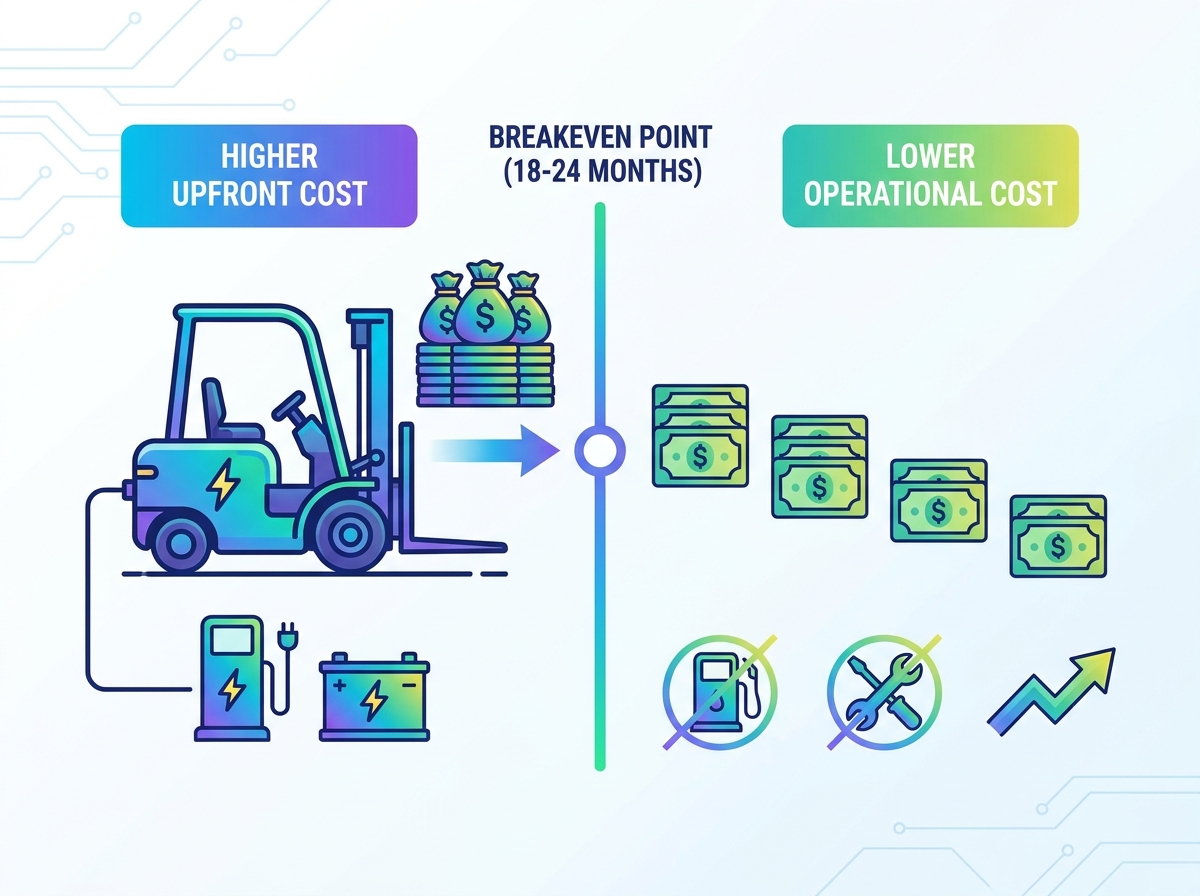
Every procurement model seeks a crossover point. This point represents the exact moment cumulative savings surpass the initial premium. You calculate the higher upfront cost of battery-powered models. Next, you plot the escalating fuel and maintenance costs of diesel alternatives. The diesel expense line climbs aggressively every month. The battery-powered expense line remains relatively flat. Eventually, these two lines intersect. After this breakeven point, the battery-powered equipment generates pure operational savings. Understanding this timeline is crucial for CFO approval.
Facility utilization rates dictate the speed of financial recovery. The operational intensity acts as an economic multiplier.
Equipment longevity severely impacts long-term capital planning. Internal combustion engines degrade heavily after 10,000 hours of use. Their resale value plummets as engines require complete rebuilds. Conversely, industrial electric motors generally outlast internal combustion engines. The solid-state architecture protects the core chassis from intense mechanical vibration. This extended useful life delays your next capital replacement cycle. It also drastically improves the residual resale value of the chassis on the secondary market.
Transitioning power sources introduces unique operational challenges. You cannot simply drop new equipment into old workflows. Facilities must proactively address environmental and human factors. Ignoring these realities leads to premature equipment failure.
Extreme environments challenge chemical battery performance. Cold storage facilities heavily impact battery discharge rates. Freezing temperatures increase internal resistance within the cells. This degradation alters expected runtimes and forces more frequent charging cycles. Conversely, extreme outdoor heat accelerates cell degradation. You must consult manufacturers about thermal management systems. Many modern batteries include internal heaters for freezer applications. Understanding your facility's specific climate constraints prevents unexpected power loss during peak shifts.
Human behavior directly impacts battery longevity. You must implement aggressive operator training programs. Lead-acid batteries require strict watering schedules. Skipping these schedules ruins the battery cells permanently. Lithium-ion chemistry requires opportunity charging disciplines. Operators must learn to plug in the equipment during short breaks. If operators treat lithium systems like traditional propane tanks, the equipment will die mid-shift. Successful transitions rely on strong management enforcement. You must change warehouse culture alongside the equipment.
Government policies increasingly penalize fossil fuel usage indoors. Tightening indoor air quality regulations force many facilities to abandon propane. You must factor regulatory compliance into your purchasing strategy. Furthermore, zero-emission equipment often qualifies for financial subsidies. Local governments and utility companies frequently offer substantial rebates. These incentives artificially lower the initial capital burden. Transitioning also supports corporate Environmental, Social, and Governance (ESG) goals. Cleaner warehouses improve worker health and boost corporate sustainability profiles.
Generic price estimates create dangerous financial blind spots. You need granular, facility-specific data to secure precise pricing. Establishing a strict procurement methodology protects your budget. Follow a structured path when engaging material handling vendors.
Approaching a vendor without internal data wastes time. Ballpark pricing is inherently dangerous. You must prepare a detailed operational baseline before requesting a quote. Document your maximum required load weight. Measure the exact height of your highest racking tier. Calculate the average run hours per daily shift. Note any steep ramps or uneven flooring surfaces. Vendors use this specific data to size the chassis and battery capacity accurately. Missing details lead to undersized, underperforming equipment.
Never accept a final quote without a physical facility inspection. Reputable vendors will mandate an on-site survey. They must physically assess your warehouse flooring conditions. Aisle widths dictate the required turning radius of the equipment. The vendor must verify your existing electrical panel capacity. They will map out potential charging station locations. A proper site survey uncovers hidden infrastructure bottlenecks. This hands-on evaluation ensures the final quote covers all necessary facility modifications.
Do not let the initial invoice dictate your final decision. You must insist that suppliers provide a five-year long-term expense projection. Place this projection directly alongside the factory quotation. Ensure the vendor includes estimated electricity costs, preventative maintenance schedules, and replacement parts. This data provides an apples-to-apples comparison against diesel alternatives. A supplier unwilling to model long-term operational expenses likely hides future maintenance burdens. Demand complete financial transparency from your chosen vendor.
The true financial impact of an electric material handling fleet involves a delicate balancing act. You face heavy upfront capital requirements. However, you secure aggressive, guaranteed long-term operational savings. Understanding this inverse relationship is vital for warehouse profitability. Facilities running double shifts indoors should view this transition as an absolute inevitability. The daily fuel and maintenance savings simply become too large to ignore. Conversely, low-hour or heavy-duty outdoor yards must weigh the infrastructure costs carefully. We strongly encourage readers to step away from generic online estimates. Contact a reputable manufacturer to request a custom factory quotation. Pair this quote with a comprehensive site assessment based on your specific facility metrics.
A: Replacement prices vary drastically based on chemistry and voltage. Standard lead-acid batteries typically range between $3,000 and $7,000. Advanced lithium-ion batteries cost significantly more, often ranging from $12,000 to $20,000. The battery represents a massive portion of the truck's total value. Always factor replacement timelines into your long-term budget planning.
A: Lifespan depends entirely on chemistry and maintenance. Traditional lead-acid batteries typically last for about 1,500 charging cycles. This equates to roughly five years in a single-shift operation. Modern lithium-ion batteries easily exceed 3,000 charging cycles. They often last up to ten years without experiencing significant power degradation.
A: Used models save capital but carry hidden risks. The primary concern is acquiring severely degraded batteries. A weak battery instantly destroys productivity and requires expensive replacement. If you buy used equipment, always require a formal battery discharge test. This test verifies the remaining cell capacity before you finalize the purchase.
A: Yes, provided they have the correct specifications. Standard indoor cushion tire models lack proper weather sealing. However, manufacturers build outdoor pneumatic tire models with high IP (Ingress Protection) ratings. These sealed components protect sensitive motors and controllers from rain, dust, and heavy debris. Always verify the IP rating for outdoor yard use.


