
Views: 0 Author: Site Editor Publish Time: 2026-11-16 Origin: Site


Purchasing or leasing warehouse equipment represents a massive capital-intensive decision. It directly impacts your daily operational throughput and your facility's overall safety. Making the wrong choice carries heavy financial and logistical consequences. You simply cannot afford guesswork here. Unfortunately, manufacturer specification sheets are dense and often incredibly tough to navigate. Misunderstanding a single metric can render a machine completely unusable in your specific environment. A misjudged load center or an overlooked collapsed mast height often creates immediate operational bottlenecks.
We designed this guide to help you prevent these common, costly purchasing errors. You will learn exactly how to translate technical specifications into practical operational outcomes. We will show you how to validate vendor claims effectively using objective data. By the end, you will confidently shortlist the perfect equipment to elevate your facility's productivity.
Equipment evaluation often fails early in the procurement process. Buyers frequently review specifications in a vacuum. They forget to map these numbers to the physical realities of their warehouse. You must evaluate every metric against your building's strict layout. Your racking architecture dictates the maximum allowable dimensions of any machine. Narrow aisles leave zero room for operator error. A machine might look perfect on paper. However, it will fail miserably if it cannot navigate your physical space efficiently.
You must define your baseline requirements before reading any specification sheets. Establish your throughput success criteria using these key factors:
Common Mistakes:
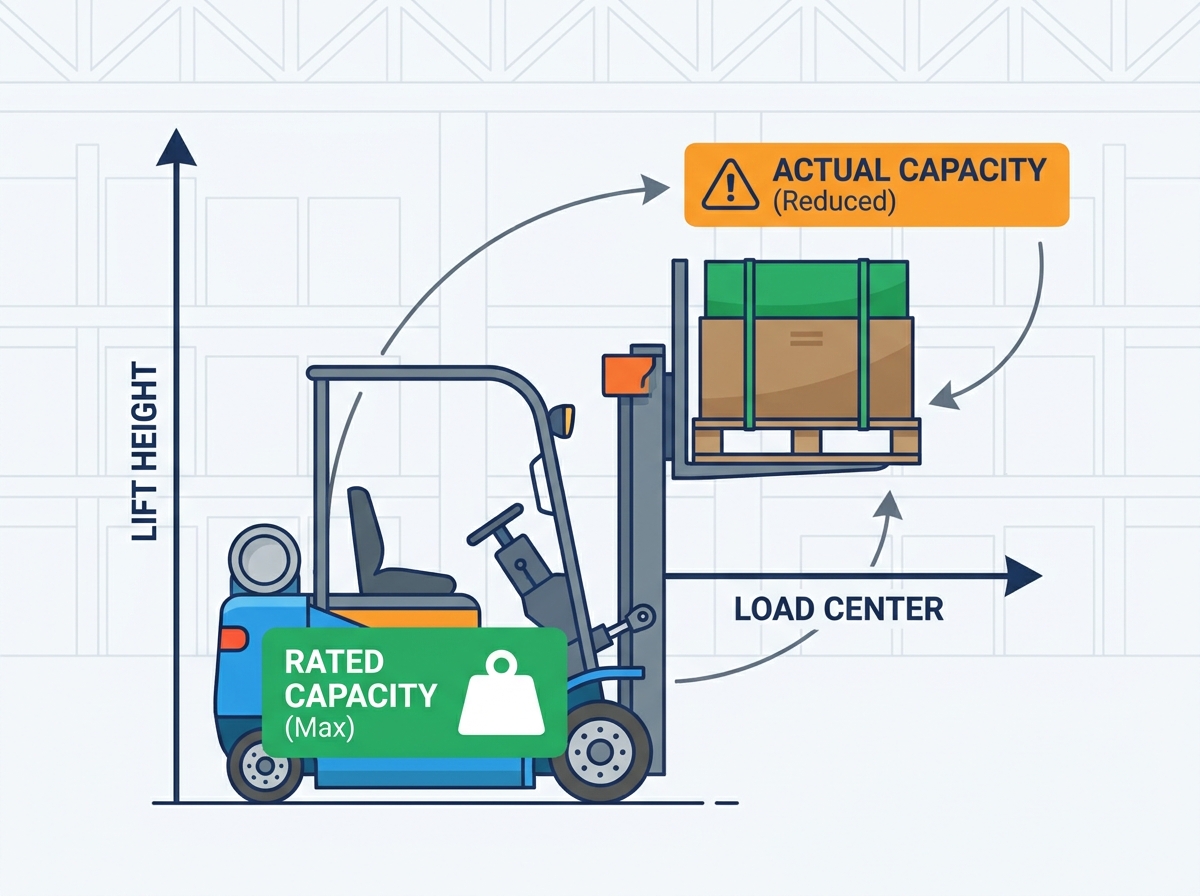
You must distinguish between rated capacity and actual capacity. Rated capacity reflects an idealized manufacturer testing scenario. Actual capacity shows what the machine safely lifts in your specific facility under real conditions. The standard load center typically measures 24 inches from the fork face. This standard assumes you handle perfectly symmetrical pallets.
Real-world operations rarely use perfect pallets. Oversized or awkwardly shaped loads instantly downgrade the safe lifting capacity. If a machine boasts a 5,000-pound capacity at a 24-inch center, extending the load to 30 inches drastically cuts this capacity. The physics remain unforgiving. Operators risk severe tipping accidents if they ignore this rule.
Best Practices:
You must align mast specifications to your precise racking geometry. Maximum Fork Height (MFH) requires careful calculation. Match this metric to your highest rack level plus a safe clearance buffer. Operators need enough room to lift and securely place the pallet without hitting the ceiling.
Overall Lowered Height (OALH) is equally crucial to operational safety. You must measure your standard doors and your loading dock doors. Do not forget to check your ceiling sprinkler system clearances. A tall collapsed mast can cause devastating overhead collisions.
Free Lift represents another non-negotiable specification. It dictates how high the forks rise before the inner mast channels extend upward. You absolutely need full free lift for loading closed trailers. Operating in areas holding strict height restrictions also requires this feature.
Mast Specification Comparison
| Specification Metric | Technical Definition | Critical Facility Constraint |
|---|---|---|
| Maximum Fork Height (MFH) | The highest point the forks reach when fully extended. | Must exceed the top rack level plus 6 inches of lift-off clearance. |
| Overall Lowered Height (OALH) | The height of the mast when completely lowered to the floor. | Must clear the lowest doorway, dock door, or ceiling obstruction. |
| Free Lift | The height forks can reach before the mast structure extends upward. | Essential for working inside enclosed semi-trailers or basements. |
Gradeability dictates how well the machine climbs inclines while fully loaded. Evaluate these specs carefully if operators navigate steep ramps daily. Uneven loading docks also demand high gradeability ratings. A low gradeability rating causes the machine to stall dangerously on steep inclines.
You must also balance top travel and lift speeds. High speeds look impressive on marketing brochures. However, you must weigh them against strict safety compliance. Actual facility speed limits often cap how fast operators can legally drive. Prioritize smooth acceleration and precise braking over absolute top speed.
When configuring electric forklifts, choosing the right voltage is critical for daily success. Standard configurations typically include 24V, 36V, 48V, and 80V systems. You must match the voltage directly to your application intensity. A 24V system handles light duty perfectly. Conversely, an 80V system excels in heavy-duty, multi-shift indoor and outdoor applications.
The chemistry debate centers primarily around operational disruption. Lithium-ion batteries offer incredible convenience and uptime. They support opportunity charging during standard operator breaks. They require zero watering or daily mechanical maintenance. Lead-acid batteries present a vastly different workflow. They demand dedicated battery swapping stations to keep shifts moving. Operators must also adhere to strict watering schedules to prevent battery death.
Amp-hour (Ah) ratings tell you exactly how much energy the battery holds. Reading Ah ratings properly helps project realistic shift run-times. Do not rely solely on generalized manufacturer estimates. Calculate your specific lift-to-travel ratios to understand actual energy drain. Factor in your average daily load weights. Heavy loads and constant high lifting drain batteries significantly faster than simple horizontal travel.
Buyers routinely overlook a major implementation risk here. Upgrading a facility's electrical grid is highly expensive and time-consuming. Fast-charging lithium-ion systems draw massive amounts of instant power. Your current electrical panel might lack the required amperage capacity to support multiple chargers.
Lead-acid batteries carry their own expensive infrastructure burdens. You must outfit a compliant, well-ventilated room for charging. Lead-acid off-gasses dangerous hydrogen during the standard charging cycle. This requires specialized exhaust fans, eyewash stations, and safety equipment. Always audit your building's current infrastructure before selecting a battery chemistry.
Maneuverability directly impacts how many pallets you can effectively store. The Right-Angle Stack (RAS) specification stands as your most important space metric. It defines the definitive minimum aisle width required for safe operation. RAS measures the space needed to turn a load 90 degrees and place it perfectly on a rack.
Use this standardized calculation formula to ensure absolute safety in your aisles:
RAS + Load Length + Clearance = Minimum Aisle Width.
Clearance usually demands at least 12 inches of buffer space. Do not skip the clearance buffer to squeeze in extra racks. Skimping on clearance causes costly rack damage and slows down your operators considerably.
Tire choice severely impacts the overall footprint and machine performance. Cushion tires consist of solid rubber wrapped around a metal band. They suit smooth indoor concrete floors perfectly. They allow the machine to maintain a very compact chassis, tightening your turning radius.
Pneumatic tires use compressed air. Solid pneumatic variants use solid rubber shaped identically to pneumatic tires. You need these for rough terrain applications. They also dominate hybrid indoor/outdoor operational environments. Keep in mind pneumatic models require a noticeably larger chassis. This larger footprint increases your required aisle widths dramatically.
You must address the physical operating weight of your new equipment. Batteries act as a crucial, heavy counterweight to prevent tipping. Ensure your facility floors can actually support this dense machinery. A fully loaded machine exerts tremendous point pressure on your concrete slabs.
You must also verify commercial trailer bed capacities. Operating a heavy machine inside an older trailer can cause sudden, catastrophic floor failure. Always calculate the combined weight of the machine, the heavy battery, and your absolute maximum load. Give these numbers to your facility engineer for verification.
Modern specification sheets feature advanced digital capabilities. Evaluate them for comprehensive fleet management compatibility. Impact sensors provide crucial operational accountability. They record precisely when an operator strikes a rack or wall. Access control features ensure only certified operators start the machinery using unique badges. These digital tools drastically reduce unmeasured facility damage over time.
Ergonomics directly drive your total shift productivity. You must translate cabin specs into human comfort metrics. Cabin visibility determines how fast an operator can safely move through busy zones. Advanced suspension seats reduce debilitating back fatigue over an intense eight-hour shift. Intuitive control layouts minimize painful repetitive strain injuries. Better ergonomics always result in higher daily productivity and much lower staff turnover.
Never accept a quote without a comprehensive site visit. Trustworthy vendors will not finalize a recommendation blindly over email. They must physically measure your facility aisles and doors. They need to observe your current operation in motion. A skilled vendor will spot hidden overhead hazards you might easily miss.
Create a standardized evaluation matrix for all competing quotes. Vendors often try to highlight different metrics to stand out. You must force them into identical comparison categories. Ensure they quote identical mast types and lift heights. Verify the battery chemistries and amp-hours match exactly. Check the tire configurations line by line. An abnormally cheap quote usually hides a severely compromised specification.
Take concrete steps before signing any long-term contracts. Request an onsite trial period. Demand a physical demonstration inside your own facility. Test the machine using your actual loads and existing racks. Validating quoted specifications in the real world prevents disastrous long-term financial commitments.
Finding the ideal warehouse equipment requires strict operational discipline. The perfect machine seamlessly bridges operational demands and physical facility constraints. Never view a specification sheet as merely a list of numbers. Treat it as a direct blueprint for your daily productivity and safety. We strongly encourage buyers to prioritize comprehensive site assessments over purely upfront price comparisons. The cheapest machine instantly becomes a massive mistake if it cannot clear your dock doors safely. Map your exact facility measurements first. Standardize your vendor evaluations rigidly. Finally, demand a real-world demonstration to validate every single manufacturer claim before making your final procurement decision.
A: The safe lifting capacity immediately drops. The machine's center of gravity shifts dangerously forward. This creates a severe risk of the equipment tipping over. You must calculate accurate capacities based on your longest loads to maintain facility safety.
A: Yes. They contain significantly fewer moving mechanical parts, eliminating oil changes and spark plug replacements. However, maintenance shifts heavily toward electrical diagnostics. You must prioritize daily battery care, cable inspections, and motor controller updates to ensure longevity.
A: Yes, but only if configured correctly. You must select models with high IP (Ingress Protection) ratings. These feature heavily weather-sealed electrical components. Additionally, you must equip them with pneumatic tires to handle wet, uneven outdoor terrain safely.
A: You must use the Right-Angle Stack formula. Add the machine's Right-Angle Stack (RAS) metric, your maximum load length, and a safety clearance buffer. We recommend using at least 12 inches for the clearance buffer to prevent rack damage.
A: Rapid advancements in lithium-ion technology make leasing highly attractive. Leasing mitigates the risk of sudden battery obsolescence. It allows you to upgrade to faster-charging, more efficient power systems every few years without dealing with asset depreciation.


