
Views: 0 Author: Site Editor Publish Time: 2026-11-11 Origin: Site


Small businesses face immense pressure to modernize operations today. Volatile fuel costs aggressively drain your operational budgets. Environmental, Social, and Governance (ESG) expectations push you toward greener alternatives. You might think buying a commercial electric car solves these issues immediately. However, transitioning an entire fleet requires more than just a simple vehicle purchase. It represents a complex infrastructure and compliance decision. You cannot simply buy vehicles and figure out charging later. You need a rock-solid, comprehensive operational strategy first.
This article provides a hype-free, evidence-based evaluation framework. We will examine 2023's top commercial models carefully. Our focus remains heavily on real-world range, operating economics, and daily infrastructure demands. By the end, you will understand exactly how to shortlist vehicles effectively. We strip away the flashy marketing jargon completely. You receive highly actionable insights to protect and grow your business bottom line.
You must establish clear success criteria before purchasing any fleet vehicles. Set baseline metrics for your desired Return on Investment (ROI). Identify a strict target cost-per-mile reduction for your daily operations. Determine acceptable maintenance downtime limits. Conventional gas-powered vans spend significant time in repair shops. Electric models reduce this downtime significantly. You need to quantify exactly how much time your drivers currently lose to oil changes and transmission repairs.
Evaluate the lifecycle cost equation closely. Compare higher upfront acquisition costs against projected fuel savings. Electric fleets benefit from massively reduced preventive maintenance needs. Electric motors lack complex moving parts requiring constant lubrication. You must also factor in regional utility rates for commercial charging. Commercial electricity costs vary wildly across different municipalities. Compare peak versus off-peak electricity prices carefully. Charging your fleet overnight often unlocks much cheaper utility rates. Relying on daytime public charging can erase your projected fuel savings entirely.
Navigate available tax incentives carefully to offset acquisition costs. The federal Commercial Clean Vehicle Credit offers massive financial help. You can claim up to $7,500 for qualifying light-duty vehicles. Heavy-duty options sometimes qualify for even more substantial credits. Research state-level rebates active in your operating area. Many states offer supplementary funds stacking on top of federal money.
Prepare for upcoming zero-emission zone compliance requirements. Many urban centers plan to restrict gas-powered deliveries soon. Some cities already impose heavy fees on combustion engine vehicles entering downtown areas. Adding a commercial electric car to your fleet early prevents future compliance headaches. You future-proof your logistics network ahead of strict local mandates.
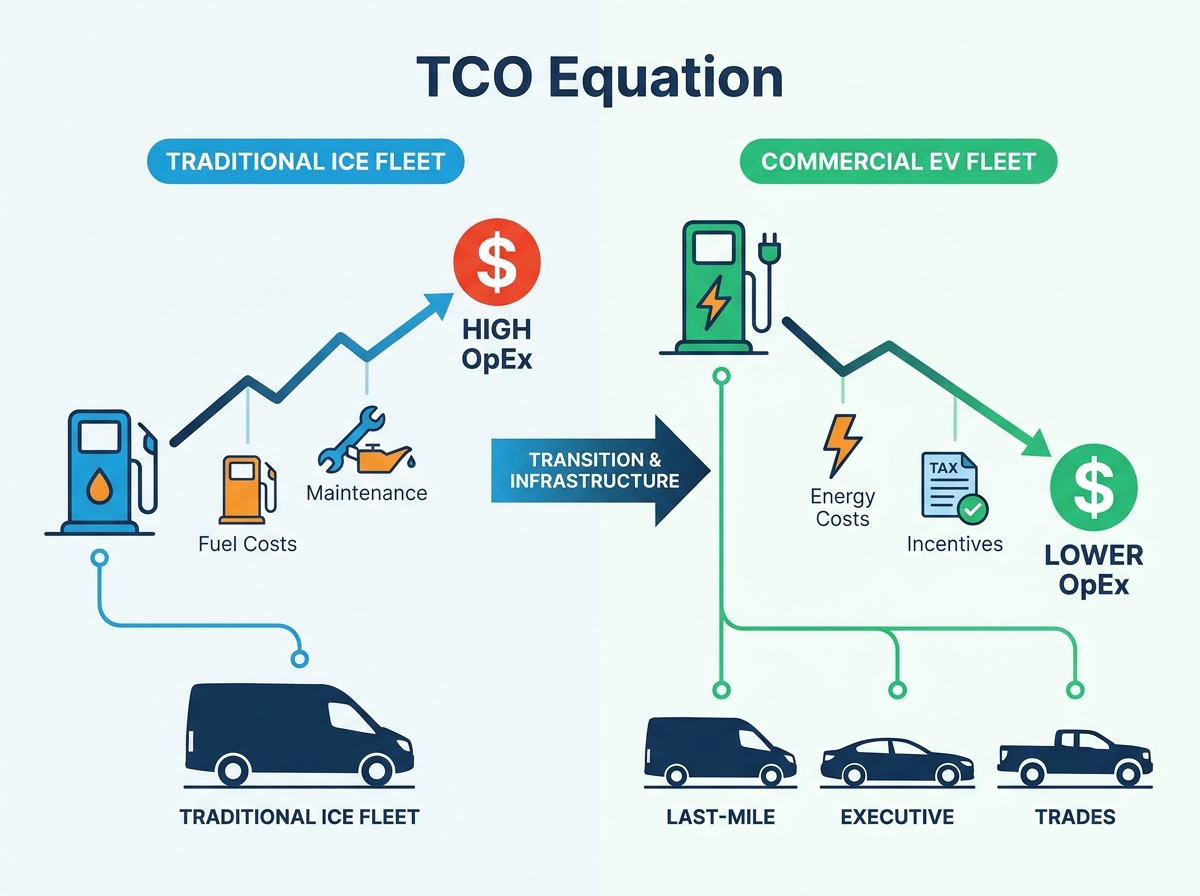
Different business operations require entirely different vehicle architectures. You cannot force a luxury sedan into a heavy construction role. You must align your procurement strategy directly to your daily physical requirements.
2023 Commercial Vehicle Categories Overview
| Category | Primary Focus | Ideal Route Type | Example Models |
|---|---|---|---|
| Cargo Vans | Volume, payload, urban turning radius | Hub-to-spoke, under 120 miles | Ford E-Transit, Rivian EDV |
| Sedans & Crossovers | Highway range, fast charging, brand image | High-mileage sales, public charging | Tesla Model 3, Hyundai Ioniq 5 |
| Electric Trucks | Towing capacity, V2L tool power | Construction, heavy payload jobs | F-150 Lightning Pro, Silverado EV |
Delivery businesses must focus strictly on cargo volume and payload capacity. Urban maneuverability also plays a massive role in tight city streets. The Ford E-Transit, Rivian EDV, and Mercedes-Benz eSprinter dominate this category. These vans offer immense rear cargo space tailored for shelving systems. They prioritize low-speed efficiency over long highway ranges. We consider them ideal for predictable, hub-to-spoke routes. They excel when driving under 120 miles per day. Drivers can easily return to a central depot for overnight charging.
Sales teams require entirely different features. You must focus on highway range and rapid charging capabilities. Direct Current (DC) Fast Charge compatibility remains mandatory for traveling representatives. Brand presentation also matters heavily when pulling up to client meetings. The Tesla Model 3, Tesla Model Y, Hyundai Ioniq 5, and Polestar 2 lead this space. These models offer sleek designs and highly efficient aerodynamics. They are perfectly suited for high-mileage sales reps. These drivers often require extensive public charging network access between distant meetings.
Contractors demand rugged durability above all else. Focus your search on towing capacity, heavy payload limits, and onboard power export. Vehicle-to-Load (V2L) technology allows workers to power job site tools directly from the truck. The Ford F-150 Lightning Pro and Chevy Silverado EV WT represent the current pinnacle of utility. They offer incredible capability on rough job sites. However, buyers must act cautiously regarding range. You must strictly calculate range degradation when towing heavy loads. Pulling a heavy trailer easily cuts your functional battery range in half.
Sticker price and advertised range rarely tell the full story. You must dig deeper into technical specifications before signing a lease. Ignoring these core evaluation dimensions often leads to severe operational bottlenecks.
Environmental Protection Agency (EPA) estimates represent ideal driving conditions. You will rarely achieve these numbers in commercial applications. Several daily factors aggressively reduce your effective range.
Expect your effective range to drop by 20% to 40% during winter months. A van boasting a 150-mile EPA range might only deliver 95 miles in snowy conditions. You must plan your routes around this worst-case scenario.
Understanding charging infrastructure is critical for fleet success. You must evaluate Level 2 AC charging against Level 3 DC Fast Charging. Level 2 chargers work perfectly for overnight depot charging. They replenish the battery slowly while the vehicle sits idle. Level 3 DC chargers facilitate mid-shift public charging. They can refill a battery to 80% in roughly thirty minutes. You should also assess vehicle telematics integration carefully. Good fleet management software tracks live charging status seamlessly. It also monitors long-term battery health across your entire fleet.
Commercial vehicle usage punishes battery packs. You must analyze commercial warranty limits deeply. Most manufacturers offer 8 years or 100,000 miles for the high-voltage battery. However, you must check the acceptable degradation thresholds. A manufacturer might only replace a battery if it degrades past 70% capacity. If your battery drops to 75% capacity, you lose significant range without warranty support. Read the fine print carefully before committing your budget.
Transitioning to electric vehicles introduces new operational risks. You must proactively manage these hurdles to maintain business continuity. Ignoring these realities will frustrate your drivers and hurt your profitability.
Securing vehicles often proves easier than installing chargers. Address the risk of supply chain delays immediately. Commercial Level 2 hardware frequently faces shipping backlogs. Utility grid upgrade timelines pose an even bigger threat. Your building might lack the electrical capacity to charge five vans simultaneously. Upgrading local utility transformers often takes several months. You must initiate utility discussions long before taking vehicle delivery.
Budget for unexpected insurance adjustments. A newly acquired commercial electric car often carries higher premiums. These vehicles utilize specialized aluminum components and heavy battery packs. Repair costs run significantly higher than traditional gas models following an accident. Parts scarcity also prolongs time spent in the body shop. Insurance companies factor this extended downtime into your commercial policy rates.
Your drivers control the ultimate efficiency of your new fleet. Detail the necessity of extensive staff training. Employees must learn how to use regenerative braking properly. This feature captures energy during deceleration to recharge the battery. Efficient driving habits drastically extend daily range. Drivers must also understand proper charging protocols. Leaving a vehicle plugged into a fast charger at 100% damages battery health over time. Proper education guarantees you actually realize your projected savings.
You need a systematic approach to fleet electrification. Guesswork leads to stranded assets and wasted capital. Follow this structured shortlisting framework to ensure a smooth transition.
The "best" commercial electric car does not exist as a universal model. The right choice aligns perfectly with your specific route data. It must match your daily payload demands and available charging capabilities. A delivery van excels in the city but fails on long highway sales routes. A luxury sedan impresses clients but cannot haul construction materials.
We highly encourage decision-makers to focus heavily on localized operating economics. Scrutinize your daily mileage and infrastructure readiness closely. Do this before committing to a specific make or brand. Electrification offers massive long-term financial benefits when executed correctly. Rushing the process guarantees expensive operational failures.
Take proactive action today to secure your future fleet. Download a trusted fleet electrification calculator to run your localized numbers. Schedule a professional infrastructure assessment for your main depot this week. Preparation remains the ultimate key to a highly profitable electric transition.
A: Yes, small businesses can claim the credit on multiple vehicles. Section 45W of the IRS code permits commercial entities to claim up to $7,500 for light-duty electric vehicles. There is currently no limit on the number of vehicles a business can claim. However, you must use the vehicles strictly for business purposes and not for resale.
A: Towing does not void your commercial warranty. However, it severely impacts your functional range. Pulling heavy loads negatively alters the vehicle's aerodynamics and increases weight drastically. You can expect your range to drop by up to 50% when towing near maximum capacity. You must modify your route planning to accommodate more frequent charging stops.
A: Leasing often proves safer for small businesses currently. Electric vehicle technology evolves rapidly, creating significant technology obsolescence risks. Leasing protects you from rapid depreciation and allows you to upgrade to better battery technology in three years. Buying suits businesses wanting long-term asset ownership and planning to drive the vehicles until the wheels fall off.
A: Home charging requires clear company policies. Many businesses utilize specialized reimbursement software solutions. These programs track exactly how much electricity the employee used for company charging. The software then automatically reimburses the employee's utility bill. Some companies also provide installation stipends to help employees install Level 2 home chargers for take-home fleet models.


