
Views: 0 Author: Site Editor Publish Time: 2026-11-07 Origin: Site


The automotive market is undergoing a fundamental transformation. Standard battery electric vehicles are rapidly becoming relics of a hardware-centric past. Today, fully integrated, software-defined vehicles dominate the global innovation landscape. Decision-makers face a difficult challenge when evaluating fleet procurement or high-involvement purchases. You must distinguish between flashy marketing hype and truly deployable, scalable innovations. Vaporware often masks underlying technological limitations. This makes strategic investments incredibly risky if you lack proper evaluation frameworks.
This article provides an evidence-based framework for evaluating a smart electric car. We base this evaluation on current technological viability and implementation risks. We will explore the realities of next-generation battery architectures. We will also dissect autonomous driving capabilities and vital data security frameworks. You will learn how to identify platforms offering genuine long-term value. This guide ensures you prioritize core compute architecture over superficial interface features.
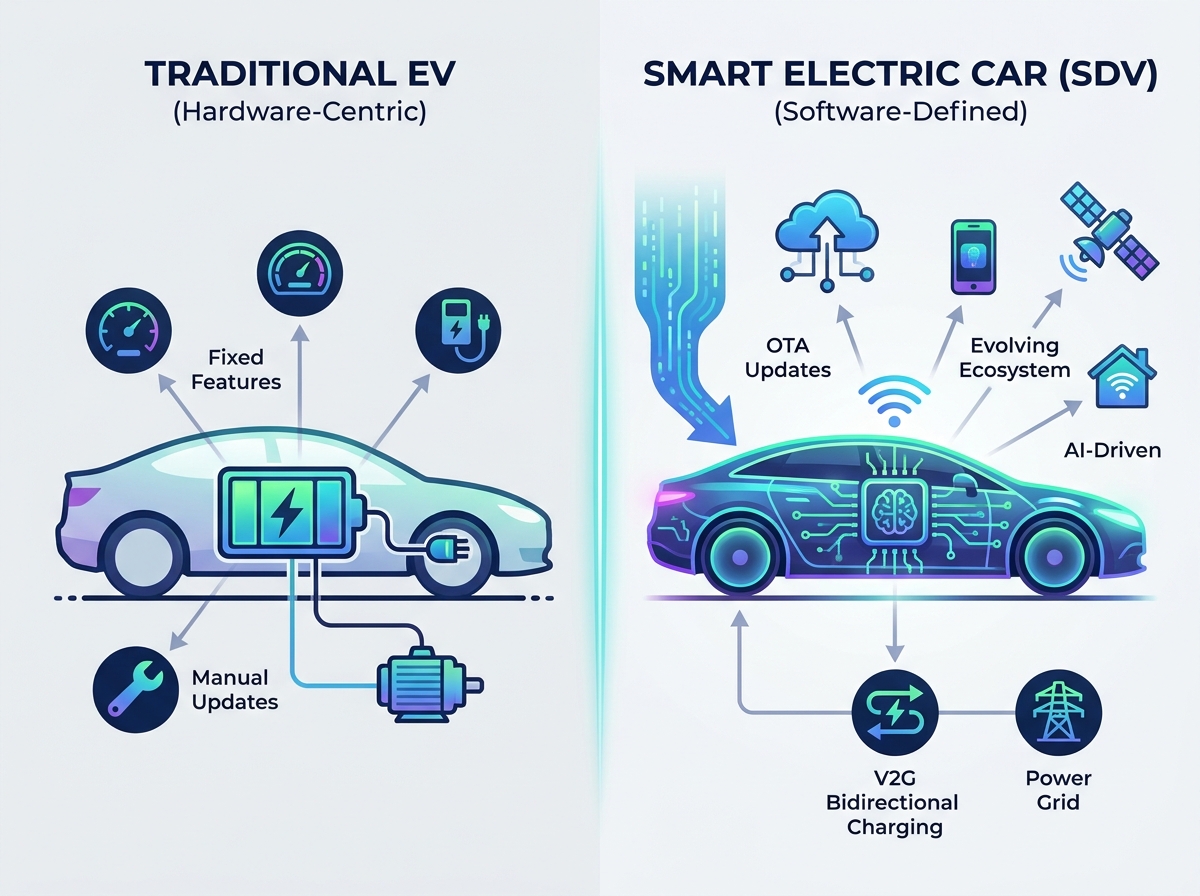
The automotive industry is shifting rapidly. We are moving from hardware-centric traditional EVs to Software-Defined Vehicles (SDVs). A traditional EV simply replaces a combustion engine with a battery pack. It relies on dozens of decentralized, isolated electronic control units. They communicate over legacy CAN bus networks. This fragmented approach prevents holistic vehicle upgrades. SDVs operate entirely differently. They function as centralized, rolling computers. Software dictates every core vehicle function.
You must evaluate an OEM's software ecosystem thoroughly. Focus heavily on core compute power. Operating system stability is paramount for safety and reliability. Cross-compatibility matters significantly for long-term usability. Your vehicle must integrate seamlessly with enterprise networks. It should also connect smoothly with smart-home ecosystems. A fragmented software experience signals future operational headaches. You should treat the vehicle as a highly mobile IoT node.
Advanced telematics require a higher upfront financial investment. You are paying for continuous connectivity and dense sensor arrays. However, these features yield distinct operational advantages. Predictive maintenance reduces unscheduled operational downtime. Over-the-air updates maintain the vehicle's technological relevance over time. This continuous evolution directly improves residual value retention. We must weigh initial purchase premiums against these substantial lifecycle benefits.
The battery landscape presents conflicting industry narratives. Solid-state batteries promise incredible energy density. They eliminate flammable liquid electrolytes entirely. However, their commercial viability remains unproven at scale. Mass deployment is still several years away. Conversely, Lithium-iron-phosphate (LFP) technology is mature and highly reliable. High-density LFP advancements dominate the current automotive market. They offer exceptional thermal stability under heavy loads. They also endure far more charge cycles than older chemistries. Base your immediate investments on proven LFP chemistry.
Table: Battery Chemistry Comparison Matrix
| Chemistry Type | Commercial Maturity | Energy Density | Thermal Stability | Primary Use Case |
|---|---|---|---|---|
| Lithium-Iron-Phosphate (LFP) | High (Currently scaling) | Moderate | Excellent | Daily driving, Fleet deployment |
| Nickel Manganese Cobalt (NMC) | High (Mature) | High | Moderate | Performance, Long-range models |
| Solid-State | Low (Pilot phase) | Very High | Excellent | Future flagship vehicles |
800-volt architectures represent the next charging frontier. They enable ultra-fast charging speeds for modern fleets. They also reduce internal vehicle wiring weight. However, you must assess local infrastructure compatibility rigorously. An 800-volt vehicle cannot charge optimally on legacy 400-volt stations. The hardware mismatch negates your premium architectural investment. Always map your primary driving routes against available high-voltage charger deployments.
Bidirectional charging transforms vehicles into mobile grid assets. Vehicle-to-grid (V2G) technology allows critical energy backfeeding. This requires specialized onboard inverters. Hardware costs for these bidirectional systems remain high. Furthermore, local utility regulations heavily influence V2G viability. Many regions lack the necessary regulatory framework for energy buybacks. You must validate local grid readiness before committing to V2G capabilities.
Charging standard fragmentation introduces severe operational risks. The rapid industry shift toward the North American Charging Standard (NACS) proves this volatility. Proprietary or obsolete connectors can strand capital quickly. Ensure your chosen platform supports dominant regional charging protocols. A smart electric car loses utility if it cannot access public infrastructure.
Autonomy levels often confuse buyers due to aggressive marketing. The operational gap between Level 2+ and Level 3 is massive. Level 2+ systems offer advanced driver assistance features. However, the driver retains full legal liability. You must supervise the system constantly. Level 3 introduces true conditional automation. The vehicle assumes control and liability in specific geofenced scenarios. You must ignore misleading OEM marketing jargon. Demand clear definitions of operational design domains.
Sensor suites vary drastically among manufacturers today. LiDAR-backed systems map environments in precise 3D point clouds. They function reliably in poor lighting or adverse weather. Pure-vision approaches rely exclusively on high-definition cameras. They use neural networks to interpret visual data entirely. Pure-vision systems cost less to manufacture initially. However, they struggle in low-visibility conditions. LiDAR offers superior long-term scalability and critical hardware redundancy.
Local regulations dictate ADAS usability strictly. A vehicle may possess advanced autonomous hardware. Yet, regional laws might prohibit autonomous feature activation. Geofencing often restricts paid features to specific highways. You must review regional compliance frameworks thoroughly. Do not pay for expensive features you cannot legally deploy. Regulatory alignment is just as crucial as technical capability.
Apply strict shortlisting logic during your procurement process. Look for the following technical advantages:
This redundant hardware supports future software-unlocked capabilities. A vehicle without overhead compute power will become obsolete rapidly.
Over-the-air updates deliver continuous performance improvements. They are essential for modern Software-Defined Vehicles. However, they introduce significant cybersecurity vulnerabilities. Malicious actors can intercept unencrypted update packages easily. You must assess OEM cybersecurity frameworks rigorously. Look for robust public key infrastructure implementations. End-to-end encryption is a non-negotiable requirement for connected vehicles.
Connected vehicles generate massive data volumes daily. They track location history, driving habits, and biometric markers. Manufacturers must anonymize and store this data securely. Review the OEM's data sharing policies carefully. They must comply with GDPR or CCPA standards strictly. You must understand exactly who owns your vehicle's telemetry. Unauthorized data monetization represents a severe privacy breach.
Fleet operators require seamless data integration capabilities. Vehicle data must handshake securely with third-party management platforms. Secure API gateways prevent unauthorized remote access. Proprietary tracking software cannot violate enterprise compliance standards. A secure connected ecosystem prevents catastrophic corporate data breaches.
Advanced telemetry fundamentally changes routine vehicle upkeep. Smart sensors monitor component degradation in real-time. They flag unusual wear before catastrophic hardware failure occurs. This proactive approach allows for scheduled component replacement. It drastically reduces unscheduled operational downtime. A smart electric car schedules its own service appointments based on algorithmic wear predictions.
Aftermarket repairability poses a major challenge for owners. Many OEMs enforce strict closed-loop repair networks. They restrict access to proprietary diagnostic software. Aftermarket accessibility for smart sensors remains highly limited. High-voltage components also require specialized handling and tooling. You must evaluate the availability of independent repair options. Strict OEM monopolies inflate long-term maintenance expenses significantly.
Software lifecycle commitments heavily drive vehicle depreciation rates. Connected vehicles require continuous operating system updates. An OEM must guarantee support timelines publicly. If software updates cease, the vehicle loses value immediately. It becomes a major security liability. Hardware degrades over time, but software obsolescence destroys residual value much faster.
You must conduct a thorough technical audit today. Examine the OEM's historical software support timeline. Analyze their warranty parameters for high-voltage batteries and sensors. Demand transparency regarding aftermarket parts availability. Do this before finalizing any adoption or fleet procurement decision. Preparation mitigates unforeseen lifecycle complications.
Strategic investment in smart EV technology is highly complex. You must look past superficial interface features and aesthetic upgrades. Focus intently on core compute architecture and processing redundancy. Scrutinize battery chemistry roadmaps closely to avoid vaporware. Demand enforceable software lifecycle guarantees from the vehicle manufacturer.
We recommend shortlisting platforms demonstrating transparent data compliance. Ensure they utilize scalable sensor hardware capable of future upgrades. Verify their proven infrastructure compatibility within your operational region. These critical factors guarantee long-term operational success. They transform a basic transportation purchase into a scalable technology investment.
A: Focus on centralized computing. A smart EV features continuous over-the-air (OTA) software evolution. It also provides bidirectional integration with external digital ecosystems. Standard EVs rely on decentralized hardware controllers that cannot receive comprehensive updates.
A: They prevent premature obsolescence directly. OTA updates improve battery management algorithms over time. They add new ADAS features seamlessly. They also patch critical security vulnerabilities long after the initial purchase.
A: Malicious interception of OTA updates is a major threat. Unencrypted telematics data exposes privacy. Unauthorized remote access via connected third-party applications can compromise vehicle controls entirely.
A: While limited pilot programs exist today, scalable deployment remains distant. Commercial deployment capable of replacing current LFP variants at a competitive cost is projected for the late 2020s.


