
Views: 0 Author: Site Editor Publish Time: 2026-11-18 Origin: Site


The logistics industry faces unprecedented pressure to move goods faster and more safely. Warehouses globally are making a massive shift. They are rapidly transitioning from internal combustion engine (ICE) models to electric material handling equipment. Stricter environmental emission regulations drive this inevitable change. The promise of substantial long-term operational savings also plays a huge role. However, navigating this transition is not always straightforward. Purchasing the wrong equipment often leads to severe warehouse bottlenecks. You might face premature battery degradation, or you could suffer through excessive daily downtime. A poorly matched machine ultimately drains your operating budget and slows down your facility throughput. This article provides a rigorous operational framework to guide your investment. We will help you evaluate and select the ideal electric forklift truck for your specific needs. You will learn exactly how to align equipment specifications with your unique facility constraints. Let us explore how to perfectly match your throughput goals with the right technology.
You must map your exact facility constraints before looking at brochures. We often see buyers overestimating or underestimating their true operational needs. Accurate baseline measurements guarantee better equipment matching.
You must identify the absolute maximum weight of your typical loads. Measure their exact dimensions carefully. A standard electric forklift truck usually rates its capacity based on a 24-inch load center. If your pallet is longer, the actual safe lifting capacity drops immediately. We call this phenomenon de-rating.
Attachments also change your lifting math entirely. When you add a side shifter or a paper roll clamp, you add heavy steel to the front carriage. This pushes the load center further away from the fulcrum. It significantly reduces your safe lifting capacity. Always consult the manufacturer data plate for accurate de-rated figures. Never assume a 5,000-pound lift can handle 5,000 pounds once you add heavy attachments.
Your mast dictates how safely you can stack goods. You must map the maximum lift height against your highest warehouse racking shelf. Always allow at least six inches of extra vertical clearance. This ensures safe pallet put-away without damaging the racking.
You also need to measure the collapsed mast height. This is the physical height of the mast when it sits fully lowered. If you load standard shipping containers, a low collapsed height is mandatory. Ensure the truck clears all internal facility doors safely. Check your dock plates and trailer transition gradients as well.
Warehouse space remains incredibly expensive. You need to maximize every square foot of your floor plan. Your aisle widths dictate your equipment choice almost entirely.
You must also consider the equipment turning radius. A 3-wheel electric lift offers a very tight turning radius. It works perfectly for indoor, smooth-floor applications. A 4-wheel model provides much better lateral stability. It handles heavier loads and mixed-use environments much better.
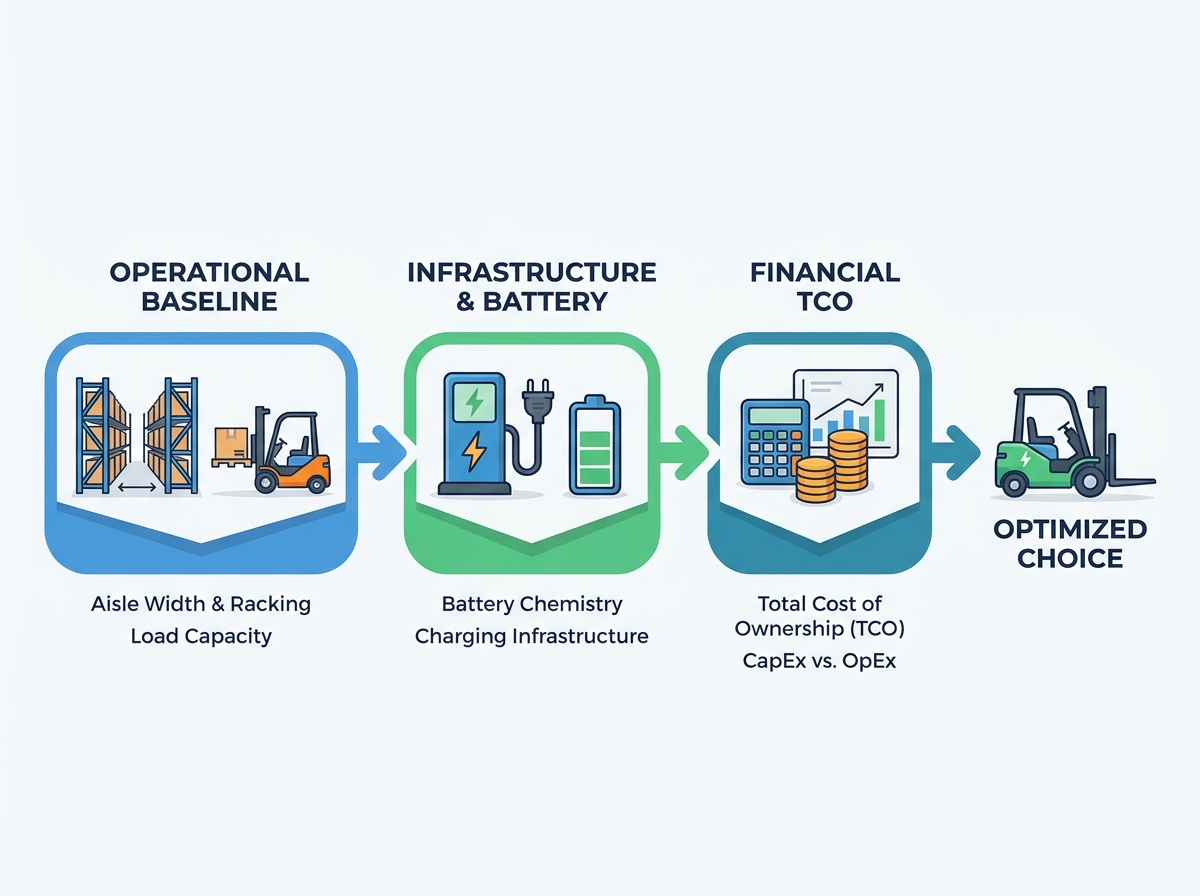
Power infrastructure is the most critical implementation risk for modern electric fleets. You simply cannot afford to guess your power requirements. A poor charging strategy ruins facility productivity.
You have two primary battery chemistries to choose from today. Both have distinct advantages and strict operational limitations.
Lead-acid batteries offer a lower upfront acquisition cost. However, they require strict 8-hour charge and 8-hour cool-down cycles. You must perform regular watering maintenance to keep them healthy. You also need dedicated, heavily ventilated charging rooms. This prevents hazardous hydrogen gas buildup during the charging process.
Lithium-ion batteries require higher initial capital expenditure. Yet, they support rapid opportunity charging. You can plug them in during short breaks or shift changes. They require absolutely zero watering maintenance. They also boast a significantly longer operational lifespan. This makes lithium-ion ideal for demanding multi-shift operations.
Table: Battery Chemistry Comparison
| Feature | Lead-Acid Battery | Lithium-Ion Battery |
|---|---|---|
| Upfront Cost | Lower | Higher |
| Charging Cycle | 8 hours charge, 8 hours cool-down | Rapid opportunity charging |
| Maintenance Required | High (Regular watering needed) | Zero (Maintenance-free) |
| Ventilation Needs | High (Dedicated charging room) | None (Can charge anywhere safely) |
| Best Application | Single-shift, lighter duty cycles | Multi-shift, heavy-duty continuous use |
Many businesses completely overlook their facility electrical grid. This is a massive hidden implementation risk. A modern fast-charging station draws immense power. You must accurately assess if your current warehouse grid can handle this peak draw.
If it cannot, you face incredibly costly utility upgrades. We strongly recommend a comprehensive electrical site audit. Consult a licensed electrical engineer before purchasing any fast chargers. You need to know your exact available amperage before signing a purchase order.
You must plan your charging workflows very carefully. Unplanned charging stops ruin your facility throughput. Proper planning keeps your fleet moving efficiently.
Different industries impose strict regulatory and environmental demands on material handling. You must match your equipment perfectly to these niche criteria.
In these sectors, an electric fleet is absolutely non-negotiable. Strict health codes prohibit any toxic exhaust fumes near consumable goods. Your equipment must produce zero local emissions to maintain air quality.
Furthermore, you must specify your lifts correctly for these ultra-clean environments. You will need non-marking tires to keep facility floors pristine. You must also mandate food-grade lubricants on the mast and hydraulics. This prevents catastrophic product contamination in case of an accidental fluid leak.
Cold environments destroy standard battery performance quickly. Sub-zero temperatures cause severe battery drain and voltage drops. They also increase hydraulic fluid viscosity, making your lifts extremely sluggish.
If you operate in blast freezers, standard lifts will fail rapidly. You must order specialized cold-conditioning packages from the factory. These packages include hermetically sealed electrical components. They also feature heated display panels and specialized low-temperature hydraulic fluids. Condensation remains your biggest enemy when moving between freezers and ambient loading zones. Proper sealing prevents this moisture from shorting out controllers.
Many operators mistakenly believe electric lifts only belong indoors. We need to debunk this outdated myth immediately. Modern technology allows electric models to thrive outdoors in harsh yards.
If you have outdoor yard use, you must configure the lift correctly. Select rugged pneumatic tires for uneven terrain, asphalt, or gravel. Specify a fully weatherized, enclosed cab to protect the operator from rain. Most importantly, ensure the drive motors have a high IP (Ingress Protection) rating. Completely sealed motors prevent rain, snow, and dust from damaging internal electrical components.
You are buying a long-term partnership, not just a heavy machine. Evaluating the dealer support network heavily de-risks your final purchase decision.
Look closely at the manufacturer before deciding. You want absolute transparency in their published specification sheets. Seek out brands with proven, multi-year track records in your specific industry.
Examine the built-in safety features closely. A modern electric forklift truck offers advanced electronic safety suites. Look for automatic speed reduction systems during sharp cornering. Ask about pedestrian presence detection systems and blue safety lights. We also recommend looking for CAN-bus technology. This allows mechanics to run rapid digital diagnostics, saving hours of troubleshooting time.
Your equipment is only as reliable as its local support network. A mechanical breakdown stops your daily revenue immediately. You must carefully evaluate the dealer service level agreement before signing.
Demand guaranteed response times for on-site repairs. A four-hour response window is an excellent industry standard to target. Anything longer than 24 hours is completely unacceptable for high-throughput logistics facilities. Ensure they have enough mobile technicians operating in your specific zip code.
Do not assume replacement parts are always nearby. Global supply chain disruptions can easily strand your equipment for months.
Ensure your local dealer maintains a robust, localized inventory. Ask specifically about highly proprietary electronic parts. Motor controllers, contactors, and battery management systems (BMS) are highly specific to each brand. If the local dealer does not stock them, you will face severe shipping delays. Ask for a tour of their local parts warehouse if possible.
Never buy a lift directly from a glossy brochure. We highly recommend requesting an on-site operational audit from the dealer.
Let their application engineers physically evaluate your facility. They should measure your exact aisles and inspect your floor conditions. Always request a one-week demonstration unit. Let your actual operators test it under real shift conditions. This confirms the machine handles your specific workflow comfortably and safely.
Choosing the right electric material handling equipment requires a careful, calculated balance. You must constantly weigh your physical space constraints against your daily throughput demands. You also have to verify your facility charging infrastructure readiness early. A perfectly specified machine fails completely if your power grid cannot support its daily charging needs.
Looking past the initial sticker price remains the most accurate way to measure your investment success. Focus entirely on lifetime value and operating expense reductions over the decade. Lower daily energy costs, zero fuel purchases, and vastly reduced maintenance labor create massive long-term financial savings.
We highly encourage you to take actionable steps today. Schedule a comprehensive facility audit with a qualified local dealer. Contact your sales team for a custom fleet operational analysis based on your exact shift data. Make your final purchasing decision based on hard facility metrics rather than assumptions.
A: Yes, provided it has an adequate IP (Ingress Protection) rating for its electrical components and is fitted with pneumatic tires suited for uneven terrain.
A: Lead-acid typically lasts 1,500 cycles (approx. 5 years), while Lithium-ion can exceed 3,000 cycles (7–10 years), depending on adherence to charging best practices.
A: It depends on your current amperage capacity and fleet size. Fast chargers draw significant power, so an electrical site assessment is a mandatory step before procurement.
A: Adding components like a side shifter or paper roll clamp moves the load center forward and adds weight, typically reducing the safe lifting capacity by 10% to 20%. Always consult the manufacturer's de-rated data plate.


