
Views: 0 Author: Site Editor Publish Time: 2026-11-14 Origin: Site


Choosing the right material handling equipment defines your operational efficiency for years to come. Buyers constantly face a difficult dilemma when expanding their fleets. You must balance upfront capital expenditure against long-term operational costs and facility constraints.
Today, electric forklifts are rapidly capturing market share due to new sustainability mandates and significantly lower operating costs. However, gas-powered internal combustion models remain indispensable for specific heavy-duty and outdoor applications. Making the wrong choice can lead to stranded assets or excessive downtime.
We will provide an objective, evidence-based framework for evaluating which powertrain fits best. You will learn how to match equipment with your facility's infrastructure and daily shift demands. This guide ensures you make a profitable and compliant fleet decision tailored to your unique operational footprint.
Your physical operating environment heavily dictates your choice of powertrain. The distinction between indoor and outdoor operations is the most critical starting point for any fleet manager.
Indoor facilities present strict safety and air quality requirements. Battery-powered models produce zero tailpipe emissions. This makes them absolutely mandatory for industries like food processing, pharmaceuticals, and poorly ventilated warehouses. They also generate significantly less noise. A quieter warehouse reduces worker fatigue and improves communication on the floor.
Conversely, gas-powered models thrive outdoors. Manufacturers build them to withstand harsh elements. They utilize propane or diesel fuel to generate high power. These machines typically feature pneumatic tires and higher ground clearance. They navigate loose gravel, mud, and uneven outdoor terrain easily. You will find them dominating lumber yards, brickyards, and heavy construction sites where battery-powered models would struggle.
Temperature fluctuations impact equipment performance differently. Extreme cold severely affects battery discharge rates. Standard battery models lose significant runtime in freezing environments. However, specialized cold-storage electric forklifts exist. These specialized units feature heated control cabins and insulated battery compartments to counteract the cold.
Gas models offer robust resilience against severe weather. They operate reliably in heavy rain, deep snow, and extreme heat. Their internal combustion engines do not suffer from the same temperature-related performance drops. This reliability ensures your operations continue uninterrupted regardless of the weather outside.
Evaluating your investment requires looking far beyond the initial sticker price. You must calculate the comprehensive financial lifecycle of the equipment.
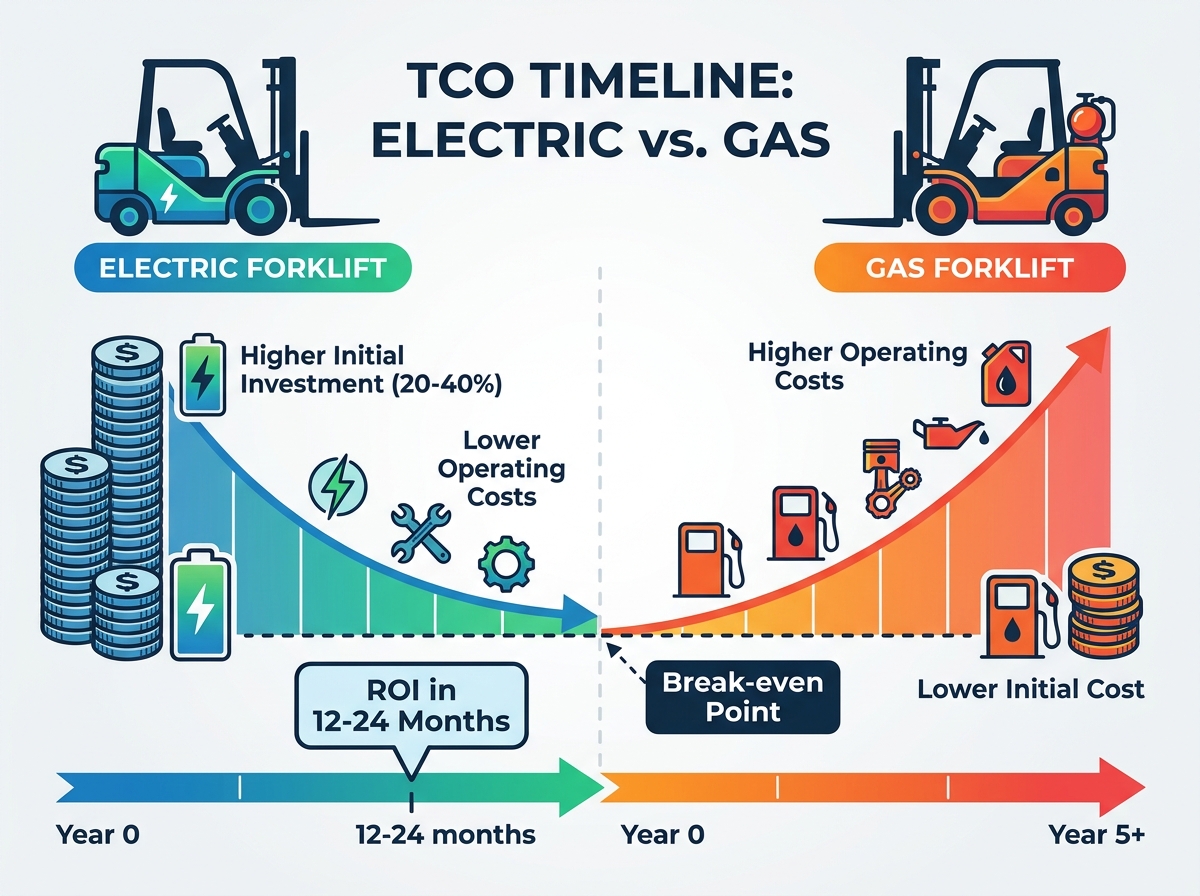
Gas models generally boast a lower initial purchase price. You are essentially buying a chassis and an engine. This makes them highly attractive for companies with strict immediate capital constraints.
Battery-powered models demand a higher upfront investment. You must purchase the chassis, the heavy battery pack, and the charging station. Dealers often price the battery and charger separately from the lift itself. This separation can surprise first-time buyers. The battery alone can represent up to thirty percent of the total equipment cost.
Energy costs represent the largest ongoing expense for any fleet. Calculating your cost-per-hour requires an accurate assessment of local energy rates. Electricity rates remain relatively stable compared to fossil fuels. You can calculate your electrical costs by analyzing your local kilowatt-hour (kWh) rates against the charger's consumption.
Gas models rely on liquid propane gas (LPG) or diesel. These fuel prices fluctuate based on global market conditions. Over a five-year period, electricity consistently proves cheaper than fossil fuels. You must model these costs based on your specific regional energy prices to see the true financial impact.
Maintenance requirements differ drastically between the two technologies.
Your facility must support your chosen fleet. Ignoring infrastructure readiness often leads to severe budget overruns and operational delays.
Adopting battery fleets requires a thorough electrical audit. Industrial chargers typically require dedicated three-phase power. Older warehouses often lack this capacity. You may need to pay for expensive utility upgrades to bring adequate power to your building.
Space allocation is another critical factor. Traditional lead-acid batteries emit hydrogen gas during charging. This requires building dedicated, well-ventilated charging rooms to meet safety standards. Alternatively, modern lithium-ion technology allows for decentralized charging. You can place lithium-ion chargers strategically around the facility since they do not off-gas.
Gas fleets bypass electrical upgrades but introduce fuel storage challenges. You must adhere to strict OSHA compliance rules for storing propane tanks or diesel fuel on-site. Propane tanks require secure, outdoor storage cages located away from building entrances.
You also face the logistics of scheduled fuel deliveries. Securing reliable fuel vendors is essential. You must factor in delivery fees, tank rental costs, and the administrative burden of managing fuel contracts.
Infrastructure Comparison Summary
| Requirement | Battery-Powered Fleet | Combustion Engine Fleet |
|---|---|---|
| Energy Source Setup | Three-phase electrical panels, high amperage | Outdoor cages for LPG, diesel storage tanks |
| Space Utilization | Dedicated charging zones (lead-acid) or decentralized (lithium) | Minimal indoor space, bulk storage outdoors |
| Safety Compliance | Eye-wash stations, ventilation systems for off-gassing | Fire suppression, strict OSHA distance rules |
Operational pace dictates how you manage refueling and recharging. Every minute spent away from moving products costs your business money.
Gas units excel in high-intensity, continuous operations. A worker can swap a propane tank in under five minutes. This rapid replenishment allows for uninterrupted 24/7 operations. You simply keep a rotating stock of full tanks available.
Battery management requires more strategic planning. Traditional lead-acid batteries follow an 8-8-8 rule. They need eight hours to charge, eight hours to cool down, and eight hours of operation. Multi-shift operations using lead-acid must purchase spare batteries and use heavy hoists to swap them. However, lithium-ion technology mitigates this issue entirely. Lithium-ion allows for "opportunity charging." Operators plug the machine in during 15-minute breaks or lunch hours. This keeps the battery topped up throughout multiple shifts without swapping.
A persistent industry misconception suggests battery models are weaker than their gas counterparts. This is no longer true. Modern 80-volt electric forklifts match the torque, lifting capacity, and travel speed of equivalent gas models. They deliver power instantly to the drive wheels.
The difference lies in power consistency. Gas engines maintain full, consistent power until the fuel tank runs completely empty. Older battery models, particularly lead-acid ones, may experience voltage drops as the charge depletes. This drop can result in slightly sluggish lifting speeds toward the end of a long shift. Lithium-ion systems solve this by maintaining sustained voltage until fully depleted.
Selecting the right equipment requires a systematic approach. Follow this standardized framework to ensure your investment aligns perfectly with your operational reality.
There is no universal "best" material handling option. There is only the most profitable and compliant option for your specific operational footprint. Indoor environments and sustainability mandates heavily favor battery technologies. Rugged outdoor applications continue to rely on the raw durability of combustion engines.
We advise all buyers to look closely beyond the initial sticker price. You must calculate a comprehensive 5-year financial model that incorporates all infrastructure upgrades, energy costs, and maintenance savings. Do not guess on electrical capacities or ventilation requirements.
Before committing to a major powertrain transition, contact a certified dealer. Request a professional site assessment and a detailed long-term expenditure analysis to guarantee your next fleet maximizes your operational productivity.
A: Yes, provided they are equipped with sealed components and weatherproofing packages. Manufacturers offer specific outdoor ratings. However, they are still best suited for paved or smooth concrete surfaces rather than deep mud or highly uneven terrain.
A: Lead-acid batteries typically last around 1,500 charging cycles, which equates to approximately five years of standard use. Lithium-ion batteries can easily exceed 3,000 charging cycles, lasting seven to ten years if properly maintained.
A: For lifting capacities exceeding 15,000 lbs in outdoor, rough-terrain environments, diesel remains the industry standard. Diesel engines provide exceptional low-end torque and unmatched durability for heavy construction and lumber yard applications.
A: Costs depend on your existing facility amperage. You must price out the need for new electrical subpanels, the specific type of chargers required, and whether you need to build costly ventilation systems for lead-acid off-gassing.


