
Views: 0 Author: Site Editor Publish Time: 2026-11-28 Origin: Site


Fleet managers and warehouse directors face mounting operational pressure today. They must continually balance strict operational efficiency goals against rigid capital expenditure limits. Evolving environmental emissions regulations add another layer of complexity. The crucial decision between investing in a new electric forklift and sticking with traditional internal combustion models goes beyond mere brand preference. It now represents a strategic infrastructure choice for modern facilities. Propane, diesel, and gas units hold established legacies, but advanced electric alternatives continually challenge them. We provide a transparent, evidence-based evaluation of both technologies below. You will learn exactly which solution aligns with your specific facility constraints and demanding shift schedules. Our comprehensive guide helps procurement teams and operations directors determine the smartest path forward. You can confidently navigate this transition and safeguard your operational productivity.
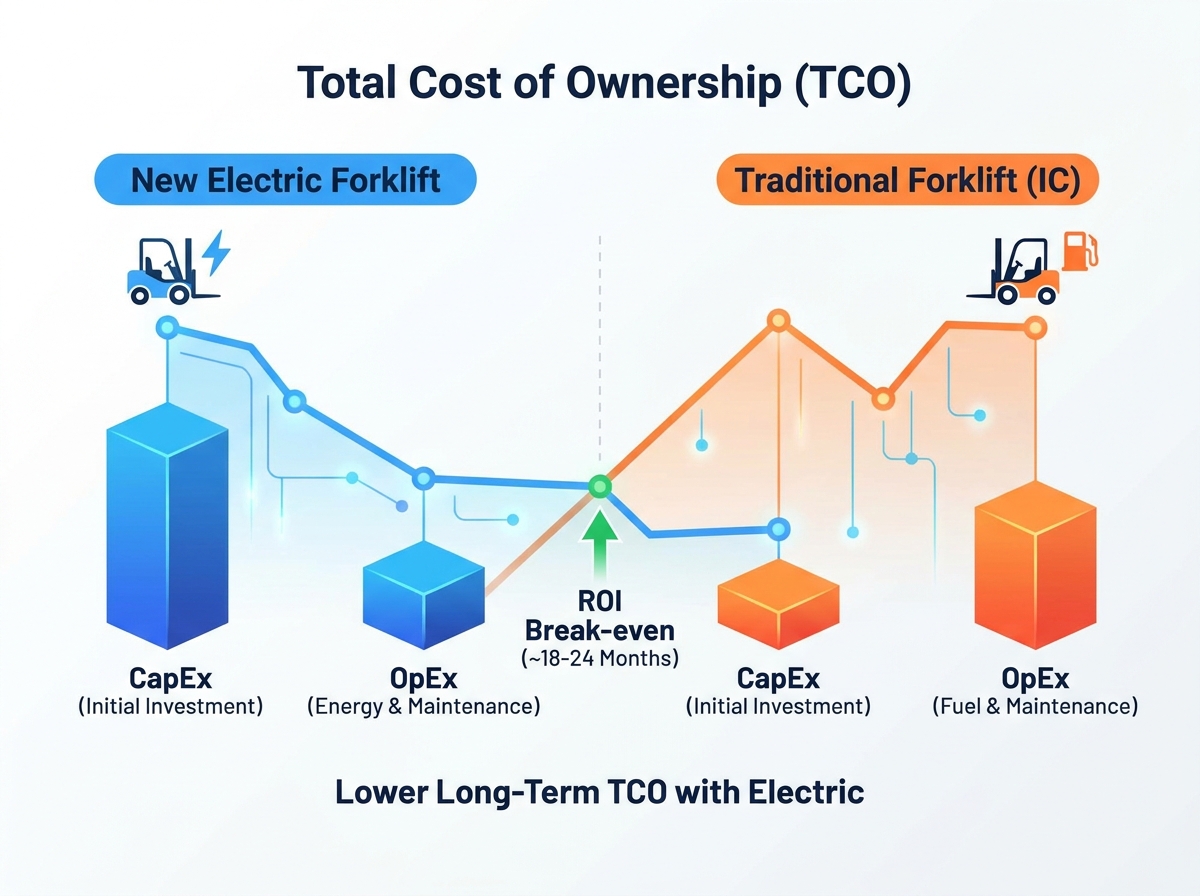
TCO Timeline: A new electric forklift requires a significantly higher upfront investment (often 20-40% more) but typically achieves ROI within 18 to 24 months due to vastly lower fuel and maintenance costs.
Application Limits are Blurring: Modern high-voltage lithium-ion electric forklifts now rival traditional diesel models in lifting capacity and outdoor performance, though traditional models still hold an edge in remote, 24/7 heavy-weather applications.
Hidden Implementation Costs: Adopting electric models requires evaluating facility electrical grid capacity and charging infrastructure, whereas traditional models require safe fuel storage and ventilation protocols.
Regulatory Reality: Stricter OSHA and EPA guidelines on indoor emissions and noise pollution are making electric models the default requirement for enclosed warehousing and food-grade facilities.
Traditional forklifts depend on robust internal combustion engines to generate power. They rely heavily on combustible fuels safely stored on-site. Operators appreciate these legacy machines for their rapid refueling capabilities. Swapping an empty propane tank takes an operator only a few minutes. Diesel engines also deliver sustained, predictable torque for highly demanding tasks. Lumber yards and heavy manufacturing plants historically favored them for this raw power. Mechanics understand their anatomy well, as they mirror standard automotive engines.
The modern material handling standard introduces a radically different engineering approach. A new electric forklift utilizes heavy-duty lead-acid or advanced lithium-ion batteries. These battery-powered machines contain radically fewer moving mechanical parts. You will not find complex transmissions, spark plugs, or exhaust systems inside them. Engineers design them utilizing sophisticated regenerative braking systems. This technology captures kinetic energy during deceleration to extend battery life. Operators can also adjust programmable performance settings directly from the dashboard. They can limit top speeds or customize hydraulic lifting speeds easily. This software-driven flexibility gives modern warehouse directors unprecedented control over their fleet's daily behavior.
Many facility managers still assume electric models inherently lack power. You should discard this outdated assumption immediately. A modern new electric forklift handles massive loads effortlessly. Some high-voltage units lift over 10,000 pounds daily. They match standard internal combustion capabilities perfectly. Modern AC drive motors deliver instant torque without the lag associated with older DC systems.
Matching the machine to its primary environment remains crucial for longevity. Inside enclosed warehouses, electric technology dominates completely. It produces zero tailpipe emissions, ensuring pristine indoor air quality. It also generates significantly lower noise levels. Food-grade facilities and pharmaceutical centers mandate these clean attributes. Conversely, traditional diesel models hold a slight advantage in specific outdoor scenarios. Deeply uneven terrain challenges early electric designs. Extreme freezing conditions also impact battery efficiency unless you provide localized charging stations. However, pneumatic-tire electrics continuously close this performance gap today. They feature sealed components resisting water and mud intrusion.
Consider your daily shift rhythms next. Traditional models offer distinct "gas-and-go" convenience. A worker just fills the tank and resumes work immediately. Electric charging introduces different operational realities into your scheduling. Lithium-ion batteries allow aggressive opportunity charging during employee breaks. You can plug them in for fifteen minutes without harming the cells. Lead-acid systems usually require full-shift battery swaps using specialized hoists. You must plan these charging intervals carefully to avoid unexpected downtime.
Forklift Environment Comparison Chart
| Environment Type | Electric Models | Combustion (IC) Models |
|---|---|---|
| Indoor Warehousing | Excellent (Zero emissions, low noise) | Poor (Requires heavy ventilation) |
| Food & Beverage | Mandatory in most cases | Highly restricted |
| Paved Outdoor Yards | Very Good (With weather sealing) | Excellent |
| Rough Terrain/Mud | Improving (Pneumatic models) | Excellent (Proven durability) |
Procurement teams must carefully evaluate the full financial picture before buying. The initial capital expenditure often surprises first-time buyers transitioning from propane. A new electric forklift commands a noticeably higher baseline purchase price. Units equipped with advanced lithium-ion technology cost significantly more upfront. You must also purchase and install the required high-voltage charging stations. This initial equipment invoice requires larger upfront capital allocation.
However, day-to-day operating expenditures tell a completely different financial story. Routine energy costs heavily favor electric models over the long run. Electricity rates generally remain relatively stable and predictable over time. Propane and diesel prices experience volatile global market swings frequently. Facilities often document an 80 percent energy cost reduction per operating hour. Charging a battery overnight costs a fraction of filling a propane cylinder.
Routine maintenance savings further justify the initial heavy investment. Mechanics do not need to perform messy engine oil changes. They skip replacing air filters, engine coolant, and transmission fluid entirely. Electric motors feature sealed housings protecting them from dust. They require minimal routine maintenance beyond basic greasing and tire inspections. This reduces your reliance on expensive third-party service calls.
You must also consider general lifespan and equipment depreciation. Electric motors typically outlast traditional combustion engines by thousands of hours. They log far more operating hours before requiring catastrophic rebuilds. They vibrate less, which preserves the structural integrity of the chassis. You must still factor periodic battery replacement cycles into long-term financial planning. Lithium-ion batteries last longer but carry a higher replacement price tag.
Adopting electric technology introduces several hidden infrastructure risks. You must evaluate your facility's electrical grid constraints very early. Fast chargers often demand robust three-phase power upgrades. Upgrading an aging electrical panel adds substantial, unforeseen project costs. Local utility companies might even need to pull new lines to your building. You absolutely cannot ignore this critical facility requirement during the planning phase.
Space utilization also requires careful consideration and warehouse mapping. Lead-acid fleets need a dedicated, heavily ventilated battery charging and swapping room. This necessary infrastructure consumes valuable indoor warehouse floor space. It also requires specialized eye-wash stations and acid spill kits. Traditional models require compliant outdoor propane or diesel storage cages instead. You must weigh these spatial footprint tradeoffs carefully against your storage needs.
Safety and compliance protocols differ drastically between the two technologies. You must update your internal safety manuals accordingly. Consider these contrasting hazard profiles carefully:
Electrical Hazards: Mishandling traditional lead-acid batteries can cause severe acid spills. Improperly managed lithium-ion units carry very slight thermal runaway risks. Chargers present high-voltage electrical shock dangers if cables fray.
Combustion Hazards: Indoor propane use risks deadly carbon monoxide exposure without extreme ventilation. Refueling stations present constant highly flammable fuel leak hazards.
Occupational Hazards: Traditional engines produce persistently high decibels. This constant noise exposure causes long-term noise-induced hearing loss among operators.
Proper employee training mitigates these specific risks effectively. You must align your safety protocols directly to your chosen technology. Never assume forklift operators automatically know how to handle high-voltage chargers safely.
Operator comfort directly impacts daily warehouse productivity and employee retention. Traditional combustion engines produce constant, heavy vibrations throughout the chassis. These intense vibrations transfer directly into the driver's body all day. Eliminating engine vibration in electric models reduces operator fatigue significantly. It also helps prevent long-term ergonomic injuries like chronic lower back pain. A rested operator simply moves pallets faster and safer.
Noise pollution represents another major operational factor in enclosed spaces. Combustion engines create a loud, stressful working environment naturally. Lower decibel levels in electrics transform daily warehouse communication entirely. Workers hear verbal instructions and critical warning alarms clearly across aisles. Enhanced situational awareness improves overall facility safety metrics dramatically. It also ensures strict OSHA noise compliance easily without requiring bulky ear protection.
Electric drivetrains also offer superior precision control and drivability. A new electric forklift delivers remarkably smoother acceleration curves. Operators utilize highly precise inching controls through the electronic drive systems. This fine-tuned movement proves critical for delicate high-rack maneuvering tasks. Drivers can position heavy, fragile pallets exactly where needed without jerky movements. Modern ergonomic cabins also feature improved visibility since they lack bulky rear exhaust pillars.
Choosing the right equipment requires a structured, unbiased evaluation method. Guesswork often leads to expensive procurement mistakes. Follow this systematic framework before finalizing any heavy equipment purchase:
Assess Facility Readiness: Inspect your current electrical infrastructure thoroughly. Determine if your panels can support a fleet of fast chargers safely. Consult a licensed commercial electrician to measure your available amperage.
Analyze Shift Density: Single-shift operations make overnight trickle charging incredibly easy. Continuous 24/7 operations require fast opportunity charging or rapid physical fuel swaps. Document exactly how many hours per day the machine actually moves.
Define Application Requirements: Identify exactly where the equipment operates daily. Clarify if it runs entirely indoors, mixes environments, or faces harsh outdoor weather. Measure your narrowest aisles to ensure the chassis actually fits.
We highly recommend conducting a professional, on-site survey first. Partner alongside a trusted material handling equipment expert. They can map your exact local energy costs accurately. Run a customized financial expenditure analysis before making your final purchasing decision. They often spot workflow bottlenecks you might overlook entirely.
No universal "perfect" forklift exists for every single warehouse operation. However, the material handling industry trajectory heavily favors electric technology today. A new electric forklift stands as the superior operational choice right now. It dominates indoor, multi-shift, and mixed-use applications globally. Your facility simply must possess the capacity to support the charging infrastructure. Traditional forklifts remain viable strictly for heavy-duty, off-grid outdoor tasks. They still shine brilliantly where high-capacity electrical charging proves logistically impossible.
You should act proactively regarding your upcoming fleet strategy. We strongly encourage you to request a comprehensive fleet audit soon. Consult an equipment specialist to calculate your specific operational expenses accurately. Use your exact local utility rates and operating hours for baseline accuracy. Evaluate your indoor space limitations and emissions goals simultaneously. Proper strategic planning ensures you secure the absolute best long-term equipment investment.
A: Yes. Modern 80V lithium-ion systems provide equivalent torque and lift capacities. Many models easily handle loads up to 15,000 pounds or more. They operate consistently without the frustrating power drop-off traditionally seen in older electric models as the battery eventually drains.
A: Lead-acid batteries generally last about 1,500 charge cycles, roughly equating to five years of standard use. Advanced lithium-ion batteries perform much better over time. They can exceed 3,000 cycles, offering a lifespan of seven to ten years. Proper opportunity charging practices maximize this longevity.
A: Yes, they absolutely can. Many newer models feature sealed enclosures with high IP ratings to repel moisture safely. They use pneumatic tires designed specifically for outdoor, wet, and rugged conditions. However, you should remember extreme cold can still reduce overall battery efficiency temporarily.
A: While propane models cost less to purchase initially, electric forklifts are significantly cheaper to run daily. The electricity cost per shift is merely a fraction of buying a replacement propane cylinder. Additionally, electric motors require drastically less routine maintenance over the equipment's entire lifespan.


