
Views: 0 Author: Site Editor Publish Time: 2026-11-26 Origin: Site


Fleet managers face a major equipment procurement decision today. You must carefully weigh the high initial capital expenditure (CapEx) of a new electric forklift against long-term operational savings. Regional compliance mandates also force a closer look at emission-free alternatives.
Transitioning from internal combustion engine (ICE) models demands rigorous financial analysis. Upgrading legacy lead-acid electric fleets poses similar evaluation challenges. You must accurately project energy costs, track maintenance reductions, and assess infrastructure needs to validate the switch.
This guide breaks down the verifiable operational outcomes of modernizing your fleet. We explore facility requirements and the implementation realities you will face. You will learn exactly how to justify and execute an electric material handling equipment (MHE) upgrade.
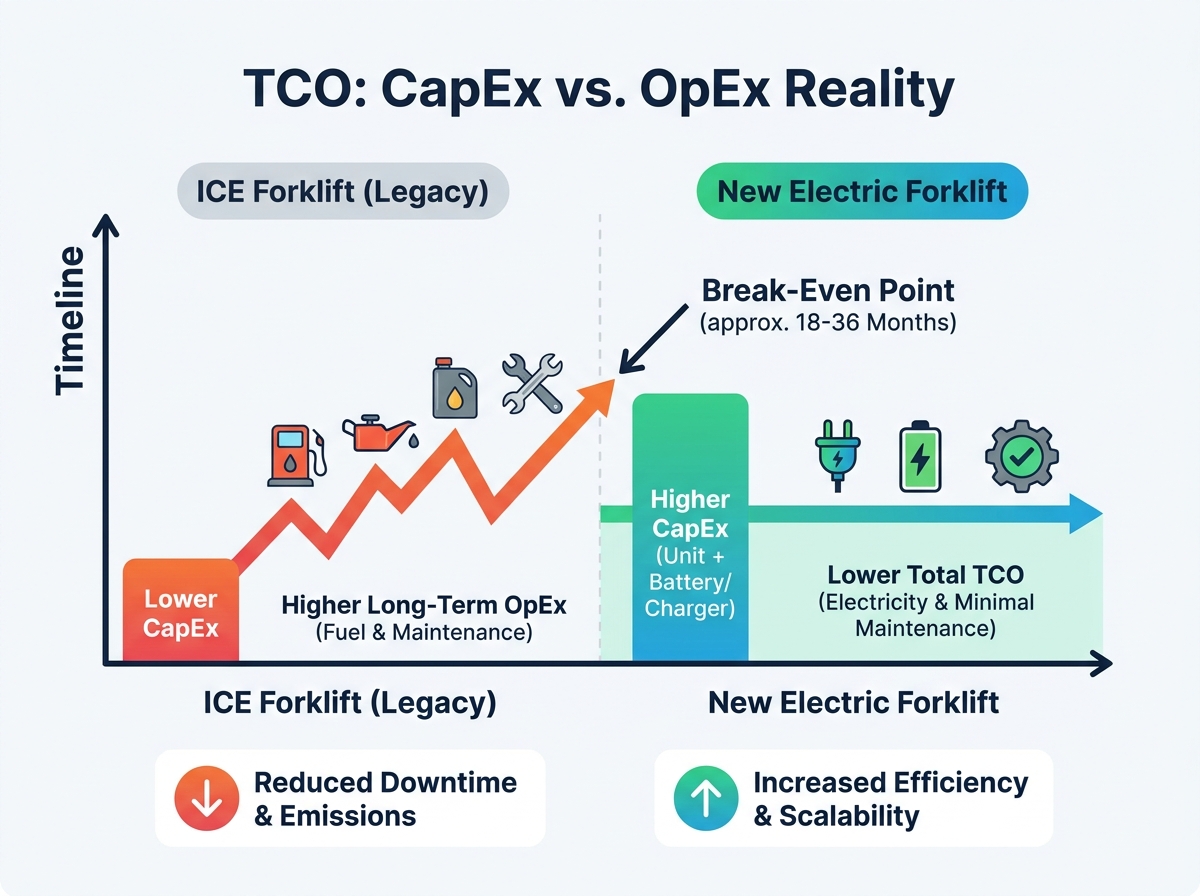
Procurement teams often stall at the initial sticker shock. A new electric forklift historically costs more upfront than an equivalent diesel or propane unit. You must look beyond the purchase price. We recommend framing this challenge around lifetime financial efficiency. A higher initial investment unlocks massive operational savings later.
You need a structured approach to compare costs. Break down the financial realities into three distinct categories.
Chart 1: CapEx vs. OpEx Financial Breakdown
| Expense Category | ICE Forklift (Diesel/Propane) | New Electric Forklift (Lithium-ion) |
|---|---|---|
| Initial CapEx | Lower baseline cost for the truck. No costly batteries. | Higher upfront cost. Requires battery and charger investment. |
| Energy Expenses | High vulnerability to volatile global fuel markets. | Stable, predictable utility rates. Highly efficient energy transfer. |
| Routine Maintenance | Frequent oil changes, filter swaps, and engine tune-ups. | Minimal checks. No fluids to change. Fewer moving parts. |
Provide realistic break-even estimates for stakeholders. You will typically see a break-even point between 18 and 36 months. Shift intensity dictates this timeline heavily. Facilities running triple shifts hit the break-even point much faster. Local energy rates also influence the exact recovery month. Once you cross this threshold, the fleet generates pure operational savings.
Modern electric fleets offer profound productivity boosts. A new electric forklift fundamentally changes how a warehouse operates day-to-day. You gain efficiency, safety, and worker satisfaction.
Operators demand reliable power. Modern electronic controllers and lithium-ion cells maintain stable lift speeds. Travel speeds remain consistent even as the battery charge depletes. Legacy lead-acid systems fail here. They suffer from voltage drops. An older lead-acid truck feels sluggish at the end of a shift.
Shift flexibility transforms warehouse logistics. We call this "opportunity charging." Workers plug the machines in during breaks or lunches. A short 15-minute charge delivers substantial battery recovery. This simple habit enables multi-shift operations. You no longer need a dedicated battery room. You keep the trucks on the floor where they belong.
You must prioritize operator comfort to retain staff. Electric models produce significantly lower decibel levels. They vibrate much less compared to ICE models. This directly lowers operator fatigue. A quiet warehouse improves communication. Workers stay alert and comfortable throughout long shifts.
Daily checks become highly simplified. Operators skip fuel tank swaps. They avoid dangerous lead-acid watering routines. They simply unplug the charger and start working. This eliminates hazardous acid spills and heavy lifting. Better ergonomics lead directly to higher employee retention.
Deploying a new electric forklift requires facility-level planning. You must align your building infrastructure with your new fleet. Preparation prevents costly deployment delays.
Zero tailpipe emissions simplify OSHA indoor air quality compliance. Indoor ICE fleets require expensive carbon monoxide (CO) monitoring systems. You eliminate this overhead entirely when you switch to electric power. Workers breathe cleaner air.
These emission-free units align perfectly with tightening regional regulations. Boards in regions like California (CARB) strictly limit industrial emissions. Upgrading your fleet proactively keeps you ahead of legal fines. It also supports internal corporate sustainability reporting. You easily meet crucial ESG (Environmental, Social, and Governance) targets.
Do not order equipment before auditing your facility. You face strict infrastructure prerequisites.
Every major operational shift carries risks. A new electric forklift fleet introduces specific transition hurdles. Acknowledge these challenges early to ensure smooth adoption.
Facility electrical upgrade delays pose the biggest risk. A delayed panel upgrade stalls entire fleet deployments. You might receive trucks you cannot charge. Schedule infrastructure work months ahead of equipment delivery.
Operator retraining remains an absolute necessity. Drivers must unlearn deeply ingrained ICE driving habits. They usually brake aggressively in diesel trucks. They must adapt to regenerative braking instead. Lifting the foot off the accelerator slows the electric truck automatically. This recharges the battery but feels unusual at first. Training bridges this gap.
Understand the transparent assumptions about battery performance in extreme cold. Batteries lose efficiency in freezing temperatures. Deploying a new electric forklift in a freezer application is entirely feasible. However, it requires specific conditioning packages. Manufacturers install internal battery heaters. These prevent severe range degradation. Always specify cold-storage needs during the RFP process.
Watch out for proprietary technology. Some manufacturers use closed charger-to-battery communication protocols. The charger only talks to their specific battery brand. This severely limits third-party replacements down the line. You lose negotiating power when replacements become necessary. Demand open-protocol equipment whenever possible.
Choosing the correct model requires precise application matching. You cannot buy a generic lift truck and expect optimal results.
Cross-reference your maximum lifting capacity against your mast height requirements. Remember the battery acts as the forklift's primary counterweight. Lithium-ion batteries weigh less than lead-acid ones. Manufacturers often add steel plates to maintain stability. Verify the total machine weight.
Tire specifications heavily influence performance. Use cushion tires for smooth indoor concrete floors. They provide excellent maneuverability. Specify pneumatic tires if the unit occasionally transitions to outdoor loading docks. Pneumatic tires absorb bumps and handle rough asphalt safely.
Table 2: Tire Selection Guide
| Tire Type | Primary Application | Key Advantages |
|---|---|---|
| Cushion Tires | Indoor warehouses, smooth concrete. | Smaller turning radius, excellent indoor traction. |
| Solid Pneumatic Tires | Outdoor yards, rough concrete, loading docks. | Puncture-proof, absorbs shocks, handles debris. |
| Air Pneumatic Tires | Uneven outdoor terrain, gravel. | Maximum operator comfort, superior grip on loose surfaces. |
Brand names matter less than local support. Advise buyers to prioritize the local dealer's service response time. Check their spare parts availability. A premium brand fails you if the local tech takes three days to arrive. Downtime kills warehouse productivity.
Examine the battery warranty terms closely. Look for cycle life guarantees rather than strict chronological timelines. A warranty offering 3,000 cycles protects you better than a basic five-year guarantee. Multi-shift operations burn through chronological years faster than single shifts.
A new electric forklift represents much more than a simple equipment purchase. It drives a facility-wide operational shift. You trade upfront infrastructure costs for predictable, lower long-term overhead.
Here are your immediate next steps:
A: Battery lifespan depends on cycle limits. Lithium-ion batteries generally last 2,500 to 3,000 cycles. Lead-acid batteries typically degrade after 1,500 cycles. In a standard single-shift operation, a lithium-ion pack can efficiently power a truck for seven to ten years before requiring replacement.
A: Yes, they can operate outdoors. You must check the IP ratings on modern electric lift trucks. While they handle light exposure well, heavy precipitation requires specific weather-sealed models. Always specify pneumatic tires for outdoor usage to ensure proper traction and safety.
A: Focus on productivity gains. You eliminate completely the daily battery swap times. Modern units feature sealed AC drive motors instead of older DC motors. This drastically reduces maintenance overhead. Operators also experience fewer voltage drops, maintaining consistent lift speeds throughout the entire shift.
A: It heavily depends on your specific operational requirements. Single-shift operations using slow charging might perfectly utilize existing infrastructure. Conversely, multi-shift facilities requiring fast charging often need substantial 480V 3-phase power upgrades. Always audit your panels first.


