
Views: 0 Author: Site Editor Publish Time: 2026-11-21 Origin: Site


The transition to zero-emission material handling surpasses basic sustainability goals. It serves as a strict baseline requirement. You must optimize indoor operating expenses while maintaining compliance. Internal combustion engine (ICE) forklifts historically dominated heavy-duty tasks. Today, battery chemistry and drivetrain efficiency have improved drastically. These advancements rapidly expand the viable use cases for modern electric fleets. Facility leaders now face critical decisions. They must match vehicle capabilities to specific indoor constraints. This comprehensive guide examines distinct industrial environments. We reveal where an electric forklift truck delivers maximum operational returns. We also outline the inevitable operational limitations you must anticipate. You will discover the essential evaluation criteria required for procurement. Our goal is to help your team make evidence-based fleet decisions confidently.
Operations across enclosed environments constantly seek workflow improvements. Eliminating carbon monoxide stands out as a top priority. Strict OSHA regulations dictate indoor air quality standards. You cannot compromise on employee health metrics. Upgrading your fleet solves numerous operational headaches simultaneously.
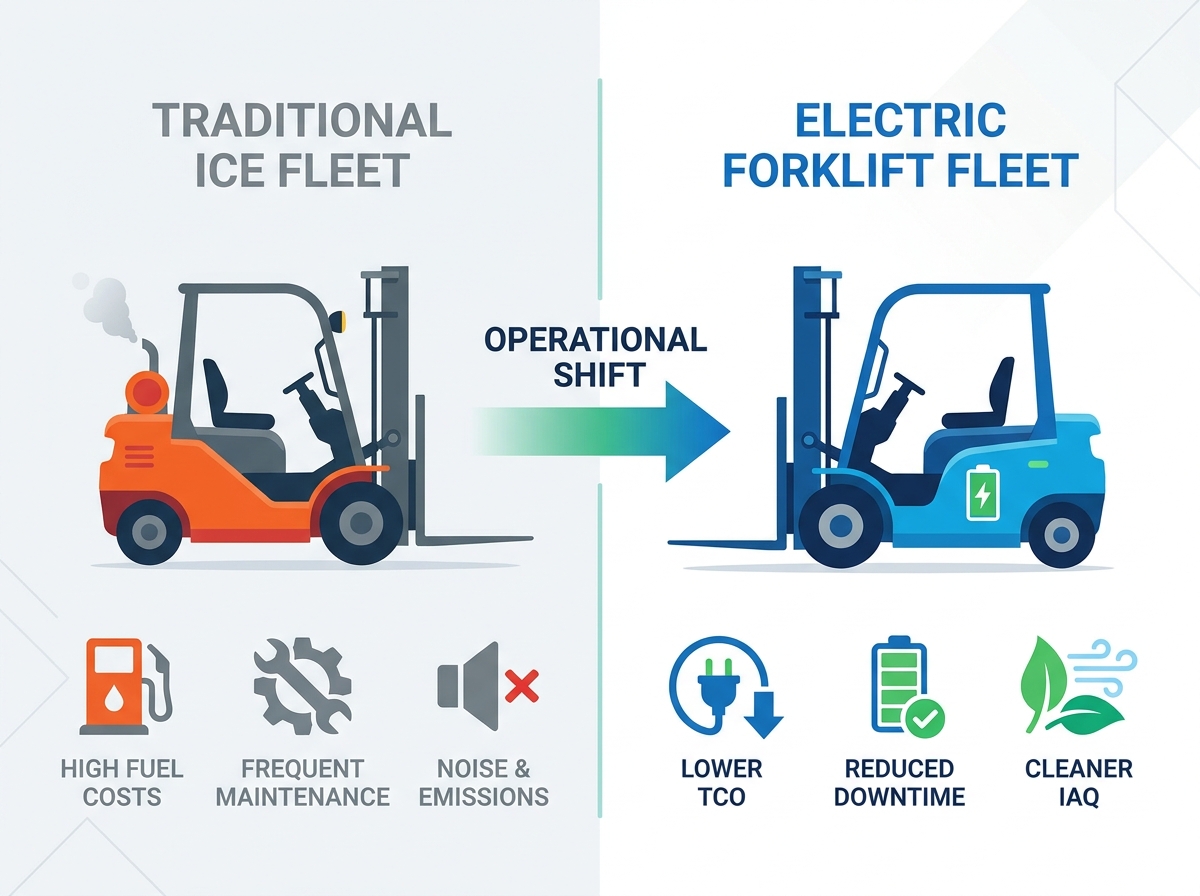
Modern enclosed facilities demand zero particulate emissions. ICE engines release harmful exhaust fumes constantly. These fumes accumulate quickly inside poorly ventilated warehouses. Employees experience headaches, fatigue, and serious respiratory issues. Switching to battery power eliminates these health hazards immediately. Your facility instantly meets stringent indoor air quality compliance rules. You avoid costly regulatory fines entirely.
Fleet managers must shift their focus. Look beyond the upfront capital expenditure (CapEx). Long-term operating expenses (OpEx) tell the real story. Battery-powered models eliminate expensive fuel deliveries completely. They lack traditional combustion engines, meaning no oil changes. You never have to service complex transmissions or replace spark plugs. Mechanics spend less time repairing broken equipment. The equipment stays on the floor moving product. This drastically reduces unexpected downtime. Your overall maintenance budget shrinks significantly over the vehicle lifecycle.
Warehouse environments generate immense noise. Loud ICE engines create chaotic acoustic conditions. Electric drivetrains operate at substantially lower decibel levels. They run almost silently compared to propane alternatives. This drastic noise reduction improves floor communication instantly. Workers can hear verbal instructions clearly. They notice warning alarms earlier. Operators experience far less fatigue during an eight-hour shift. You ultimately create a much safer, more productive warehouse environment.
Different environments demand tailored material handling strategies. An electric forklift truck adapts seamlessly to several highly regulated sectors. Understanding these applications helps you deploy assets intelligently.
Modern logistics centers maximize vertical storage space. They rely heavily on narrow aisle navigation. Operators execute high-rack stacking continuously. Pallet movement never stops. Battery-powered models fit these constraints perfectly. They provide exceptionally tight turning radiuses. Drivers experience incredibly smooth acceleration and deceleration. Precision handling becomes effortless inside constrained spaces. You can navigate narrow corridors safely.
Transporting perishable goods requires pristine conditions. Climate-controlled environments face strict FDA sanitary regulations. Zero exhaust emissions prevent product contamination entirely. Food safety inspectors actively look for propane exhaust residues. Cold storage environments present unique technical hurdles. Standard batteries lose charge rapidly in sub-zero freezers. Lithium-ion variants solve this problem beautifully. They resist voltage drops significantly better than traditional lead-acid options. They maintain consistent power output even in freezing conditions.
Production lines follow a rigorous daily cadence. Just-in-time (JIT) parts delivery keeps everything moving smoothly. Workers execute indoor-to-indoor component transfers repeatedly. Consistent power delivery supports this demanding schedule. Precise speed control allows operators to maneuver safely around assembly stations. You can support semi-automated production lines without disruption. Furthermore, the quiet motors preserve the acoustic environment. Factory workers appreciate the reduced background noise immensely.
Medical facilities handle extremely sensitive materials. They move delicate chemical precursors daily. Finished medical products require sterile handling procedures. Cleanrooms maintain stringent ISO classifications. Combustible fuels have no place here. Oil leaks instantly ruin sterile environments. Exhaust fumes violate sanitary codes. Battery-powered units eliminate all these contamination risks. They remain the only compliant option for sanitary, highly regulated zones.
Procurement requires careful alignment. You must match equipment capabilities to your operational reality. Failure to evaluate these dimensions causes severe productivity drops.
You must assess realistic daily throughput first. Standard electric models handle 3,000 to 8,000 lbs efficiently. They maneuver standard pallets effortlessly across flat floors. However, heavy-duty applications change the equation entirely. Continuous heavy lifting above 10,000 lbs stresses the system. Driving up steep ramps drains batteries much faster than anticipated. Standard units may fail mid-shift under these intense conditions. You will require specialized high-voltage units for intensive applications. Always calculate your exact load averages before purchasing.
Power sources dictate your entire daily workflow. You choose between two dominant chemistries.
Industrial Battery Chemistry Comparison Chart| Feature | Lead-Acid Battery | Lithium-Ion (Li-ion) Battery |
|---|---|---|
| Upfront CapEx | Lower initial purchase price | Higher initial purchase price |
| Maintenance Routine | Weekly watering and cleaning | Zero daily maintenance required |
| Charging Cycle | 8 hours charge, 8 hours cool | Short opportunity charging sessions |
| Facility Needs | Dedicated ventilated charging room | Wall-mounted chargers anywhere |
| Ideal Application | Standard single-shift operations | Demanding multi-shift environments |
Lead-acid chemistry offers a lower upfront cost. It delivers proven reliability across decades of use. However, these batteries demand extensive maintenance. You must build dedicated ventilation rooms for toxic off-gassing. The charging protocol remains rigid. You need 8-hour charge times followed by 8-hour cooldowns. Therefore, lead-acid works best for single-shift operations.
Lithium-Ion (Li-ion) requires a higher initial investment. It offsets this cost through extreme efficiency. Li-ion supports opportunity charging dynamically. Operators simply plug the vehicle in during lunch breaks. The battery accepts quick charges without capacity degradation. It requires zero weekly maintenance. You never add water. Li-ion proves essential for multi-shift, high-throughput environments.
Electric models traditionally utilize smooth cushion tires. These solid rubber tires work perfectly on indoor concrete. They offer excellent stability for high-rack lifting. However, some applications involve mixed terrain. You might move goods across rough outdoor yards occasionally. Standard cushion tires fail quickly on gravel. They provide terrible traction on wet asphalt. If your workflow includes outdoor terrain, you must act. You need to source pneumatic-tire electric models specifically. These air-filled tires absorb shocks and handle uneven surfaces safely.
Adopting an electric forklift truck requires comprehensive facility planning. Ignorance often leads to severe implementation failures.
The most common rollout failure surprises many managers. They buy the fleet first. Then they discover severe electrical limitations. The facility's electrical panel simply cannot handle the load. Multiple charging stations create a massive simultaneous amp draw. Breakers trip instantly. Work grinds to a halt. An electrical site audit remains strictly mandatory before procurement. You must hire a licensed electrician. Have them evaluate your incoming three-phase power capacity. They will tell you if grid upgrades are necessary.
Refueling a standard propane tank takes five minutes. Battery charging requires entirely different operational discipline. You cannot treat a battery like a gas tank. You must recalibrate daily routes carefully. Break times must align with charging schedules. Opportunity charging demands strict adherence. Operators must plug the equipment in during every downtime window. If you use lead-acid, battery swapping protocols become necessary. Ignoring these vital workflow adjustments guarantees mid-shift power failures.
Experienced drivers often resist new equipment initially. They grow accustomed to ICE truck characteristics. Propane engines provide aggressive torque curves. They also rely heavily on engine braking. Electric trucks alter the driving dynamics entirely. They deliver immediate torque the second you press the pedal. Regenerative braking stops the vehicle rapidly when releasing the accelerator. The load-handling feel changes dramatically. You must implement mandatory retraining programs. Proper instruction reduces operator frustration and prevents accidents.
Structured evaluation prevents costly procurement mistakes. Follow these logical steps when shortlisting your options.
Transitioning to battery-powered material handling is a major infrastructure project. It goes far beyond a simple vehicle purchase. You must meticulously align new equipment with your existing facility capabilities. Shift demands dictate your exact battery chemistry needs. Careful planning guarantees a smooth, productive rollout. When executed properly, this shift yields undeniable long-term operational savings. You simultaneously create a noticeably safer, quieter working environment for your team.
Next Actions:
A: Lead-acid batteries typically last 1,500 charge cycles, equating to about five years in standard single-shift use. Conversely, modern lithium-ion batteries can easily exceed 3,000 cycles. They can operate up to 10 years with minimal capacity loss, making them highly durable for intense applications.
A: Yes, provided they are explicitly rated for outdoor environments. You must select models featuring IP65+ weatherproofing and pneumatic tires. Standard indoor units with cushion tires should never be exposed to wet conditions, as moisture can severely damage unsealed electrical components.
A: Yes. Manufacturers now produce massive high-capacity electric models capable of lifting upwards of 30,000 lbs. These heavy-duty units run on robust 80-volt to 120-volt systems. However, they draw massive power and require significant facility charging infrastructure to operate continuously.
A: Opportunity charging is the practice of plugging in the vehicle for short durations during operator breaks or shift changes. This technique, typically used with lithium-ion systems, maintains high charge levels throughout the day. It allows continuous operation without degrading the overall lifespan of the battery.


