
Views: 0 Author: Site Editor Publish Time: 2026-11-20 Origin: Site


Fleet electrification has shifted from a mere corporate sustainability talking point to a core operational efficiency strategy. Modern warehouses and material handling facilities now prioritize advanced equipment to stay competitive. They rely on these modern machines to deliver tangible performance upgrades directly on the warehouse floor.
As emissions regulations tighten globally, lithium-ion technology also matures at a rapid pace. The transition from internal combustion engine models to an electric forklift truck is heavily driven by clear operational metrics. Procurement leaders and facility managers know evaluating this equipment goes far beyond reading basic spec sheets.
This comprehensive guide breaks down the core mechanics and critical features you must understand. You will discover verifiable business benefits and learn exactly what facility infrastructure you need. We will help you make a fully informed and sound purchasing decision for your fleet.
An electric forklift truck operates using large industrial batteries rather than traditional fossil fuels. These power sources eliminate the need for diesel, propane, or gasoline. Historically, the industry relied heavily on lead-acid batteries. Today, many facilities increasingly adopt lithium-ion alternatives for better efficiency. These batteries supply direct power to highly efficient electric motors.
Modern electric models utilize advanced AC drive motors for smooth propulsion. They also feature separate electric motors dedicated strictly to hydraulic lift functions. This dual-motor setup ensures operators experience consistent power delivery. You get precise control over both travel speed and heavy lifting operations simultaneously.
Electric lift trucks feature significantly fewer moving parts than internal combustion variants. They lack engine blocks, complex transmissions, radiators, and exhaust systems. This mechanical simplicity fundamentally changes your entire maintenance paradigm. Fewer moving components mean less daily friction and heat generation. Operators spend less time troubleshooting mechanical failures. Fleet managers benefit from higher overall equipment reliability.
Common Mistake: Many new operators treat electric models like traditional gas trucks. They often apply abrupt throttle inputs. You should train your team to utilize smooth acceleration to maximize battery life and motor longevity.
You must evaluate several critical features before purchasing new equipment. The underlying technology dictates how well the machine performs in your specific environment.
Your choice of battery chemistry dictates your daily operational workflows.
Table 1: Battery Technology Comparison
| Feature | Lead-Acid | Lithium-Ion |
|---|---|---|
| Upfront Cost | Lower | Higher |
| Routine Maintenance | Daily watering, equalization | None required |
| Charging Style | Full 8-hour charge required | Fast opportunity charging |
| Space Requirements | Dedicated, ventilated rooms | Decentralized wall chargers |
Modern electric models feature sophisticated regenerative braking. This system captures kinetic energy during deceleration. It feeds this generated power directly back into the battery. This process extends your total shift runtime. It also drastically reduces physical brake pad wear, saving you money on replacement parts.
Telematics integration modules act as the brain of your fleet. They allow fleet managers to monitor battery health remotely. You can easily restrict maximum travel speeds in pedestrian-heavy zones. These systems also track impact incidents to ensure strict safety compliance. Programmable parameters let you customize acceleration curves for different operator skill levels.
Electric models do not house bulky internal combustion engines or fuel tanks. Manufacturers can design a much more compact counterweight system. This optimization allows for tighter turning radii. You can easily optimize your warehouse aisle widths to increase total storage density.
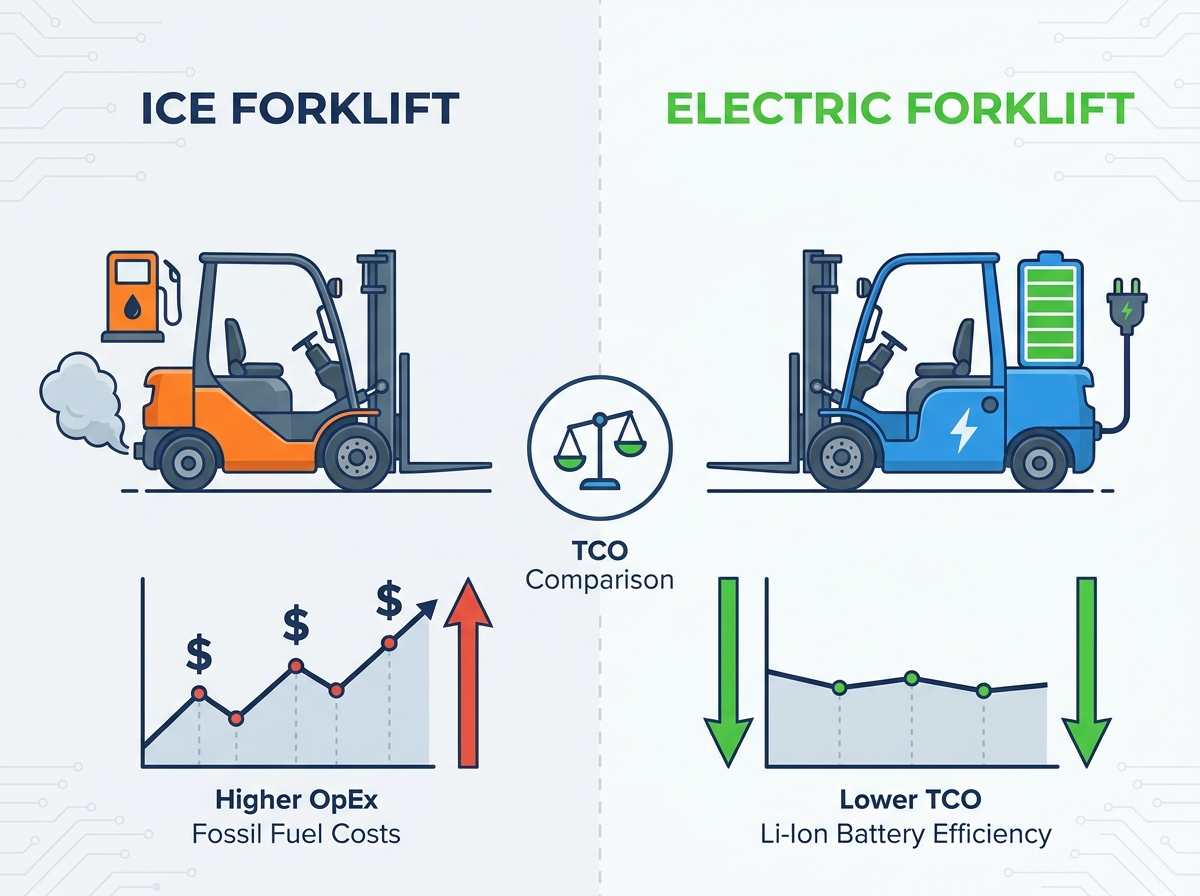
Transitioning your fleet delivers measurable advantages across your entire operation. You must look past the sticker price to see the true value.
You should shift your focus from initial acquisition costs to daily operating expenses. Significant financial savings come from the stark difference between industrial electricity rates and volatile fossil fuel prices. You also experience a dramatic reduction in consumable parts. You no longer buy engine oil, transmission fluid, or expensive spark plugs.
Electric equipment is absolutely essential for enclosed warehousing environments. An electric forklift truck entirely eliminates the risk of carbon monoxide exposure. This improves your indoor air quality immediately. It ensures strict compliance with OSHA and EPA regulations. It also helps you meet stringent food safety standards in grocery or pharmaceutical distribution.
Electric motors hum quietly rather than roar loudly. This massive noise reduction directly lowers operator fatigue during long shifts. It drastically lowers your facility's ambient decibel level. Auditory safety improves because operators can hear warning alarms and warehouse traffic much more clearly.
You can eliminate messy oil changes and filter replacements entirely. You never have to flush a transmission again. This streamlined maintenance schedule leads to significantly higher equipment availability. Your trucks stay on the floor moving product instead of sitting in the repair shop.
Choosing the right equipment requires a realistic look at your operational environment. Neither technology is universally perfect for every single application.
Electric units excel in several distinct scenarios. They are ideal for multi-shift indoor operations. They perform beautifully in cold storage facilities if you spec them with proper modifications. You should choose electric if your facility features predictable travel routes. They are also perfect for companies actively prioritizing their Environmental, Social, and Governance (ESG) goals.
ICE models still hold their ground in specific environments. You might need them for heavy-duty outdoor applications involving massive payloads. They dominate in rugged or uneven terrain where ground clearance is critical. Remote lumber yards lacking stable electrical infrastructure often require diesel units. ICE also makes sense if your operation simply cannot accommodate any charging downtime.
Follow these numbered steps to evaluate your true operational needs:
Risk and Skepticism Check: Acknowledge that standard battery performance degrades rapidly in extreme cold environments. You must use specialized heated batteries for freezers. Also, failing to enforce proper charging habits will prematurely destroy expensive battery life.
You cannot simply buy an electric machine and plug it into a standard wall outlet. Successful deployment requires careful facility planning.
You must answer a critical question early. Does your facility have the necessary 3-phase power available? Do you have sufficient total amperage to charge an entire fleet simultaneously at the end of a shift? Utility upgrades can delay your rollout by several months. Engage your local power provider immediately during the planning phase.
Your battery choice dictates your warehouse layout.
Transitioning to electric power requires comprehensive operator retraining. Your staff must shift from a "refuel when empty" mindset to designated charging protocols. They must learn to read and understand battery management system (BMS) dashboards. Resistance to change is common. You should implement clear training programs to ensure smooth adoption.
Buying industrial equipment is a major capital investment. You need a structured approach to narrow down your options effectively.
You must precisely map out your daily payload capacities. Determine your exact desired lift heights to the inch. Calculate the number of hours the truck actually runs per shift. You must differentiate between raw engine hours and actual key-on working hours. This data prevents you from over-specifying or under-powering your fleet.
Your operating schedule dictates your ideal battery solution. Single-shift operations can easily rely on lower-cost lead-acid setups. They have plenty of overnight downtime for eight-hour charges. Conversely, 24/7 operations typically require lithium-ion systems. If lithium is too expensive, you must invest in secondary swappable lead-acid batteries and extraction hoists.
Require your vendor partners to provide detailed five-year operational expense models. Ask them to compare your localized industrial electricity rates against your current propane or diesel fuel costs. Factor in the reduced labor costs associated with eliminated maintenance routines. This provides a clear picture of your actual financial return.
The best machine is useless without reliable technical support. Prioritize original equipment manufacturers (OEMs) or local dealers with robust service networks. Ensure they carry deep local parts inventory. Verify they offer rapid battery support and skilled telematics integration capabilities.
Best Practice: Always test drive a demo unit in your actual facility. Operators need to feel the ergonomics and test the turning radius within your specific aisle dimensions.
The shift to an electric fleet is a capital-intensive but highly rewarding operational move. You gain tremendous value when you match the equipment correctly to your facility's workload and infrastructure. You secure long-term efficiency, protect your workforce from emissions, and streamline your daily maintenance tasks.
Do not purchase this machinery in isolation. You must treat this procurement as an integrated system purchase. The truck, the battery, the charger, and your utility infrastructure must work together perfectly. Begin your journey with a comprehensive site power audit before you ever solicit equipment bids. This proactive step prevents costly delays and ensures a smooth, profitable rollout.
A: Operational life varies significantly by battery type. Lead-acid batteries typically last around 1,500 charging cycles when properly maintained. Lithium-ion batteries offer a much longer lifespan, often exceeding 3,000 cycles. Daily maintenance habits heavily influence these numbers. Operators must follow strict charging protocols to maximize battery longevity.
A: Yes, many modern units operate outdoors safely. You must check the equipment's IP (Ingress Protection) rating first. High IP ratings mean the truck is sealed and weather-resistant. They can handle light rain and damp conditions easily. However, they are not universally designed for deep water or heavy mud.
A: Charging times depend entirely on your battery chemistry. A standard lead-acid battery requires an eight-hour charge followed by an eight-hour cooldown period. Conversely, lithium-ion batteries support fast opportunity charging. You can fully charge them in one to two hours. Operators can even plug them in during short breaks.


