
Views: 0 Author: Site Editor Publish Time: 2026-11-24 Origin: Site


Transitioning your fleet to electric material handling equipment often means navigating fragmented and confusing pricing. You might see an appealing sticker price online, but base MSRPs rarely reflect the fully operational cost. Prices jump significantly once batteries, chargers, and facility upgrades are factored in. A successful procurement evaluation must move past the upfront hardware tag. Instead, buyers should calculate the complete 3- to 5-year lifetime expenses based on shift utilization, facility infrastructure, and routine maintenance requirements.
This article breaks down the real costs associated with purchasing a new electric forklift. We will compare different power configurations. We will also provide a clear framework for shortlisting vendors and negotiating contracts effectively. You will learn exactly what to budget for, ensuring your next equipment investment delivers maximum operational efficiency.
Understanding equipment pricing requires breaking down the core specifications. Load capacity directly dictates the size of the electric motors required. Mast height influences the hydraulic system complexity. Chassis design impacts the overall manufacturing cost. These three variables form the foundation of your baseline price.
Walkies and rider pallet jacks serve as the entry point for powered material handling. Their general price range sits between $4,000 and $10,000. They work best for low-throughput retail environments. They also excel in tight warehousing spaces where full-sized machines cannot maneuver. These units keep initial costs very low while significantly reducing operator fatigue.
Standard electric models dominate modern warehouses. They typically handle capacities ranging from 3,000 to 5,000 pounds. The general price range falls between $25,000 and $40,000. These machines serve as the industry standard for dock-to-stock operations. Three-wheel designs offer tighter turning radiuses for narrow aisles. Four-wheel designs provide better stability for heavier loads on uneven dock plates.
Specialized equipment commands premium pricing. High-reach trucks, narrow aisle selectors, and units lifting over 10,000 pounds require heavy-duty engineering. The general price range starts at $45,000 and often exceeds $80,000. Dense racking systems demand these precise machines. Heavy manufacturing facilities also rely on their massive lifting capabilities.
Buyers must understand a crucial industry pricing tactic. Many quoted baseline prices represent a "naked" forklift. This means the quote entirely excludes the battery and charger. Buyers must strictly define what is included in any dealer's quote. Always request a fully itemized proposal. Ensure the chassis, power source, and charging hardware are clearly listed.
| Equipment Category | Typical Load Capacity | Estimated Base Price Range | Best Use Case |
|---|---|---|---|
| Light-Duty (Walkies/Riders) | 1,000 - 4,500 lbs | $4,000 - $10,000 | Retail, tight spaces, low-throughput |
| Standard 3 & 4-Wheel | 3,000 - 5,000 lbs | $25,000 - $40,000 | Dock-to-stock, standard racking |
| Heavy-Duty / Specialized | 10,000+ lbs / High-Reach | $45,000 - $80,000+ | Dense racking, heavy manufacturing |
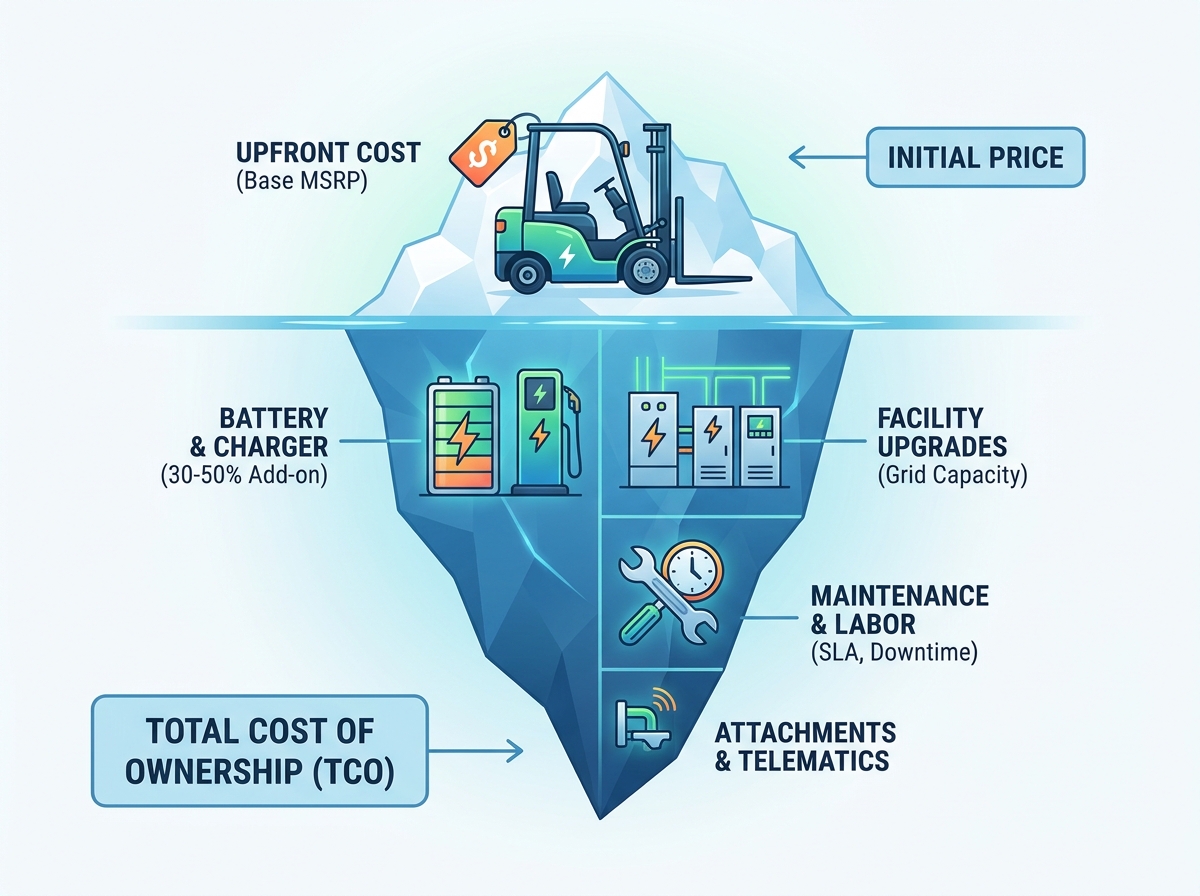
The power source represents the most significant ongoing operational factor. Choosing the right battery chemistry impacts daily routines and long-term budgets. You must weigh upfront pricing against lifetime operational expenses.
Lead-acid technology remains a staple in material handling. It presents several distinct advantages and drawbacks.
Lithium-ion technology has transformed warehouse operations. While expensive initially, it changes how fleets operate entirely.
Calculating true return on investment requires a broad evaluation framework. First, factor in the expected lifespan using battery cycle counts. Lithium-ion batteries often deliver triple the cycle life of lead-acid units. Next, calculate daily maintenance hours saved. Eliminating battery watering and swapping reclaims hundreds of labor hours annually. Finally, measure energy efficiency differences. Modern chargers paired with advanced batteries waste far less electricity. These combined savings often justify higher initial battery investments.
Once you select your equipment, you must decide how to acquire it. Procurement models heavily influence cash flow and maintenance responsibilities. Carefully consider your organization's financial strategy before signing.
Buying equipment outright remains a popular choice for cash-rich companies.
Leasing offers financial flexibility and operational predictability.
Sometimes immediate procurement is not the right move. A short-term rental makes sense under specific conditions. You might experience seasonal inventory spikes demanding temporary fleet expansion. Alternatively, you might want to pilot a new operational layout. Renting allows you to test workflows before fully committing to a new electric forklift.
A procurement budget must account for implementation realities. Ignoring site preparation or operational software leads to immediate budget overruns.
Infrastructure limitations pose the greatest risk to electric fleet deployments.
Standard forks rarely meet all operational needs. Evaluating the cost impact of custom attachments is essential. Side-shifters allow operators to align pallets without repositioning the whole truck. Fork positioners adjust fork width hydraulically from the driver's seat. Cold storage conditioning protects electronics in freezing environments. Non-marking tires prevent floor scuffing in clean-room or food-grade facilities. Each of these upgrades adds to the final invoice.
Data drives modern warehouse efficiency. Weigh the upfront cost of software modules against long-term operational benefits. Fleet management systems provide crucial impact tracking. They enforce access control so only certified operators can start the machine. They also deliver deep utilization analytics. This data highlights idle times and bottlenecks. Over a five-year period, telematics data often pays for itself by reducing accidental damage.
Selecting the right dealership matters just as much as picking the right brand. Hardware is only as good as the local support backing it. You need a structured approach to vendor selection.
Always evaluate dealership Service Level Agreements (SLAs) closely. Assess their guaranteed response times for emergency breakdowns. Investigate their local parts availability. Ask where they stock their replacement components. Verify technician proximity to your warehouse. A fantastic truck becomes useless if you wait four days for a simple repair part.
Do not accept standard warranties at face value. Compare standard coverage against extended warranties across different brands. Look for separate coverage terms. The chassis, the drivetrain, and the battery usually carry different protection lengths. Ensure you understand exactly what voids the coverage.
You should always insist on an on-site demo. The pilot program approach mitigates adoption risks. Request a short-term pilot rental before signing a multi-unit fleet replacement contract. Your operators need to test the ergonomics. Your facility needs to verify turning radiuses in actual aisles.
The "best deal" on a new electric forklift is rarely the lowest upfront quote. A truly successful investment is the configuration that aligns perfectly with your shift structure. It must respect your facility constraints and match your long-term cash flow strategy. Sacrificing battery performance or dealership support for a cheaper sticker price usually backfires through expensive downtime.
Your next steps require coordinated internal planning. Form an internal procurement committee involving your Operations, Finance, and Facilities teams. Audit your current electrical infrastructure thoroughly to prevent charging bottlenecks. Finally, request unbundled quotes from at least three local dealers. Comparing chassis, battery, charger, and maintenance costs individually ensures you maintain total transparency during the negotiation process.
A: Replacement costs vary widely based on the underlying battery chemistry. A standard lead-acid replacement typically costs around $3,000 to $5,000. Conversely, a high-capacity lithium-ion replacement can range from $10,000 up to $15,000+. This massive price difference emphasizes exactly why proper daily battery care and optimized charging routines remain critical.
A: Light-duty pallet jacks and walkies can often charge on standard 120V wall outlets. However, full-sized sit-down warehouse forklifts draw significantly more power. They strictly require hardwired 240V or 480V three-phase electrical power. Attempting to charge large machines without adequate infrastructure is impossible and poses severe safety risks.
A: Typical industry benchmarks place the average lifespan between 10,000 to 12,000 hours of operation. A well-maintained machine might last roughly five to seven years in a busy single-shift application. Harsh operating environments, like freezing cold storage or abrasive outdoor yards, will negatively impact overall equipment longevity.
A: Yes, they are highly capable of outdoor work today. While traditionally designed for smooth indoor floors, modern engineering has changed this. Newer pneumatic-tire electric models feature sealed internal components. Units with IP65+ ratings easily handle outdoor yard work, rain exposure, and rougher terrain without compromising sensitive electronics.


