
Views: 0 Author: Site Editor Publish Time: 2026-11-25 Origin: Site


Transitioning your warehouse fleet requires serious strategic planning. Upgrading your material handling equipment means aligning tough operational demands with modern machinery capabilities. Without the right data, you risk buying machines that look great on a specification sheet but fail on the warehouse floor. This mismatch creates unexpected downtime, frustrates operators, and ruins your projected return on investment.
We aim to fix this common procurement issue today. We will provide a highly transparent, specification-driven framework for evaluating a new electric forklift. You will learn exactly how to match equipment specs to your unique facility constraints, shift structures, and safety requirements. Achieving optimal performance is rarely about buying the highest possible specifications available. Instead, it involves securing the exact technical match for your specific environment. Let us dive into the core specifications and operational realities you must consider.
Before finalizing any purchase order for a new electric forklift, you must map your existing facility constraints. The equipment specifications must align flawlessly with your physical environment. Overlooking these baseline metrics leads to constant operational bottlenecks.
When assessing a new electric forklift, actual lift capacity remains paramount. You must calculate the actual load center derating for your heaviest pallets. A machine rated for a 4,000-pound maximum capacity cannot lift that maximum weight to its highest point safely. The actual lifting capacity decreases significantly as the forks rise higher into the air. For example, adding a specialized paper roll clamp attachment drastically reduces the base lifting capacity. Always mandate a finalized capacity data plate based on your specific attachments and maximum lift heights.
Standard warehousing environments typically utilize 2–5 ton capacities. These tonnage sweet spots easily handle most palletized consumer goods efficiently. Heavy manufacturing or metal fabrication requires much higher-capacity variants.
Next, you must evaluate mast types based strictly on your overhead clearance restrictions. You must clear standard facility doors while still reaching your maximum top-rack heights. Evaluators often choose between several mast designs:
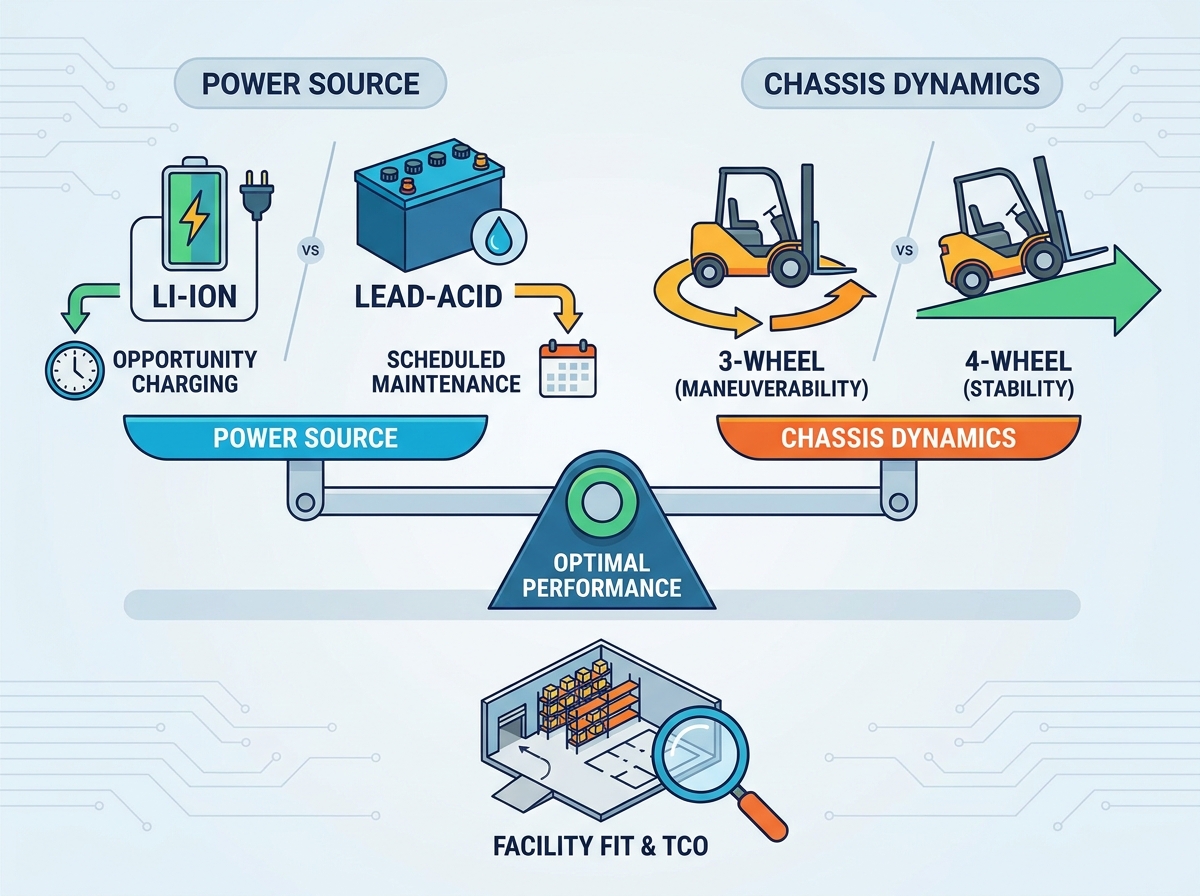
Chassis selection determines how smoothly the equipment navigates your physical space. You must match the wheel configuration to the specific application environment.
Your battery choice directly determines your daily facility workflow. You must understand the distinct differences between modern power systems before upgrading.
Lithium-ion systems currently dominate modern fleet upgrades. They do carry a noticeably higher upfront capital expenditure. However, they require absolutely zero daily watering maintenance. They allow for rapid opportunity charging during short employee breaks. They also deliver consistent, reliable voltage until complete depletion, meaning the machine never slows down at the end of a long shift.
Advanced lead-acid systems remain viable for certain operations. They offer a much lower initial procurement cost. However, they demand strict, daily watering schedules to function safely. You must provide dedicated ventilation spaces for hazardous off-gassing during charging. They also force you to follow a rigid 8-8-8 cycle: eight hours of running, eight hours of charging, and eight hours of cooling before reuse.
Table 1: Battery Technology Comparison for Forklifts
| Feature | Lithium-Ion Systems | Advanced Lead-Acid Systems |
|---|---|---|
| Daily Maintenance | Zero (No watering required) | High (Strict watering schedules) |
| Charging Protocol | Opportunity charging (Short bursts) | Strict 8-8-8 cycle (Run, Charge, Cool) |
| Ventilation Needs | None (Sealed units) | High (Dedicated off-gassing rooms) |
| Power Delivery | Consistent until depletion | Gradually fades as charge drops |
Operating heavy machinery demands intense, continuous focus. Operator fatigue leads directly to costly safety incidents and product damage. Modern material handling equipment prioritizes deep ergonomic support to protect workers on the floor.
Visibility and Mast Design: Clear-view mast construction is an essential safety feature. It aggressively reduces hazardous blind spots during precise load handling. Better forward visibility helps operators place heavy pallets accurately without leaning outside the protective cage. This modern design prevents severe crush injuries.
Operator Compartment Features: Any premium new electric forklift usually features highly adjustable seating. Operators benefit immensely from intuitive, fingertip hydraulic controls rather than heavy manual levers. Vibration-dampening floor mats reduce severe physical strain over long twelve-hour shifts. Less physical fatigue always translates to higher hourly throughput and better employee retention rates.
Electronic Safety Interventions: Modern occupational safety standards strongly encourage active electronic safety measures. Look for programmable travel speed limiters based on warehouse zones. Automatic cornering deceleration prevents dangerous tip-over events when driving aggressively around tight racks. Presence-sensing systems ensure the truck immediately stops moving if the operator accidentally leaves the seat. These electronic interventions act as a highly reliable, invisible safety net for your facility.
You cannot simply deploy a new electric forklift fleet without properly upgrading your underlying facility. Ignoring baseline infrastructure creates incredibly costly operational bottlenecks that halt production.
Electrical Grid Audits: You must verify your total facility amperage first. Many facility managers mistakenly assume standard industrial wiring supports fast chargers. A high-output charger can draw massive amperage. Can your current electrical grid support multiple high-frequency fast chargers simultaneously? If not, you risk triggering severe peak demand penalties from your local utility provider. You might even trip main breakers, shutting down entire production lines. Consult a commercial electrician early in the procurement process.
Charging Station Footprints: You must allocate strictly compliant physical space for charging. Traditional lead-acid battery rooms require significant, dedicated square footage. They need aggressive ventilation systems, chemical spill kits, and emergency eyewash stations to meet compliance codes. In stark contrast, you can strategically place decentralized charging nodes for Li-ion systems throughout the warehouse. This modern approach saves highly valuable warehouse storage space.
Maintenance Transitions: Always factor in the required retraining time for your maintenance staff. Your in-house technicians must transition away from traditional Internal Combustion Engine (ICE) diagnostics. They now need highly specific training on high-voltage electric drivetrains and complex Battery Management Systems (BMS). Failing to upskill your mechanics leads to prolonged equipment downtime.
Selecting the perfect machine requires rigorous, data-driven shortlisting. You must look far beyond the initial, superficial sticker price to understand true long-term value.
Cost Modeling Strategy: Evaluate projected energy consumption costs over a standard 5–7 year lifecycle. Carefully estimate the expected maintenance reductions when comparing these electric machines to your legacy gas-powered fleets. Calculate the projected battery lifespan based heavily on your actual shift density. This thorough modeling ensures you understand the true financial impact of your procurement decision over time.
Warranty and SLA Evaluation: Always review the manufacturer guarantees carefully before signing contracts. Pay close attention to specific battery degradation clauses and capacity replacement thresholds. Examine the drivetrain component warranties for hidden exclusions. A strong Service Level Agreement (SLA) guarantees rapid, reliable technician response times. This formalized agreement directly protects your daily operational uptime.
Next Steps for Procurement: Never purchase an entire replacement fleet blindly. Structure limited pilot programs first. Request site-specific operational audits from your competing equipment vendors. Set highly measurable success criteria before authorizing any fleet-wide rollout. A standard two-week pilot test always reveals hidden operational friction that glossy brochures ignore.
Selecting a high-performance new electric forklift hinges on precise, data-driven alignment. You must rigorously match technical specifications with your daily operational realities. Never prioritize raw, theoretical lifting performance over your actual infrastructure readiness.
You must secure adequate grid capacity and safe charging zones before taking delivery. Ensure your operators receive comprehensive ergonomic adjustments and electronic safety support. Follow a strict, methodical shortlisting process involving detailed warranties and real-world pilot testing. This rigorous, analytical approach guarantees maximum operational efficiency, improves worker safety, and secures long-term reliability for your warehouse.
A: Battery lifespan depends heavily on chemistry and maintenance. A standard lead-acid battery typically delivers around 1,500 charging cycles. They require strict watering and cooling routines to achieve this. Conversely, a lithium-ion battery offers 3,000 or more cycles under normal use. They demand virtually no maintenance. This extended lifespan makes them highly efficient for demanding multi-shift facilities.
A: Yes, but you must check the specific IP ratings for the internal motors and controllers. High IP ratings indicate strong protection against dust and moisture ingress. However, standard electric models still have limitations compared to rough-terrain ICE forklifts. You should avoid deep puddles and severe weather. Always specify a specialized outdoor protection package for frequent yard operations.
A: Freezing temperatures severely impact battery efficiency. Cold storage degrades standard battery capacity quickly, causing much shorter run times. You must equip the machine with specific cold-prep packages. These packages include specialized hydraulic fluids and robust condensation protection for internal electronics. Heated operator cabins also become essential for maintaining productivity and safety during prolonged freezer shifts.
A: Opportunity charging is the practice of plugging in the forklift during short intervals, like lunch breaks or shift changes. This modern practice links directly to lithium-ion battery technology. Lithium systems handle frequent, short charges perfectly without degrading cell capacity. If you run a high-density, multi-shift operation, you absolutely need opportunity charging to keep machines running continuously without swapping batteries.


