
Views: 0 Author: Site Editor Publish Time: 2026-11-22 Origin: Site


The material handling industry is undergoing a massive, unprecedented shift. Warehouses, manufacturing plants, and distribution centers are rapidly swapping internal combustion engine (ICE) fleets for electric alternatives. Stricter global emissions compliance rules and the growing push for workplace noise reduction drive this rapid change. Facilities can no longer rely on outdated diesel or propane equipment indoors.
However, selecting an electric forklift truck is not just about matching basic lift capacity. You must precision-match complex technical specifications to your unique facility infrastructure. Shift patterns, racking layouts, and dock configurations all play a vital role in this decision. You cannot simply buy a truck off the shelf and expect it to work perfectly.
This comprehensive guide breaks down the critical technical specs you need to know. We explore everything from tonnage limits and advanced battery chemistry to exact mast clearances. Procurement and operations teams can use this detailed information to evaluate options rigorously. You will learn exactly how to shortlist the right equipment for your specific operational demands.
Specifying the wrong load capacity creates major operational problems across your facility. Under-specifying your equipment leads to severe safety risks for your operators. Pushing a truck beyond its limits causes accelerated equipment wear and frequent, costly breakdowns. Conversely, over-specifying wastes your capital expenditure unnecessarily. It compromises maneuverability in tight warehouse aisles, slowing down daily productivity. You must find the perfect balance for your daily operational loads.
We can divide equipment solutions into three main categories based on standard industry usage:
You must evaluate capacity strictly through the lens of the load center. Manufacturers specify how rated capacity changes based on this crucial metric. A 3.0T rating typically relies on a standard 24-inch (500mm) load center. This assumes a perfectly cubed pallet evenly distributing weight.
Longer or irregularly shaped loads will drastically reduce the actual safe lifting capacity. If you pick up a 48-inch deep load, the center of gravity shifts further forward. This shift diminishes the weight the truck can safely lift without tipping forward. Adding heavy attachments, such as side shifters or paper roll clamps, also eats into your base capacity.
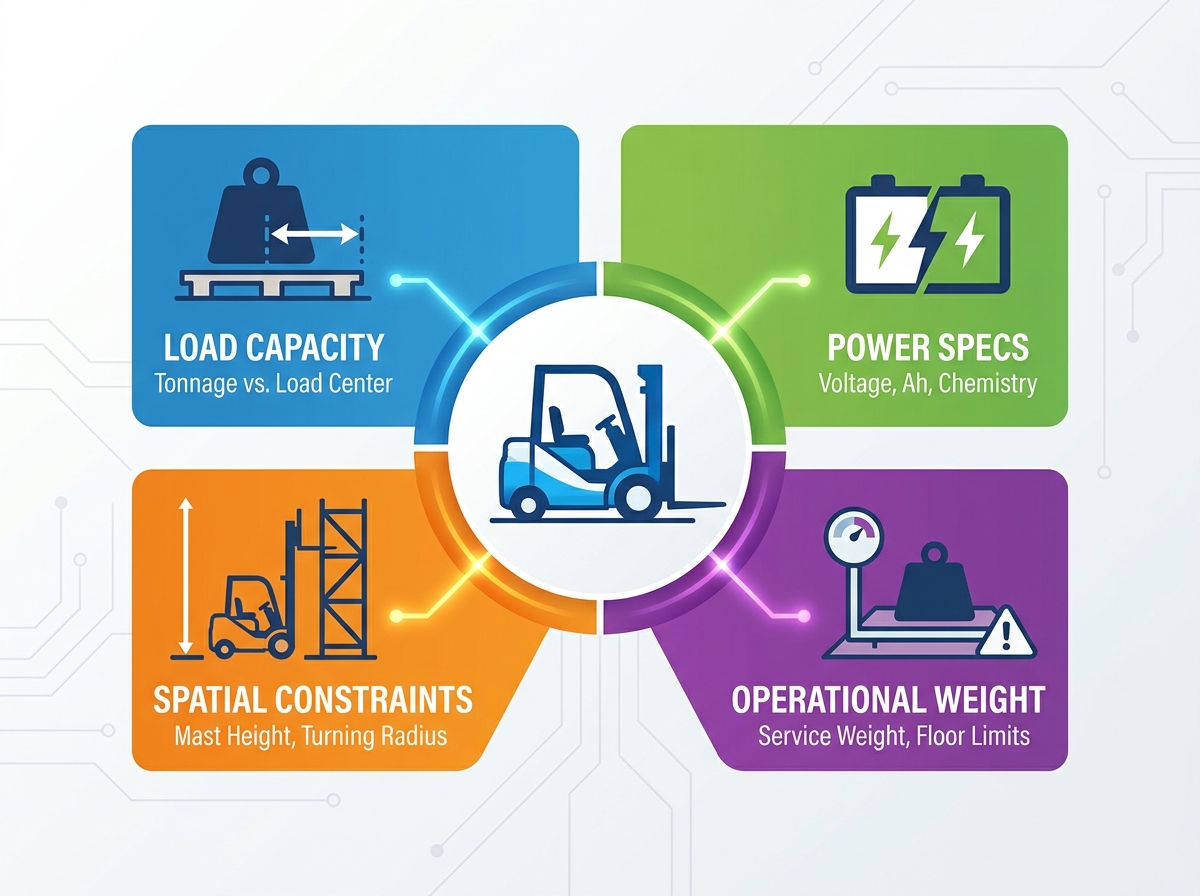
Power specifications dictate whether your equipment can survive a heavy multi-shift operation. They also determine if your facility needs an expensive, time-consuming electrical infrastructure upgrade. Choosing the wrong power source can cripple your operational efficiency and stall production.
You must evaluate two primary dimensions when looking at power specs:
Implementation considerations carry significant operational risks that you must plan for. Lead-acid batteries present a traditional, upfront cost-effective choice. However, they remain highly labor-intensive for your maintenance crew. They require dedicated, well-ventilated charging rooms to prevent dangerous hydrogen gas buildup. You must perform strict watering maintenance regularly to prevent cell degradation. They also demand a rigid 8-hour charge and 8-hour cool cycle, requiring multiple batteries per truck for continuous shifts.
Lithium-ion technology changes this dynamic completely. It allows for fast opportunity charging during brief operator breaks or shift changes. It requires absolutely zero daily maintenance, eliminating watering schedules entirely.
Trustworthiness Note: Always audit your existing facility electrical amperage before committing to a lithium-ion fleet. Fast chargers draw immense peak power from the local grid. This massive draw can trigger hidden facility upgrade costs, such as new transformers or upgraded electrical panels. These unexpected capital expenses can quickly negate the operational advantages you originally sought.
Table 1: Battery Chemistry Feature Comparison
| Specification Category | Traditional Lead-Acid | Modern Lithium-Ion |
|---|---|---|
| Daily Maintenance Routine | High (Watering, Equalization charges) | Zero Maintenance required |
| Standard Charging Time | 8 Hours (+ 8 Hours cooling period) | 1 to 2 Hours total |
| Opportunity Charging Capability | Not Recommended (Shortens lifespan) | Highly Recommended |
| Facility Ventilation Needs | Dedicated Exhaust Room Required | None Required |
| Multi-Shift Operation Setup | Requires 2-3 batteries per truck | Requires 1 battery per truck |
Forklift dimensions must seamlessly navigate existing dock doors, standard enclosed trailers, and top-tier racking. They must accomplish this without causing structural damage to your building. You also want to avoid redesigning your facility layout just to accommodate new equipment dimensions.
You will encounter several specific solution categories when configuring lift masts:
You must evaluate two critical dimensions before making a final purchase decision. First, compare the Overall Lowered Height (OALH) against your lowest facility doorway. You must also check it against low-hanging sprinkler pipes, lighting fixtures, or HVAC ducts. If the OALH is too high, the truck literally cannot move between warehouse zones.
Second, compare the Maximum Fork Height (MFH) against your highest rack shelf. You must ensure the truck maintains sufficient residual capacity at its absolute full extension. Lifting a heavy load to maximum height changes the physics of the machine drastically.
Maximizing warehouse storage density requires systematically narrowing your operating aisles. This physical constraint strictly limits your equipment choices from the very beginning. You must fit the truck to the aisle, not the aisle to the truck. Trying to squeeze a large machine into a narrow aisle guarantees rack damage and safety incidents.
Evaluate these dimensions carefully to ensure a perfectly safe fit:
The standard industry formula for Right-Angle Stack is straight forward:
Turning Radius + Load Length + Equipment Overhang + 12-inch Safety Clearance.
If you fail to include the 12-inch safety clearance, your operators will struggle to turn smoothly. They will constantly bump racks, causing catastrophic inventory damage over time.
Implementation considerations often come down to choosing between a 3-wheel and 4-wheel chassis design. A 3-wheel chassis offers superior, tighter turning radii. It is the perfect choice for indoor, narrow-aisle environments where floor space is premium. The single rear drive wheel allows it to pivot almost on its own axis.
Conversely, a 4-wheel chassis provides much better structural stability. It handles uneven floor surfaces, wider operating aisles, and heavier tonnage requirements far better than a 3-wheel design. If your operators cross uneven dock plates frequently, a 4-wheel design is mandatory.
Deploying equipment without verifying environmental ratings introduces severe safety liabilities. Ignoring floor load limits poses equally dangerous equipment failure risks. You must consider exactly where and how the machine will operate daily before finalizing specs.
When reviewing implementation considerations, service weight is a surprisingly crucial factor. An electric forklift truck is exceptionally heavy compared to its visual size. The massive battery pack acts as the primary stabilizing counterweight for the machine. Because of this dense weight, a 2.0T capacity truck may weigh well over 3.5T in total service weight.
Operations must verify mezzanine structures, freight elevator limits, and trailer floor load limits prior to procurement. Dropping a heavy machine through a weak, rotting trailer floor happens more often than warehouse managers admit. Always check your dock leveler weight ratings to ensure they can support both the truck and the heaviest load combined.
Tire specifications also dictate environmental compliance and ride quality. Cushion tires are designed exclusively for smooth indoor concrete surfaces. They offer excellent traction indoors but fail completely on dirt. Solid pneumatic tires are mandatory for outdoor yards or uneven, gravel-filled surfaces.
Cold storage and IP ratings require specialized attention during procurement. Standard electric trucks will fail quickly in commercial freezer environments. Condensation shorts out standard electronics as the truck moves between warm and freezing zones. Extreme cold also thickens standard hydraulic fluids, slowing down lift speeds.
Ensure specific models are factory-conditioned for cold storage applications. These specialized models feature sealed electronics and cold-rated fluids. If you operate outdoors in the rain, ensure the truck carries appropriate IP weatherproofing ratings.
Evaluating technical specifications requires a highly methodical and exact approach. Base your initial equipment elimination on three non-negotiable facility constraints. These are the heaviest peak load you handle, the highest rack elevation in your building, and your tightest operating aisle width. Let these three definitive factors establish your baseline chassis and mast requirements before looking at brands.
Take these action-oriented next steps to move your procurement process forward:
A: Load capacity and actual service weight are entirely different metrics. Electric models are inherently heavy because they use massive lead-acid or lithium-ion batteries as primary counterweights. For example, a standard 5,000 lb capacity truck often has a total service weight exceeding 8,000 lbs. You must always check your warehouse floor, freight elevator, and semi-trailer load limits before deploying these exceptionally heavy machines.
A: Runtime depends heavily on the specific Ah rating, system voltage, and daily usage intensity. Typically, a standard lead-acid battery provides 6 to 8 hours of continuous operational use before needing a full charge. Lithium-ion batteries offer a different advantage altogether. They allow for near-continuous multi-shift use because operators can safely utilize strategic opportunity charging during their quick rest breaks.
A: Yes, it is a common industry misconception that electric models are indoor-only machines. Manufacturers design specific 4-wheel, 80V models expressly for heavy outdoor yard use. These rugged units come equipped with solid pneumatic tires, fully sealed AC drive motors, and high IP weatherproofing ratings. They act as direct, highly capable replacements for traditional outdoor diesel yard trucks.


