
Views: 0 Author: Site Editor Publish Time: 2026-11-13 Origin: Site


Facility managers face mounting pressure to optimize operations while navigating complex sustainability targets. Procuring material handling equipment represents a critical milestone for growing distribution centers and warehouses. Transitioning to or expanding a fleet of electric forklifts involves substantial capital expenditure, precise facility modifications, and lasting operational impacts. Internal combustion engine models dominated historically across industrial settings. Today, stricter emissions regulations and rapid advancements in high-capacity battery technology heavily shift this landscape. Modern battery-powered models now prove highly viable for heavy-duty applications and rigorous multi-shift operations. We will explore how you can make the absolute best procurement choices. You will gain a rigorous, vendor-neutral framework to evaluate your daily operational requirements accurately. We will help you compare leading battery technologies and formally assess your facility readiness. Ultimately, this comprehensive guide helps you confidently shortlist equipment matching your exact workflow needs.
Many facility managers question their initial equipment investments closely. Capital outlays for battery-powered lifts run higher than traditional propane or diesel equivalents. However, smart businesses must evaluate the long-term financial reality. Daily energy costs drop by roughly 70 to 80 percent immediately. These electric machines also feature significantly fewer moving internal parts. You spend much less on routine engine maintenance over time. Operational savings rapidly offset the heavier initial purchase price.
Regulatory compliance often forces this transition regardless of hardware pricing. Indoor air quality standards strictly govern warehouse work environments today. Standard internal combustion engines produce harmful carbon monoxide emissions continuously. Battery-powered models eliminate these dangerous exhaust emissions completely. They represent a mandatory choice for food-grade processing facilities. Pharmaceutical distribution centers also require sterile, zero-emission equipment. Unventilated warehouses rely on clean technology to protect worker health.
Still, practical operational limitations exist for battery-powered machinery. Managers must address specific use-case scenarios before committing capital. Standard electric models struggle during continuous heavy-duty outdoor use. Extreme cold weather conditions degrade battery performance rapidly. Facilities lacking high-voltage infrastructure face immediate electrical deployment hurdles. You might need highly specialized configurations for demanding yard work. Always match the equipment realistically to your specific environmental challenges.
Selecting proper equipment requires matching machine capabilities directly to physical space. Your aisle width restricts your chassis options significantly. Maximum necessary lift height determines the required mast specifications. Average load weight dictates the necessary lifting capacity. Let us review the primary equipment categories dominating the industry.
Forklift Category Comparison Table| Category | Best Environment | Primary Advantage | Main Limitation |
|---|---|---|---|
| 3-Wheel Electric | Tight indoor spaces, narrow aisles | Zero turn radius maneuverability | Lower maximum load capacities |
| 4-Wheel Electric | Standard aisles, uneven floors | High stability for heavy loads | Wider turning footprint |
| Specialty (Reach/Order Pickers) | High-density vertical storage | Maximizes vertical racking space | Requires perfectly smooth floors |
Warehouse layouts containing extremely tight indoor spaces demand specialized agility. We highly recommend 3-wheel variants for narrow aisles and congested docks. They offer superior maneuverability through an innovative zero turn radius design. Operators can spin the machine seamlessly within its own footprint. The primary trade-off involves overall lifting capability. They generally support lower maximum load capacities compared to larger siblings. You usually deploy them for moving pallets under 4,000 pounds.
Standard warehouse aisles accommodate larger machinery very comfortably. 4-wheel models handle much heavier commercial loads seamlessly. They provide exceptional structural stability across uneven concrete floors. You sacrifice some tight maneuverability due to a wider turning radius. However, they safely lift massive weights to impressive rack heights. You can also equip them using optional rugged pneumatic tires. This critical addition enables reliable outdoor lumber yard use.
High-density storage environments require unique engineering solutions. Reach trucks and order pickers serve high-racking environments perfectly. You exclusively deploy them to maximize vertical warehouse space effectively. They allow facilities to shrink aisle widths dramatically. However, they demand perfectly smooth indoor concrete flooring constantly. Uneven surfaces compromise their towering mast stability dangerously. They cannot operate on rough terrain or outdoor loading areas.
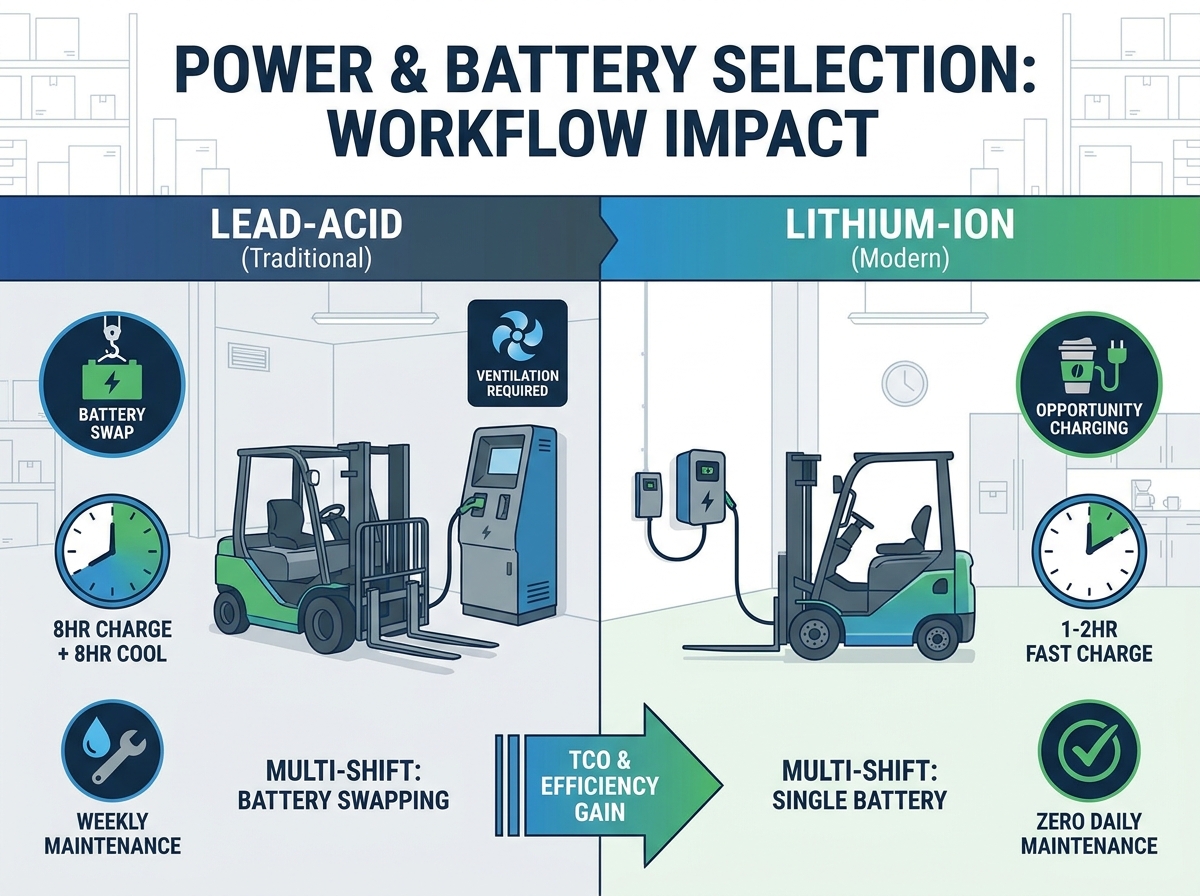
Battery chemistry determines your daily operational rhythm completely. Choosing the correct power source impacts shift planning deeply. It directly alters charging space requirements across the facility. It also dictates your daily maintenance schedules. You must understand the major differences before committing capital.
Lead-acid batteries represent a proven, historical industry standard. Most traditional warehouses operate using this reliable chemical technology.
Lithium-ion transforms modern fleet management through advanced electrical efficiency. This chemistry dominates newer, high-volume distribution centers.
Purchasing reliable material handling equipment demands careful specification review. Do not simply buy machines based on an "average" load weight. Evaluate your unique operational hazards deeply. Understand the physical physics governing warehouse machinery.
Many buyers underestimate maximum load requirements dangerously. We strongly warn against ignoring the physics of capacity derating. Safe lifting capacity decreases significantly as the mast extends upward. An electric forklift rated for 5,000 pounds changes behavior vertically. It might only safely lift 3,500 pounds at its maximum reach. You must calculate these load physics carefully beforehand. Always evaluate your heaviest potential loads at their highest storage racks. Buying undersized equipment creates severe safety liabilities.
Tire choice dictates where your machine can safely travel daily.
Driver adoption dictates operational success and overall warehouse safety. Evaluate modern features reducing daily risk actively. Clear mast visibility prevents accidental racking collisions during busy shifts. Anti-rollback technology protects operators effectively on steep loading ramps. Programmable speed limits enforce facility safety mandates automatically. Regenerative braking reduces mechanical brake wear significantly. It simultaneously recharges the battery during normal deceleration. Good ergonomics reduce worker fatigue, lowering injury rates.
Procurement extends far beyond simply ordering heavy machines. You must prepare your physical building thoroughly first. A comprehensive facility audit prevents expensive deployment delays. Ignoring infrastructure requirements leads to parked, unusable equipment.
High-output charging stations draw massive electrical currents daily. This proves especially true for expanding lithium-ion fleets. We strongly outline the necessity of a professional electrical site survey. Your current facility panel might lack sufficient total amperage. Upgrading facility electrical panels requires significant capital and permitting time. You must coordinate with local utility providers early. Ensure your transformer can handle the simultaneous charging load.
Evaluate the physical footprint of new charging zones carefully. Lead-acid fleets require dedicated battery swapping rooms permanently. These spaces mandate expensive acid spill containment measures, including eyewash stations. They also need industrial ventilation systems to clear explosive hydrogen gas. Conversely, lithium-ion technology allows decentralized charging strategies flexibly. You can install compact charging stations directly near break rooms. This decentralization improves daily workflow efficiency drastically.
Technology transitions require deliberate behavioral adjustments from your workforce. Note the critical importance of mandatory operator retraining programs. Your staff must shift from rapid propane fueling routines gracefully. They must adopt disciplined electrical plugging-in routines instead. Enforcing opportunity charging habits during breaks ensures continuous fleet uptime. Without proper behavioral training, expensive equipment sits idle awaiting power. Strong leadership ensures a smooth transition to electric operations.
Equipment specifications matter greatly during the procurement process. However, dealer partnerships determine your long-term operational success. Evaluate potential vendors rigorously before signing binding hardware contracts.
The local dealer's actual service response time matters immensely. It often proves just as important as the forklift brand itself. Search for comprehensive guaranteed uptime Service Level Agreements. Ensure the dealer maintains excellent local parts availability consistently. Broken equipment drains facility profitability rapidly every single hour. Ask prospective dealers about their emergency loaner equipment policies. A reliable partner keeps your supply chain moving regardless of breakdowns.
Always compare standard manufacturer warranties closely across different brands. A trustworthy vendor clearly separates warranty terms logically. The main forklift chassis usually carries one specific coverage period. The internal electrical drivetrain receives different protection terms entirely. The expensive battery pack should feature its own extensive guarantee. Understand exactly how many charging cycles the battery warranty covers. Clarify who pays for labor during major warranty repairs.
Financial strategy dictates how you acquire equipment best. Consider this simple decision framework for your budget:
Your immediate next step involves requesting a detailed site survey. Ask your shortlisted vendors for a real-world pilot demo locally.
Selecting the perfect material handling equipment requires balancing multiple complex factors. It represents a careful intersection of load physics, battery chemistry, and facility infrastructure. Buyers must base final decisions on total operational reality continuously. Do not simply trust speculative spec-sheet maximums blindly. A forklift rated for extreme weights fails if your aisles prove too narrow. You should initiate a comprehensive warehouse site survey immediately. Partner alongside a certified local dealer before committing heavy capital. Finalize your specific voltage requirements and optimal chassis type together logically. Taking these deliberate, calculated steps ensures a highly productive, cost-effective warehouse environment.
A: Yes, but they must be specifically configured for external environments. Manufacturers must seal sensitive electrical components against moisture actively. You need proper weather protection for the operator cabin. The machine also requires rugged pneumatic tires for uneven surfaces. Standard indoor models will fail quickly if exposed to outdoor elements.
A: The lifespan varies heavily by the underlying chemistry. Lead-acid batteries typically last roughly 1,500 charging cycles if staff maintain them properly. Conversely, advanced lithium-ion models can easily exceed 3,000 charging cycles. Proper daily charging habits dramatically extend the functional life of both battery types.
A: Charging times depend entirely on the battery technology. Lead-acid batteries require a strict 8-hour charge followed by an 8-hour cooldown period. Lithium-ion batteries can fully recharge in just 1 to 2 hours. Furthermore, lithium allows for convenient short top-ups during standard employee breaks without causing damage.
A: The initial purchase price runs noticeably higher for battery-powered equipment. However, long-term financial crossover typically occurs within two to three years. These machines drastically reduce monthly energy expenses. They also eliminate oil changes and reduce overall maintenance needs, driving substantial operational savings.


