
Views: 0 Author: Site Editor Publish Time: 2026-11-10 Origin: Site


Fleet managers and operational directors face unprecedented pressure to transition toward zero-emission operations. Volatile fuel costs consistently drain operational budgets. Tightening state and federal regulations force rapid strategic shifts across the logistics sector. You cannot ignore these compounding industry challenges. This decision goes far beyond a simple ideological shift. It represents a deeply calculated business risk involving route viability, grid readiness, and significant capital allocation. You must carefully weigh theoretical promises against harsh operational realities on the road. Many operators jump into electrification prematurely. They often face stranded assets and frustrated drivers. This guide provides an evidence-based framework for evaluating your next steps. You will learn how to assess whether adopting a commercial electric car fleet makes strategic sense. We will systematically compare these modern assets against traditional internal combustion engine vehicles. By the end, you will understand how to navigate implementation bottlenecks and confidently plan your fleet’s future.
You must identify the exact pain points driving your fleet evaluation process. We see many companies rushing into electrification without a clear strategic goal. Are you trying to hedge against unpredictable fuel price volatility? Perhaps you need to meet aggressive corporate ESG targets demanded by investors. You might also face looming state DMV and DOT zero-emission mandates. Clarifying your primary business problem prevents costly missteps later. You need specific metrics to define what a successful transition looks like for your unique operation.
Electric viability relies heavily on predictable daily mileage. We look closely at your duty cycles and detailed route profiling. Short-haul, return-to-base operations represent the absolute prime candidates for electrification. Drivers complete known urban routes and return to a central depot for overnight charging. Last-mile delivery services fit this model perfectly. Conversely, variable, long-haul routes still heavily favor traditional vehicles. You simply cannot risk stranding drivers without reliable infrastructure across unpredictable cross-country highways.
You must also evaluate complex asset lifespans carefully. Traditional ICE vehicles offer an established 10-to-15-year lifecycle. Fleet operators understand their depreciation curves perfectly. We know exactly how a diesel engine performs at 200,000 miles. In contrast, you must balance this predictability against the 8-to-10-year battery warranties typical of commercial EVs. The industry still lacks comprehensive long-term historical data on battery longevity under heavy commercial stress. You must factor this uncertainty into your long-term fleet rotation schedules.
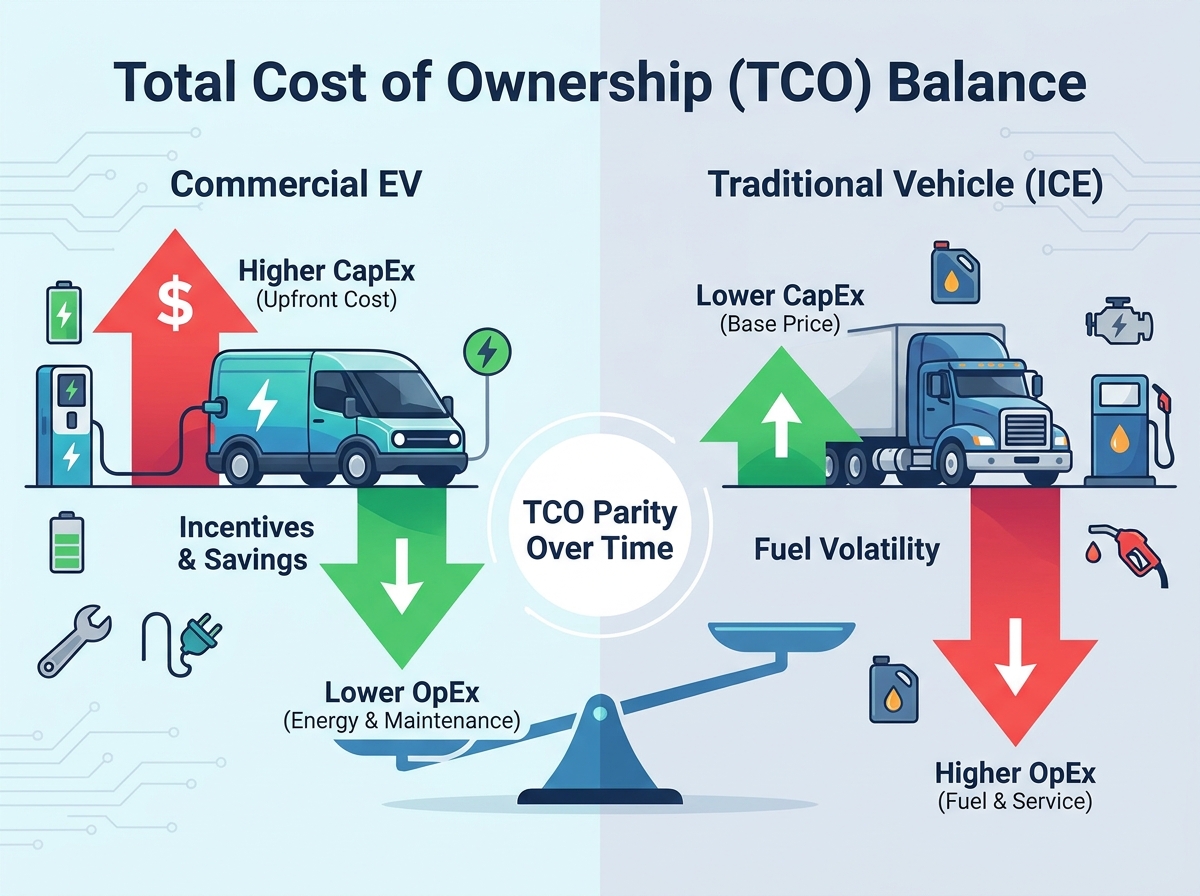
The base purchase price of traditional commercial vehicles remains noticeably lower than EV equivalents. You will find an electric unit often demands a massive premium upfront. Manufacturers price these vehicles higher due to expensive battery pack production. However, you must also calculate the critical cost of infrastructure. Fleet managers routinely overlook these hidden capital requirements. Installing Level 2 or DC Fast Chargers requires substantial facility investment. You might need major grid upgrades to handle the massive electrical load. Facility trenching, permitting, and electrical engineering add heavy upfront costs before a single vehicle arrives.
Moving to daily operations, you see distinct maintenance differences. EVs eliminate routine oil changes, spark plug replacements, and transmission servicing. They completely remove complex exhaust system repairs. You also extend brake life significantly through regenerative braking technology. Electric motors handle the deceleration, saving physical brake pads. We must analyze energy costs carefully alongside maintenance. You can secure predictable commercial electricity rates from your local utility. Smart operators account for peak and off-peak charging times to minimize bills. You compare these stable rates against wildly fluctuating diesel and gasoline prices.
Current markets show deep skepticism regarding used electric asset resale values. Battery degradation concerns drive this ongoing industry uncertainty. We lack decades of auction data for electric fleets. Buyers hesitate to purchase used EVs without guarantees on battery health. Conversely, traditional ICE vehicles enjoy a highly predictable secondary market. You know exactly what a used diesel van will fetch after five years of service. You must build this residual value risk into your financial models. Relying on inflated resale values can severely damage your long-term budget projections.
Charging downtime drastically alters how you manage daily operational logistics. You must evaluate the direct operational impact of charging speeds. A standard Level 2 charge takes between four to eight hours to complete. Even commercial DC fast chargers demand 30 to 60 minutes for a meaningful top-up. You must compare this reality against a traditional five-minute fuel stop. This vast time difference directly affects driver shifts and daily vehicle utilization rates. You may need to purchase more vehicles just to cover the exact same delivery routes. Slip-seating becomes incredibly difficult when the vehicle must sit plugged in for hours between driver shifts.
Consider payload and range trade-offs very carefully. Commercial EV battery packs weigh thousands of pounds. This incredibly heavy weight inherently reduces your maximum legal payload capacities. Lower payload directly impacts your overall revenue per trip. You must carry less cargo to stay strictly within legal gross vehicle weight limits. We strongly advise calculating this potential revenue loss when planning routes. A vehicle carrying 15% less cargo requires more frequent trips to deliver the same volume.
Extreme weather introduces another critical variable into your dispatching. Cold weather degrades battery performance significantly across the board. Evidence shows extreme winter temperatures reduce an electric vehicle's range by 20% to 40%. The battery uses massive energy just to keep itself warm. Fleet managers must build substantial mileage buffers into their daily route planning. Traditional vehicles simply do not suffer this severe range loss during winter operations. You must adjust dispatch schedules dynamically during winter months to avoid stranded drivers.
| Performance Factor | Commercial EV | Traditional ICE |
|---|---|---|
| Refueling / Charging Time | 30 minutes to 8 hours | 5 to 10 minutes |
| Payload Capacity | Reduced due to battery weight | Standard maximum limits |
| Cold Weather Impact | 20-40% range reduction | Minimal range impact |
| Maintenance Frequency | Low (fewer moving parts) | High (oil, belts, filters) |
| Route Flexibility | Rigid (infrastructure dependent) | High (widespread gas stations) |
You must leverage federal and state data to guide your procurement strategy safely. We strongly recommend tracking Department of Transportation (DOT) policy shifts constantly. State-level mandates often dictate your actual transition timeline. For example, the California Energy Commission pushes aggressive zero-emission targets through formal regulations. These strict regulations will eventually force widespread adoption across all commercial sectors. You cannot ignore these legislative signals if you operate across state lines. Understanding compliance timelines prevents sudden regulatory penalties.
Many operators rely heavily on incentive dependency to justify the expensive switch. Securing federal tax credits remains completely necessary for most modern fleets. State-level rebates help offset the massive initial capital requirements significantly. Without these crucial financial injections, achieving budget parity with traditional ICE vehicles proves nearly impossible today. You must research local grant programs meticulously before signing any purchase orders. These incentives change frequently based on political cycles and budget availability.
Trade policies and supply chain security also play pivotal roles in your planning. Shifting import tariffs directly impact your final procurement costs. Recent White House executive actions focus heavily on restricting overseas motor vehicles and battery components. These aggressive tariffs affect the availability and pricing of critical EV replacement parts. In contrast, domestic ICE supply chains remain deeply established and highly stable. You face potential operational delays if overseas battery components stall at customs during a repair cycle.
We strongly advise against risky "rip-and-replace" transition strategies. A massive overnight transition almost always invites operational disaster. Instead, embrace the controlled pilot program approach. We recommend starting with a small 5% to 10% fleet transition. This measured approach allows you to test real-world charger uptime reliably. You can evaluate true vehicle performance under actual heavy payload conditions. A pilot reveals local infrastructure flaws before you commit your entire budget.
Change management addresses the critical human element of fleet transition. You must retrain your drivers for optimal daily operation. They need to learn how to maximize regenerative braking to extend their daily range. Aggressive driving drains batteries incredibly fast. Furthermore, you must retrain your maintenance staff entirely. High-voltage systems require specialized safety certifications and entirely new insulated toolsets. You cannot send a traditional diesel mechanic to fix a complex battery management system without rigorous proper training.
Next-step actions for fleet managers should begin immediately to ensure success:
You must evaluate every commercial electric car manufacturer through a lens of long-term support. Look closely at their localized service center availability. A great warranty means nothing if the nearest certified technician operates three states away.
The choice between electric assets and traditional vehicles is no longer a simple binary decision. It has evolved into a complex strategic question of where and when to deploy them effectively. Traditional vehicles still offer unmatched operational certainty and routing flexibility today. They handle heavy payloads and extreme weather with predictable reliability. However, electric commercial vehicles provide a crucial hedge against harsh future regulatory restrictions. They also promise long-term operating cost stability in an increasingly volatile global energy market.
We encourage key decision-makers to begin telematics route analysis immediately. You should initiate local utility consultations this week, even if full procurement sits 18 to 24 months away. Upgrading facility power grids takes significant time and permitting. Proactive planning prevents costly operational grid-lock later. Start small with a controlled pilot, gather actionable localized data, and scale your zero-emission efforts based on proven internal success.
A: Most manufacturers provide a standard 8-year or 100,000-mile warranty for commercial batteries. Real-world degradation rates vary significantly based on your daily charging habits and local climate. Heavy payload stress and frequent DC fast charging can accelerate battery capacity loss over time. Fleet managers should plan for gradual range reduction as the asset ages.
A: Yes, insurance premiums currently run higher for electric fleets. This increase primarily stems from much higher upfront vehicle valuations. Additionally, specialized repair requirements and a severe shortage of certified high-voltage technicians drive up post-accident claim costs. Underwriters price these unknowns into your monthly premiums.
A: It largely depends on your specific charging strategy. Localized Level 2 charging for a few vans might only require minor panel upgrades. However, installing high-voltage DC fast charging depots almost always requires major utility interventions. You will likely need new transformers and significant site trenching.
A: Electric vehicles feature significantly fewer moving parts. This eliminates routine oil changes and drastically reduces physical brake wear. You will experience fewer routine shop visits. However, out-of-warranty battery replacements or complex proprietary software issues can result in much higher isolated repair bills.


