
Views: 0 Author: Site Editor Publish Time: 2026-11-12 Origin: Site


Transitioning your business fleet to electric power goes far beyond simple sustainability goals today. It represents a major financial decision driven by bottom-line economics. Operational realities also heavily influence this shift. Urban emissions zones force companies to adapt quickly. However, replacing a traditional fleet requires careful financial planning. Many buyers naturally feel skeptical during this transition. Consumer metrics like zero-to-sixty times fail to reflect true commercial utility. Theoretical maximum ranges also mislead fleet managers frequently. You need reliable data to keep operations running smoothly. Marketing hype cannot power a delivery route.
We provide a rigorous framework for evaluating a commercial electric car for your fleet. We explore real-world performance limitations and infrastructure readiness. We also examine comprehensive lifetime pricing models. You will learn how payloads affect daily range drastically. You will see why charging logistics dictate fleet feasibility. By the end, you will possess actionable strategies. These steps align fleet investments precisely against your daily business demands.
You must define what success looks like before visiting any dealership. Every fleet operates differently. A single approach rarely works across different industries. You must evaluate your specific daily requirements closely. Consider the following core criteria to guide your procurement strategy.
Automotive brochures highlight best-case scenarios. Fleet managers must plan for worst-case realities. Understanding the technology limitations prevents costly operational failures.
Laboratory numbers rarely survive the demands of actual fleet duty. You will notice a significant discrepancy between claimed ranges and commercial realities. WLTP and EPA testing occurs inside controlled environments. Fleet drivers face harsh weather and aggressive delivery schedules. They navigate steep urban hills constantly. Stop-and-go traffic impacts regenerative braking efficiency.
Several degradation factors drain batteries faster than expected. Continuous climate control usage pulls significant power continuously. Cold weather drops battery performance drastically. You can expect a twenty to thirty percent range loss during winter months. Lithium-ion cells resist charging and discharging in freezing temperatures. Maximum cargo loads also require more energy to move from a standstill.
Always buffer your range requirements proactively. Add at least twenty-five percent above your maximum daily route distance. This buffer ensures drivers complete their shifts safely. It protects against unexpected detours or severe weather changes. Conservative estimates keep your business running without interruption.
Understanding power delivery is essential for effective fleet management. You must choose the right charging speed for your operational model. A mismatch causes severe logistical bottlenecks.
Alternating Current (AC) charging typically delivers between 7kW and 22kW. This speed works perfectly for overnight depot charging. The vehicle has several hours to replenish its battery safely. Direct Current (DC) fast charging delivers between 50kW and 350kW. You will find DC charging mandatory for mid-shift top-ups. Fast chargers minimize driver waiting times during busy operational hours.
Fast charging does not remain fast indefinitely. The charge curve slows down significantly after reaching eighty percent capacity. The vehicle management system reduces power intake deliberately. This reduction protects the internal battery cells from thermal damage. Commercial route planning should rely entirely on twenty to eighty percent charge intervals. Never plan daily routes around complete zero to one hundred percent cycles.
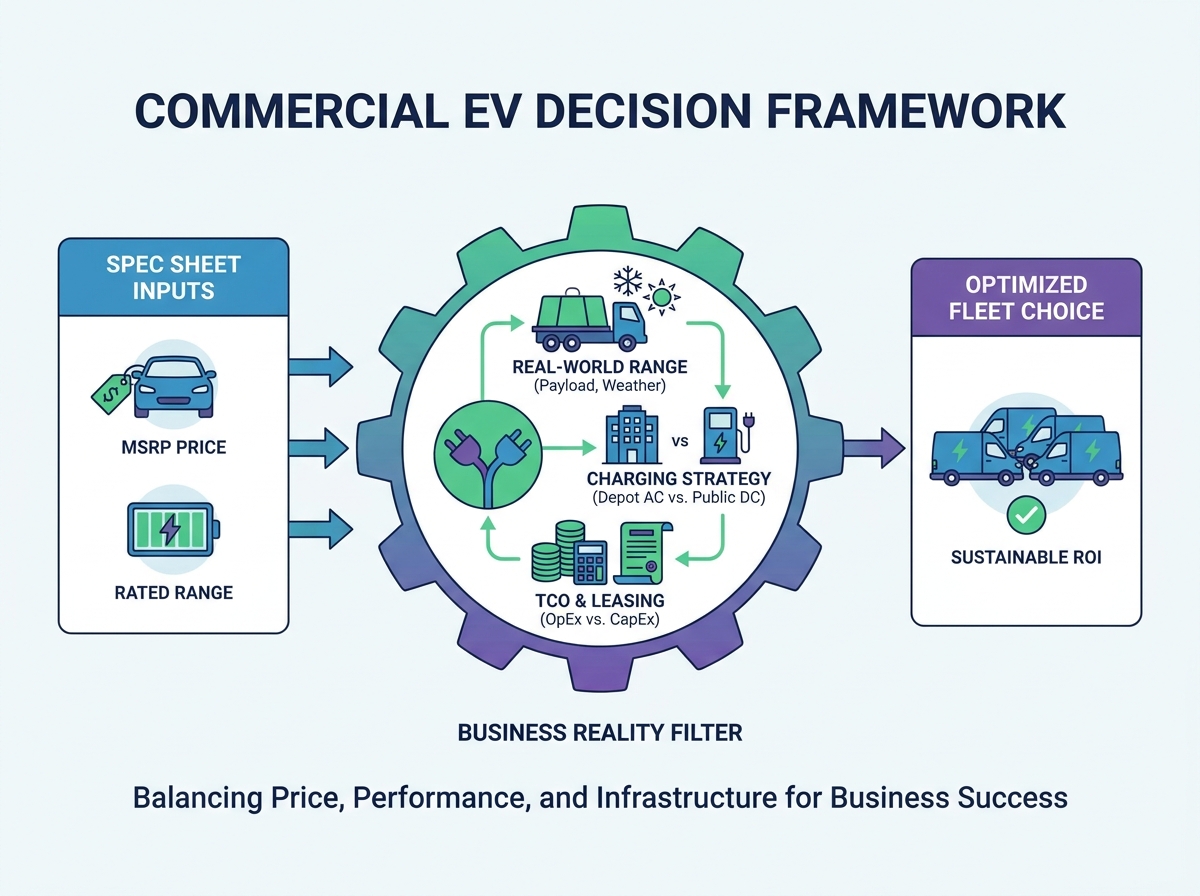
Evaluating financial viability means looking past the initial sticker price. Lifetime financial impacts dictate the true value of your investment. A commercial electric car changes how you model annual budgets.
You must address the higher initial acquisition cost immediately. Electric vehicles generally cost more upfront than their diesel counterparts. Advanced battery chemistry drives this premium pricing. However, you rarely pay the full retail price.
You need to factor in local and federal grants. Governments offer generous subsidies to encourage fleet electrification globally. Infrastructure rebates also help bridge the initial price gap. Securing these funds early makes the transition financially attractive. Many regions provide specific grants for commercial charging point installations. You should consult a tax specialist to maximize these immediate deductions.
Electric drivetrains contain significantly fewer moving parts. You eliminate routine oil changes completely. You no longer worry about transmission fluid degradation. Complex exhaust systems become a thing of the past. This mechanical simplicity leads to dramatically lower preventative maintenance costs. Regenerative braking systems also extend brake pad longevity immensely.
Fuel savings present another massive financial advantage. You must compare localized electricity tariffs against commercial diesel costs. Projecting monthly fuel savings often reveals a rapid return on investment. Overnight electricity rates usually cost a fraction of traditional liquid fuels. Managing these charging times optimally maximizes your operational budget.
Monthly Fuel and Maintenance Comparison Chart
| Expense Category | Traditional Diesel Fleet (Per Vehicle) | Commercial Electric Fleet (Per Vehicle) | Estimated Monthly Savings |
|---|---|---|---|
| Fuel / Energy Costs | $450 - $600 | $120 - $180 | ~$330 - $420 |
| Routine Maintenance | $150 - $200 | $40 - $70 | ~$110 - $130 |
| Tolls & Emission Zone Fees | $100 - $300 | $0 - $50 | ~$100 - $250 |
Electrifying your fleet unlocks several notable tax advantages. You can leverage corporate tax write-offs effectively. Capital allowances often permit accelerated depreciation schedules for zero-emission vehicles. Benefit-in-Kind (BiK) advantages make these models highly attractive to company car drivers. Lower BiK rates act as a direct financial incentive for employees.
However, you must acknowledge residual value uncertainty. Battery technologies evolve rapidly every single year. This rapid evolution creates risk regarding future resale values. Older models might depreciate faster if newer batteries offer double the range. Careful financial modeling helps mitigate these depreciation concerns. You must forecast the secondary market demand conservatively.
Failing to plan your charging infrastructure guarantees operational failure. You must assess facilities and networks carefully before purchasing vehicles.
How you finance your vehicles matters just as much as which models you choose. Each strategy offers distinct financial implications for your business.
Outright Purchase (CapEx)
Purchasing vehicles outright works best for organizations boasting high capital liquidity. This path suits businesses seeking long-term asset ownership strongly. You hold the asset clearly on your balance sheet. You gain total control over vehicle modifications and branding. However, you also carry the full burden of battery degradation risks. You absorb any future residual value shocks directly.
Leasing/Contract Hire (OpEx)
Leasing remains the preferred commercial route for most modern fleets today. It shifts the financial risk away from your business completely. Leasing protects you from sudden residual value drops. Contracts typically include comprehensive maintenance packages. They simplify your monthly budgeting processes significantly. Most importantly, leasing allows for frequent fleet upgrades. You can adopt better electric vehicle technology as it hits the market.
Procurement Options Summary
| Feature | Outright Purchase (CapEx) | Leasing / Contract Hire (OpEx) |
|---|---|---|
| Capital Requirement | High initial cash outlay required. | Low upfront cost; predictable monthly payments. |
| Asset Ownership | Company owns the vehicle entirely. | Leasing provider retains vehicle ownership. |
| Depreciation Risk | Company bears full residual value risk. | Provider absorbs all market depreciation risks. |
| Technology Upgrades | Difficult; requires selling older assets first. | Easy; upgrade to newer tech at contract end. |
Choosing a reliable commercial electric car demands a structured decision framework. A successful choice aligns conservative real-world performance estimates against rigorously calculated lifetime costs. You must balance daily route demands against strict charging realities. Never base procurement decisions solely on marketing brochures.
We strongly advise against a full-fleet overhaul as your very first step. Instead, initiate a targeted pilot program using one or two vehicles. This small-scale test allows you to validate operational assumptions safely. You can measure real charging times and monitor payload impacts closely.
Take action today to future-proof your commercial fleet. Contact your sales representative to arrange a tailored financial fleet audit. You can also download a commercial EV ROI calculator directly from our resources page. Request a comprehensive consultation to begin mapping your transition seamlessly today.
A: Running at maximum gross vehicle weight significantly reduces your effective range. You can expect a fifteen to thirty percent range drop depending on specific factors. Route elevation and aggressive driving styles drain the battery faster under heavy loads. Always factor your maximum cargo weight into daily route planning.
A: Manufacturers typically provide standard warranties covering eight years or one hundred thousand miles. Total battery failure remains extremely rare in commercial applications. Gradual capacity degradation happens naturally over time. Replacement costs stay high, which makes leasing an attractive option to mitigate hardware risks completely.
A: Depot charging is significantly cheaper. Using commercial overnight electricity tariffs guarantees low, predictable energy costs. Public fast-charging networks charge premium variable rates constantly. Relying on public road charging drastically increases your operational expenses. Depot infrastructure remains the most cost-effective method overall.
A: Standard commercial fleet policies generally cover electric vehicles without issue. However, your monthly premiums may differ from traditional diesel vans. Insurers factor in specialized repair networks required for high-voltage systems. They also consider potential battery replacement costs following severe collisions. Always request specific fleet quotes early.


