
Views: 0 Author: Site Editor Publish Time: 2026-08-10 Origin: Site


Transitioning a material handling fleet requires a thorough evaluation of long-term operational impacts. Fleet managers must look beyond traditional performance metrics to drive true warehouse efficiency. Upgrading your equipment fundamentally alters daily fleet utilization, charging workflows, and routine maintenance overhead. This technological shift demands careful strategic planning across all warehouse departments. Selecting the right equipment requires aligning your facility’s specific throughput demands, infrastructure capacity, and strict safety compliance requirements. You must match these operational realities with the correct battery chemistry and seamless vehicle integration strategies. Making the wrong choice can disrupt supply chains and frustrate operators. Conversely, the correct implementation yields unprecedented uptime and operational predictability. We will explore exactly how to evaluate these critical factors. You will learn actionable steps to assess shift intensity, ensure truck compatibility, and audit your electrical grid before committing to a Lithium battery forklift truck.
Understanding your daily warehouse rhythm is the first critical step. Equipment must match the physical demands of your environment. You cannot evaluate a power source without defining how your facility operates minute by minute.
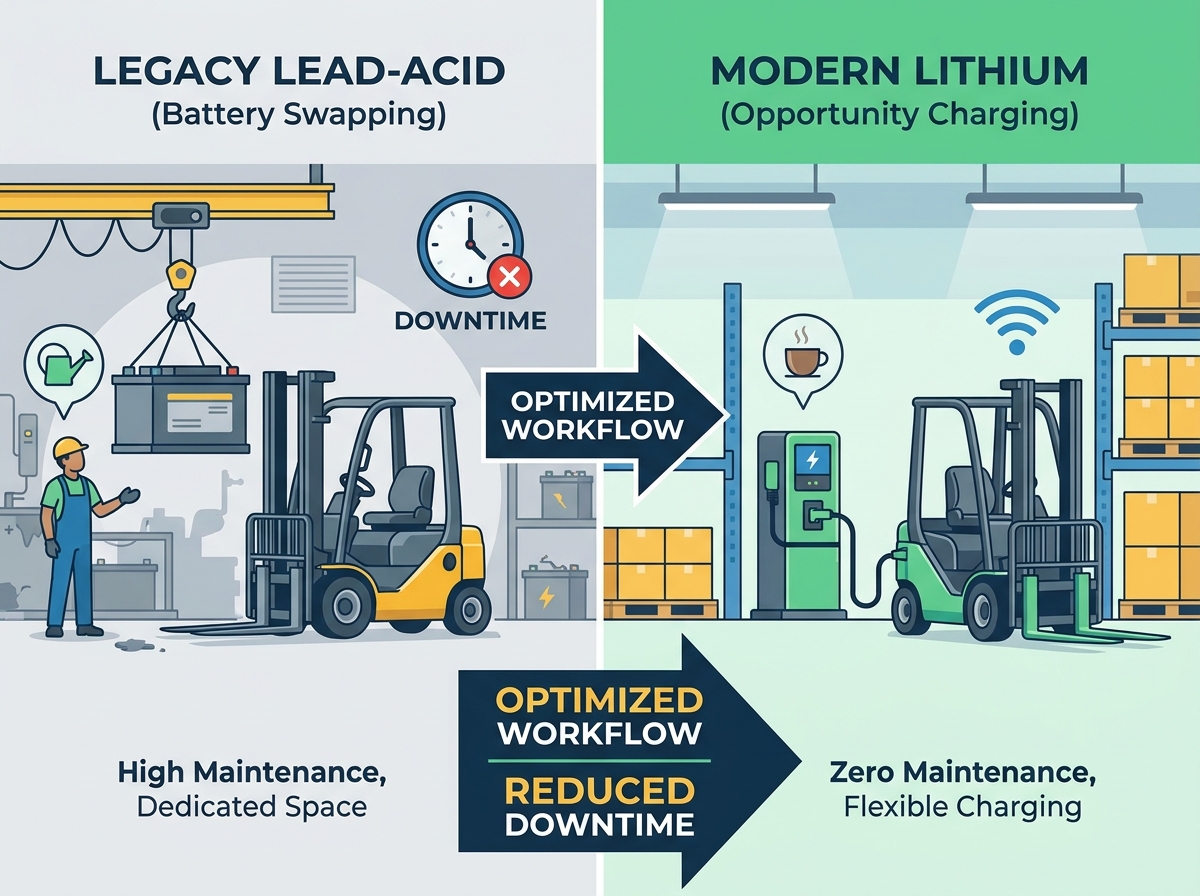
Warehouse throughput dictates power consumption. You must define your continuous operation requirements precisely. Moving hundreds of heavy pallets per hour draws massive amounts of energy. Multi-shift facilities traditionally rely on battery swapping rooms. Workers remove depleted batteries and hoist heavy replacements into the chassis. This outdated process halts productivity.
Modern operations utilize opportunity charging. Operators plug the truck into decentralized stations during coffee breaks, lunches, and shift changes. Short, frequent charging bursts keep the battery operational indefinitely. This eliminates the need for battery swapping entirely in two- or three-shift facilities. The vehicle remains on the warehouse floor where it belongs.
Note for Skeptical Buyers: Single-shift operations require careful validation. If your equipment sits idle for sixteen hours a day, traditional power systems easily handle the workload. The advanced capabilities of newer technologies shine brightest under high utilization rates. Facilities running light-duty cycles must ensure their operational intensity justifies the upgrade.
Operating environments push equipment to its physical limits. Different industries impose unique environmental stressors on your fleet.
Not all advanced power systems use the same internal components. The underlying chemical makeup dictates safety, longevity, and thermal stability. You must understand these differences before integrating a Lithium battery forklift truck into your fleet.
The material handling industry relies primarily on two chemical structures. Lithium Iron Phosphate (LFP) serves as the heavy-duty standard. Nickel Manganese Cobalt (NMC) dominates consumer electronics and passenger vehicles. LFP offers distinct operational advantages for warehouse environments.
LFP chemistry features a significantly higher thermal runaway threshold. It resists overheating even under extreme mechanical stress. If a forklift tine accidentally punctures an LFP casing, the risk of a catastrophic fire remains exceptionally low. LFP also delivers a much longer cycle life. It withstands thousands of rapid charging events without degrading.
Battery Chemistry Comparison Chart
| Feature | LFP (Lithium Iron Phosphate) | NMC (Nickel Manganese Cobalt) |
|---|---|---|
| Thermal Stability | Exceptional (High threshold) | Moderate (Lower threshold) |
| Cycle Life | 3,000+ cycles | 1,000 - 2,000 cycles |
| Energy Density | Lower (Heavier physical footprint) | Higher (Lighter physical footprint) |
| Safety in Forklifts | Industry Standard | Rarely Recommended |
The Battery Management System acts as the brain of the power unit. A robust BMS actively protects the cells from user error. It prevents overcharging when plugged in too long. It stops deep discharging when operators push the equipment past safe limits. The system also monitors core temperatures, throttling power if the unit gets too hot.
Beyond protection, the BMS serves as a powerful fleet management tool. Modern systems include Wi-Fi or cellular connectivity. They stream live telemetry data directly to your warehouse management system (WMS). Managers can track charge states, usage patterns, and fault codes remotely. This predictive maintenance data prevents unexpected downtime.
Never compromise on safety certifications. Uncertified equipment poses severe risks to your facility and personnel. Look for non-negotiable compliance marks.
Integrating new technology into heavy machinery requires precise engineering. You cannot simply drop a modern power source into an old chassis without modifying the physical dynamics of the vehicle.
You face two primary procurement paths. You can purchase a purpose-built Lithium battery forklift truck directly from the manufacturer (OEM). Alternatively, you can retrofit existing legacy trucks using drop-in replacement units.
OEM integration guarantees flawless compatibility. The manufacturer designs the chassis around the lighter power unit. They optimize the suspension, braking, and lifting hydraulics for the exact vehicle weight. Retrofitting offers a viable upgrade path for existing fleets but requires careful engineering oversight.
Forklifts rely on simple physics. They use massive counterweights to offset heavy loads on the front forks. In legacy systems, the incredibly heavy lead-acid battery acts as essential ballast. It often weighs several thousand pounds. Modern power units weigh significantly less.
Replacing a legacy power source with a much lighter pack completely alters the vehicle's center of gravity. You must address this implementation reality. Engineers must install custom steel counterweights into the battery compartment. This extra ballast restores the original weight distribution. Without it, the forklift loses its rated lifting capacity and becomes a severe tipping hazard.
Modern equipment relies on sophisticated digital networks. The vehicle and the power unit must speak the same language. Ensure the battery utilizes a CAN bus (Controller Area Network) architecture. This system allows the BMS to communicate flawlessly with the truck’s main controller.
Proper CAN bus integration provides accurate state-of-charge (SOC) displays on the operator's dashboard. It enables early warning alerts for temperature spikes or maintenance needs. If communication fails, the truck may shut down unexpectedly during a crucial lift.
Upgrading your material handling equipment changes how your building consumes electricity. You must evaluate your facility’s electrical grid before finalizing any equipment decisions. High-frequency charging strains older electrical systems.
Traditional workflows rely on dedicated, ventilated battery rooms. Workers charge units slowly over eight hours. The new operational model relies on decentralized opportunity charging stations scattered throughout the facility. Operators plug in near break rooms, loading docks, and staging areas.
This transition introduces serious implementation risks. Fast chargers draw massive amounts of electrical current in short bursts. A single high-frequency charger might demand 30kW to 50kW. Multiple chargers running simultaneously create massive peak electrical demand spikes. You must conduct a comprehensive electrical grid audit. Verify that your transformers, breaker panels, and main service lines can handle this intense load. Upgrading facility wiring often becomes a necessary prerequisite.
Moving to decentralized charging unlocks valuable warehouse real estate. Legacy battery rooms require specialized ventilation, acid-spill containment, and heavy lifting hoists. This non-productive footprint consumes prime square footage.
You can reclaim this space completely. Once you decommission the legacy charging room, you can convert it into revenue-generating warehousing space. Facility managers often transform these areas into high-density storage racks or specialized fulfillment zones. This spatial optimization dramatically improves overall facility throughput.
Adopting a new fleet architecture requires validation. Claims on paper must translate into measurable physical performance on your warehouse floor. A structured pilot program isolates variables and proves operational viability.
We recommend starting with a strictly limited pilot program. Procure one or two test units before committing to full-fleet adoption. Deploy these vehicles in your most demanding operational zone. Select the longest routes, the heaviest lifting requirements, and the most aggressive shift schedules.
During the pilot phase, track evidence-oriented metrics that often go unnoticed. Factor in the complete elimination of daily maintenance tasks. You no longer need dedicated personnel for watering, equalizing, or cleaning acidic corrosion. Calculate the recovered labor hours previously spent swapping heavy power units mid-shift. Your staff can redirect this recovered time toward active order picking.
Additionally, monitor your energy consumption at the meter. Advanced systems charge roughly 30% more efficiently than legacy options. They convert grid power into stored energy with minimal heat loss. Documenting these specific operational gains provides the definitive evidence needed to justify broader fleet expansion.
Choosing the right equipment represents a major structural shift for your operations. Adopting a Lithium battery forklift truck is an operational infrastructure decision, not just a simple vehicle purchase. You must align your facility’s specific throughput demands with robust engineering and electrical planning.
Your next steps dictate the success of your implementation. First, map your facility's electrical capacity with a certified commercial electrician. Second, demand extensive trial periods from shortlisted vendors. Run these pilot trucks through your most demanding, high-intensity shifts. By meticulously evaluating your shift structures, counterweight physics, and charging networks, you ensure a seamless transition that maximizes operational uptime and drastically reduces maintenance friction.
A: A high-quality power unit typically delivers 3,000 to 5,000 charging cycles. In a standard multi-shift operation, this translates to excellent capacity retention over 5 to 7 years. Unlike older technologies, they maintain consistent power output even as they age, rarely requiring mid-life replacement.
A: Yes, but it requires professional retrofitting. You cannot simply swap them out. Because newer packs are significantly lighter, engineers must add steel ballast to maintain the forklift’s safe lifting capacity. Proper CAN bus integration is also necessary for the dashboard displays to function accurately.
A: No. Opportunity charging actually maximizes operational efficiency. Advanced chemistries do not suffer from the "memory effect" that degrades older technologies. Plugging the truck in for short 15-minute bursts during breaks is highly recommended and extends the overall health of the cells.
A: They require significantly less daily upkeep. You completely eliminate routine fluid checks, watering, and acid cleaning. However, they do require periodic software updates for the Battery Management System (BMS) and regular visual inspections of the charging cables and electrical connectors.


