
Views: 0 Author: Site Editor Publish Time: 2026-08-14 Origin: Site


Warehouse operations are evolving rapidly across the global logistics sector. Upgrading to lithium-ion technology represents a standard progression for modern multi-shift fleets. However, long-term success depends heavily on precise specification matching. Purchasing a Lithium battery forklift truck without aligning technical specifications to your facility infrastructure leads to major operational bottlenecks. Wasted capital and unplanned downtime quickly follow these poor procurement choices.
This guide focuses strictly on critical, bottom-of-funnel evaluation criteria. We evaluate vital electrical requirements, hidden physical constraints, necessary infrastructure alignment, and crucial vendor guarantees. You will learn exactly how to match forklift specifications to your distinct operational workflows. By mastering these specific parameters, you can build a highly resilient and efficient material handling fleet.
Transitioning to lithium power should yield measurable improvements in daily uptime. Fleet managers must define clear success criteria before purchasing new equipment. The primary goals often include eliminating battery swapping entirely and reducing daily maintenance tasks. By removing dedicated battery rooms, facilities reclaim valuable floor space for core operations.
Assess your current shift density carefully. Identify whether your fleet operates on single, double, or continuous 24/7 shifts. Heavy, continuous usage absolutely justifies premium lithium capacity. E-commerce fulfillment centers running three shifts rely heavily on brief opportunity charges. This charging rhythm maintains workflow without removing trucks from service.
You must also evaluate environmental realities. Operating temperatures drastically impact internal battery performance. Cold storage facilities require lithium batteries equipped with built-in heaters. These integrated heating pads prevent severe capacity degradation in sub-zero environments. Without internal heaters, extreme cold significantly restricts daily runtimes.
Finally, apply a healthy skepticism check to your fleet usage. Low-use fleets operating on single-shift or light-duty cycles face different economic realities. They may not realize a fast enough ROI to justify the initial premium price. Assess your actual usage hours honestly before committing capital.
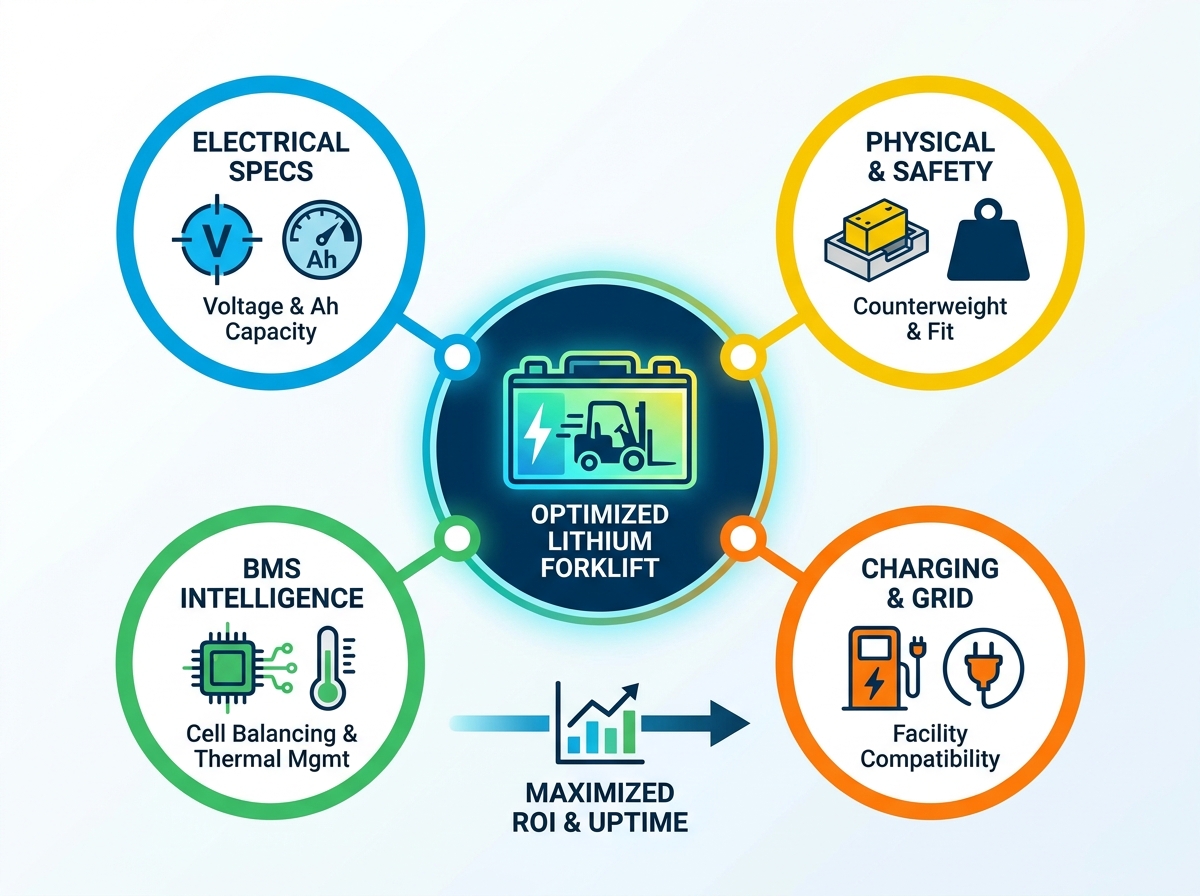
Electrical specifications dictate the core performance capabilities of your material handling equipment. You must select the precise voltage (V) for your specific truck type. Undervaluing your voltage needs leads to sluggish lifting performance.
Here is a standard voltage specification breakdown:
Next, calculate your specific Amp-Hour (Ah) requirements. Map your Ah capacity directly to typical load weights and maximum lift heights. Heavier loads and higher lifts naturally draw much more sustained electrical current. Compare continuous discharge rates against peak discharge rates carefully. Peak electrical rates remain necessary for the initial lifting thrusts when moving heavy pallets.
Understanding the kilowatt-hour (kWh) translation is equally critical. Voltage multiplied by Ah determines the total usable kWh of the battery system. For example, a 48V battery rated at 400Ah provides 19.2 kWh of total energy. This calculation helps you accurately estimate actual runtime per charge cycle. Knowing the exact energy pool allows operators to schedule highly precise charging breaks.
Physical dimensions dictate much more than just a snug component fit. You must ensure the battery tray matches exact OEM forklift compartment dimensions. A perfect tray fit prevents dangerous component shifting during fast cornering or sudden stops. Loose batteries cause severe internal wire chafing and unexpected power failures.
The counterweight imperative represents a crucial warehouse safety factor. Lithium batteries weigh significantly less than traditional lead-acid power blocks. Counterbalanced forklifts fundamentally rely on battery weight to prevent tipping during heavy lifts. Lithium systems must include heavy-duty steel cases or engineered ballast plates. This extra steel ensures the equipment meets the specific minimum weight plate requirement.
Consider this operational comparison between traditional and modern power sources:
| Specification Element | Lead-Acid Systems | Lithium-Ion Systems | Required Action |
|---|---|---|---|
| Inherent Weight | High (Acts as natural ballast) | Low (Up to 50% lighter) | Add engineered steel ballast plates |
| Compartment Fit | Standardized heavy blocks | Customized modular trays | Verify strict OEM dimensional tolerances |
| Center of Gravity | Consistently lower | Shifts upward without added weight | Recalculate safe lifting capacities |
Additionally, strictly standardize your electrical connectors. Verify compatible connector types between the battery, the truck, and your charging station. Common industry standards like SB or Euro DIN connectors prevent costly mating errors. Mismatched connectors lead to high electrical resistance and dangerous overheating incidents.
A robust Battery Management System (BMS) acts as the central brain of your power source. It handles critical cell balancing and comprehensive system protection tasks. The BMS must actively monitor voltage, current, and temperature at the individual cell level. This continuous monitoring prevents catastrophic overcharging and damaging deep discharging scenarios.
Thermal management stands out as a critical BMS safety feature. Look for automatic shutoff protocols hardcoded into the system software. Active cooling or heating features are necessary for extreme temperature warehouse applications. These mechanisms keep internal cells operating within safe thermal limits constantly.
Evaluate telematics and data integration capabilities very closely. The BMS should offer dependable CAN bus communication. This integration provides fleet managers with actionable, real-time data streams. Important metrics include accurate State of Charge (SOC), live fault codes, and predictive maintenance alerts. Relying on voltage-based fuel gauges is highly inaccurate for lithium chemistries.
Use BMS transparency as a definitive trustworthiness indicator during procurement. Avoid brands hiding their specific BMS fault-tolerance limits or software parameters. Reputable manufacturers openly publish operational temperature ranges and exact safety thresholds. Transparent engineering data always indicates a higher quality, highly reliable product.
Opportunity charging compatibility remains the primary operational advantage of this advanced technology. Operators can charge equipment rapidly during brief 15-minute or 30-minute shift breaks. You must verify the accepted maximum charge rate before finalizing any purchase. Typically, a charge rate between 0.5C and 1C provides optimal fast-charging performance.
However, you must balance charger output against your facility limitations. High-frequency fast chargers draw substantial electrical power from the grid. Assess whether the required chargers exceed your current electrical grid capacity immediately. Verify the available Amps, Phase, and Volts in your specific building sectors.
The hidden costs of facility electrical upgrades can be staggering. Rewiring a large warehouse or installing new step-down transformers requires significant capital. Surpassing peak demand utility thresholds also triggers massive monthly electrical penalties.
Follow these steps to evaluate your grid compatibility properly:
Finally, ensure the charger and battery share closed-loop communication protocols. This digital handshake optimizes the ongoing charge curve continuously. It maximizes energy transfer efficiency and strictly preserves the overall cycle life of the cells.
Evaluating vendors requires looking far past basic marketing claims. Scrutinize the distinct difference between true cycle life and generic calendar life. Look for engineering specifications guaranteeing a minimum cycle life metric. A strong industry benchmark is 3,000 or more cycles at an 80% Depth of Discharge. Generic multi-year warranties often hide remarkably poor cycle endurance.
Pay exceptionally close attention to specific warranty exclusions. Scrutinize the fine print for hidden void clauses. Common exclusions relate to extreme operating temperatures or neglected BMS software updates. Improper charger use can also void an entire expensive warranty prematurely.
Safety certifications are absolutely non-negotiable for modern warehouses. Require documented proof of UL 2580 compliance for commercial electric vehicle batteries. You also need UN38.3 certification ensuring safe global transport standards. Do not accept products lacking these vital international safety markers under any circumstances.
When shortlisting vendors, combine several efficiency factors to gauge real financial viability. Analyze the upfront purchase price against daily saved labor hours. Remember, lithium technology requires zero battery watering and eliminates dangerous daily swapping. Factor in long-term electricity efficiency gains and the projected overall lifespan. These specific elements reveal the actual economic benefit of the facility upgrade.
Specifying a lithium battery system is a major infrastructure decision, not just a simple parts replacement. Every single component must integrate seamlessly into your daily warehouse ecosystem to maximize uptime.
A: Yes, physical modifications are often necessary. Because lithium batteries weigh significantly less than lead-acid ones, you must add engineered steel counterweights to prevent the forklift from tipping over. Additionally, you may need to install a compatible gauge display to read the precise digital State of Charge from the new BMS.
A: Sub-zero temperatures cause severe capacity drop-offs and restrict charging acceptance rates. To operate efficiently in cold storage, you must specify batteries equipped with integrated, thermostatically controlled heating pads. These internal heaters draw a small amount of power to keep internal cells at an optimal operating temperature.
A: No, you cannot use a standard lead-acid charger safely. Lithium batteries require chargers capable of closed-loop CAN bus communication. Using an incompatible charger often triggers a BMS safety lockout or causes irreversible cell damage. You must purchase a lithium-specific charger or reprogram advanced smart chargers to match the specific algorithm.
A: A realistic ROI timeline typically ranges from 12 to 36 months. The exact duration depends heavily on your specific operational intensity. Multi-shift operations eliminating daily battery swapping see the fastest economic returns. Facilities facing high local labor rates also accelerate their ROI through significant daily maintenance hour reductions.


