
Views: 0 Author: Site Editor Publish Time: 2026-08-11 Origin: Site


Transitioning or expanding a material handling fleet forces a critical choice. You face a serious decision between legacy familiarity and modern efficiency. Lead-acid batteries have reliably powered warehouses for several decades. However, the initial adoption barrier for modern lithium-ion technology is falling rapidly. Global supply chains face rising operational demands every single day. Choosing the right power source is no longer just a simple procurement decision. It represents a highly strategic facility management choice. This choice directly impacts your operational throughput. It dictates your warehouse space utilization. It also affects daily labor allocation across your workforce. We will analyze the financial realities of both power sources. You will discover how charging curves impact daily productivity. We will guide you through crucial facility infrastructure assessments. Finally, we will provide a clear decision framework. You will learn exactly which technology aligns best against your specific operational tempo.
A Lithium battery forklift truck usually presents a significant initial price tag. Buyers often experience sticker shock during the procurement phase. The lithium setup typically costs two to three times more upfront. A comparable lead-acid setup appears highly attractive at first glance. Evaluating the purchase price requires looking at the broader economic impact. When a business relies on outdated technology, it accepts hidden inefficiencies. Capital expenditure represents only a fraction of the financial reality.
We must evaluate the complete lifecycle and average cycle counts. Lead-acid technology typically averages 1,000 to 1,500 charging cycles. This cycle count usually translates to three to five years of use. After this period, battery capacity degrades severely. Conversely, lithium technology averages 2,000 to 3,000 or more cycles. You can reliably expect it to last seven to ten years. This extended lifespan delays future replacement expenditures significantly. You essentially buy one battery instead of two.
You must also factor in hidden labor and maintenance costs. Lead-acid demands strict, ongoing physical maintenance. You must pay hourly wages for mandatory battery watering. Maintenance staff must equalize cells weekly. Workers spend valuable time cleaning dangerous acid spills. Physical battery swaps drain precious operational minutes. Over a five-year period, these labor hours multiply rapidly. You lose thousands of dollars to unavoidable maintenance routines.
High-utilization fleets typically see a rapid financial return. The initial premium pays for itself through eliminated labor. Reduced battery replacements accelerate this financial recovery. Most multi-shift facilities reach their break-even threshold within 12 to 18 months. After this threshold, the operational savings become pure profit. Consider a real-world scenario involving a three-shift distribution center. Maintenance teams spend roughly twenty minutes per shift swapping traditional batteries. Eliminating these tasks completely transforms your financial baseline.
Traditional battery management relies heavily on the well-known "8-8-8 Rule". Lead-acid requires eight hours of continuous use. You must then charge it for eight full hours. Finally, it requires an eight-hour cooling down period before use. This rigid schedule makes battery swaps absolutely mandatory. Multi-shift fleets must maintain multiple heavy batteries for a single forklift. You lose immense productivity managing this rotation.
Lithium technology fundamentally changes this dynamic. It supports aggressive opportunity charging throughout the day. Operators can plug the equipment in during a 15-minute coffee break. They can charge it again during a 30-minute lunch window. This frequent charging keeps the energy levels consistently high all day. It entirely eliminates mid-shift battery swaps.
Let us examine a direct performance comparison between the two technologies.
| Feature | Lead-Acid Battery | Lithium-Ion Battery |
|---|---|---|
| Charging Paradigm | 8-8-8 Rule (Use, Charge, Cool) | Opportunity Charging (Anytime) |
| Battery Swaps | Mandatory for multi-shift | Never required |
| Power Output | Degrades as charge drops | Flat and consistent |
| Cooling Requirement | 8 hours mandatory | None required |
Voltage degradation directly impacts your overall uptime factor. Lead-acid forklifts experience a steady voltage drop as they discharge. The battery loses electrical pressure throughout the shift. This causes the hydraulic pumps to slow down considerably. You will notice sluggish lifting and moving speeds near shift end. Operators lose crucial productivity during their final two hours.
In sharp contrast, a Lithium battery forklift truck maintains a completely flat discharge curve. It delivers consistent, maximum power from a full charge down to zero. The hydraulic pumps run at peak efficiency all day. Operators maintain their target picking rates without experiencing equipment fatigue. You get predictable, reliable performance across every single shift.
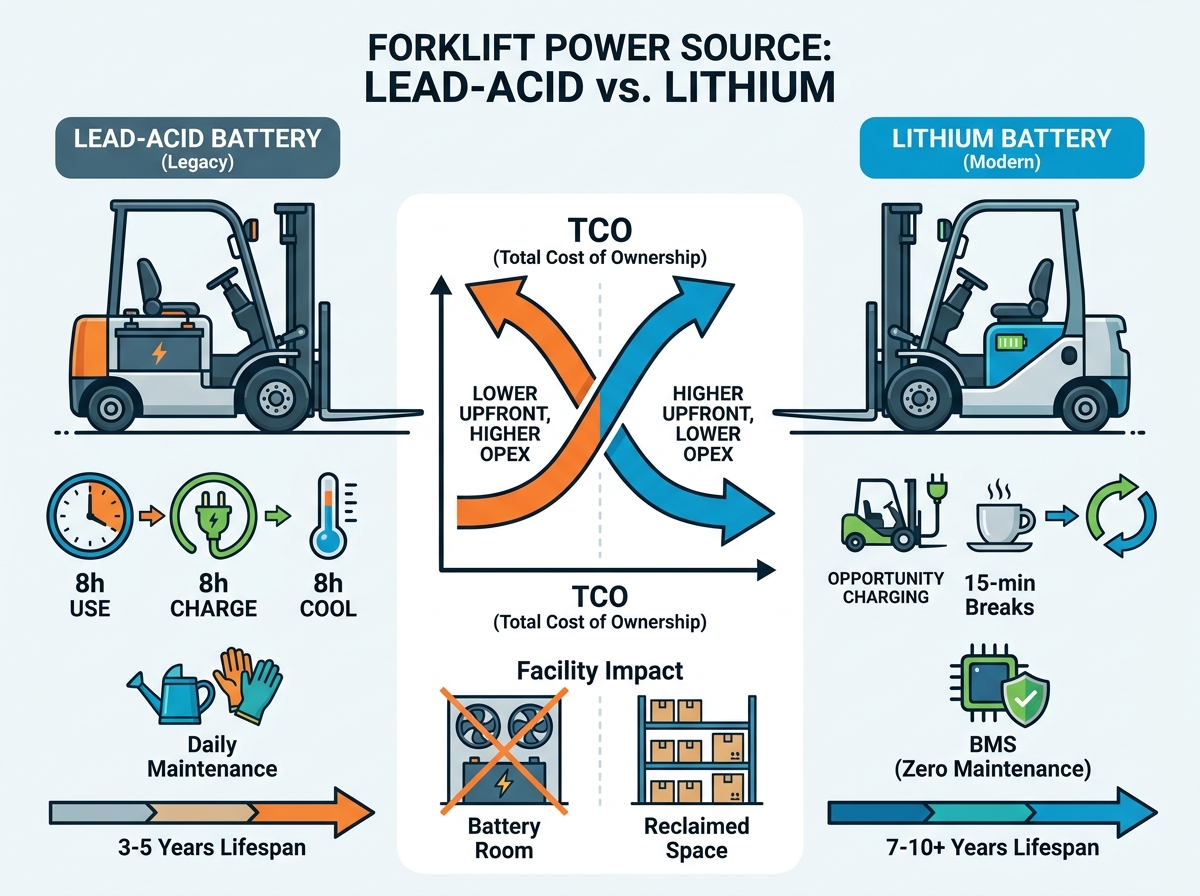
Warehouse real estate holds massive financial value. Every square foot should ideally generate storage revenue. Traditional power sources require dedicated, specialized battery charging rooms. These rooms need expensive acid-resistant flooring and emergency eyewash stations. They require heavy overhead crane systems for lifting. They also mandate robust ventilation systems to remove hazardous gases. Building and maintaining these rooms drains capital.
Switching to lithium allows facilities to dismantle these traditional rooms. You can safely place small chargers directly next to break areas. You can install them near the main loading docks. You can reclaim this massive square footage. Turn this newly available space into profitable, revenue-generating pallet storage. Facility managers often underestimate the value of this reclaimed real estate.
However, you must acknowledge a hidden infrastructural risk. We advise readers to audit their facility’s electrical grid capacity immediately. Lithium fast-chargers draw significant peak electrical power from the grid. You might need to upgrade your building's main power supply. A major three-phase transformer upgrade can cost tens of thousands of dollars. Upgrading a building's power supply can severely alter your financial timeline. Always consult a certified commercial electrician before finalizing your equipment purchase.
We must also compare performance in extreme environments. Cold storage and freezer applications punish traditional equipment. Lead-acid loses up to 30% to 50% of its capacity in freezing temperatures. Cold electrolytes slow down the chemical reaction significantly. Conversely, advanced lithium batteries feature integrated internal heaters. These smart heaters maintain the internal cells at optimal temperatures. This allows the equipment to maintain near-full capacity and maximum efficiency even in deep freezes.
Environmental health and safety requirements demand strict attention. Traditional batteries introduce significant off-gassing and acid risks. Lead-acid units emit highly flammable hydrogen gas during the charging phase. Facilities must install heavy-duty ventilation systems to prevent explosive gas accumulation. Toxic acid spills happen frequently during the manual watering process. Workers risk severe chemical burns if they bypass proper handling protocols. You must provide specialized personal protective equipment for all maintenance staff. Safety incidents cause immense financial and emotional damage.
Battery Management Systems introduce unparalleled safety controls. The BMS acts as the intelligent brain of a Lithium battery forklift truck. It constantly monitors cell voltage, internal temperature, and electrical current. It automatically prevents dangerous overcharging scenarios. It blocks the battery from entering a deep discharge state. It actively balances the individual cells during every single charging cycle. This validated safety mechanism eliminates nearly all operator-induced risks. By removing toxic acids from the daily workflow, you protect your most valuable asset.
Modern industrial operations rely heavily on accurate data. Advanced lithium setups easily integrate with standard fleet management software. They connect via modern telematics hardware. Managers receive real-time data on daily energy consumption. You can monitor specific driver behavior and charging habits. Predictive maintenance becomes an easy, data-driven management process. You can identify underutilized trucks quickly. You can then rotate equipment usage to maximize your overall fleet lifespan.
Choosing the correct power source requires analyzing your specific needs. We have developed a simple decision framework to guide you. You must evaluate your operations honestly against these criteria.
Traditional power remains highly viable under specific operational constraints. Consider this legacy technology if you meet these exact conditions:
For low-intensity applications, the lower initial purchase price often wins. The long-term labor costs do not accumulate fast enough to matter for small operations.
Modern power solutions excel in high-demand, rigorous environments. You should actively pursue this technology if you match these profiles:
High-throughput warehouses cannot afford the downtime associated with legacy equipment. The rapid charging capabilities completely transform material handling workflows. You unlock unprecedented operational agility.
The choice between lead-acid and lithium remains highly nuanced. It is not about which technology is inherently perfect. Instead, it is about which option aligns with your specific operational tempo. You must balance the technology against your unique facility constraints. Single-shift warehouses may prefer the low initial cost of legacy systems. Busy distribution centers will demand the relentless uptime of modern solutions. Every warehouse requires a tailored approach to energy management.
We highly recommend taking deliberate next steps today. Start by conducting a localized electrical power audit in your building. Request a detailed financial ROI analysis from a certified equipment dealer. Base this analysis on your exact shift schedules and daily picking volumes. Factor in your complete fleet size to see the true financial impact over five years.
Take action and modernize your warehouse operations today. Contact your dedicated sales engineering team. We will help you map out a comprehensive fleet power transition plan. You can secure a more efficient, safer, and highly productive future for your entire facility.
A: Yes, "drop-in" lithium batteries exist for many older models. However, you cannot simply swap them without careful evaluation. Lithium is much lighter, which affects the equipment's lifting counterweight. Counterweights and BMS compatibility must be assessed by an OEM-certified technician. This ensures both mechanical stability and electrical safety during heavy lifting operations.
A: It typically takes one to two hours for a full charge. However, modern operations rarely require a complete charge cycle. Opportunity charging allows operators to plug in during short breaks. This prevents the battery from ever fully depleting during standard operations. Frequent short charges keep the equipment running continuously across multiple shifts.
A: Industrial forklift batteries use Lithium Iron Phosphate (LFP) chemistry. This specific chemistry is vastly more stable than the Lithium Cobalt used in consumer electronics. LFP is significantly less prone to thermal runaway or fire. Furthermore, the integrated BMS provides a robust secondary layer of safety. It actively shuts down the system if internal temperatures rise.


