
Views: 0 Author: Site Editor Publish Time: 2026-11-08 Origin: Site


Fleet electrification has firmly moved past early pilot programs. Today, operational deployment is scaling rapidly across the globe. Selecting a commercial electric car requires careful evaluation beyond simple environmental targets. Fleet managers must apply strict scrutiny to payload-to-range degradation and complex charging logistics. The reality of commercial operations demands vehicles perform reliably under heavy loads. They must also endure tough weather conditions without disrupting daily delivery schedules. This guide strips away marketing claims. It focuses purely on operational realities and baseline specifications. We provide an evidence-based comparison of the top five market-ready commercial EVs available today. You will learn how to evaluate critical criteria and match vehicle capabilities to your specific route demands.
You cannot evaluate electric fleet vehicles using the same metrics as internal combustion engine (ICE) vans. The transition requires a fundamental shift in how you measure operational success.
Moving beyond the initial sticker price is crucial. You should evaluate metrics like vehicle uptime, route completion rates, and driver adoption. An electric van spending hours at a public charger during a shift destroys productivity. Success means the vehicle seamlessly completes its daily duty cycle. It should return to the depot with a safe battery buffer. Driver adoption also plays a vital role. Drivers who experience less fatigue due to reduced vibration often become your strongest advocates.
Laboratory range estimates rarely reflect fleet realities. Weather conditions heavily alter operational range. Heating the cabin in winter draws significant power directly from the battery pack. Air conditioning usage in summer has a similar, though slightly lesser, effect. Cargo weight adds another layer of energy drain. We recommend derating official WLTP or EPA figures by at least 20% to establish a baseline. You must build route profiles based on this adjusted figure. This prevents drivers from experiencing range anxiety on the road.
Electric vehicles carry heavy lithium-ion battery packs. This battery weight directly subtracts from the vehicle's maximum payload capacity. You must assess the trade-offs between battery size and cargo limits. A larger battery provides more range. However, it significantly reduces the weight you can legally haul. If your business transports lightweight, bulky items, cargo volume matters most. If you transport heavy liquids or dense tools, payload capacity becomes the absolute constraint.
Modern fleets run on data. Relying on third-party OBD-II dongles often fails in electric vehicles. You need native API access from the manufacturer. This allows you to track the State of Charge (SoC) in real-time. You can monitor energy consumption patterns accurately. Predictive maintenance alerts help prevent unexpected downtime. Seamless software integration reduces administrative overhead. Dispatchers can route vehicles based on their live battery levels. They avoid assigning long trips to a commercial electric car running low on charge.
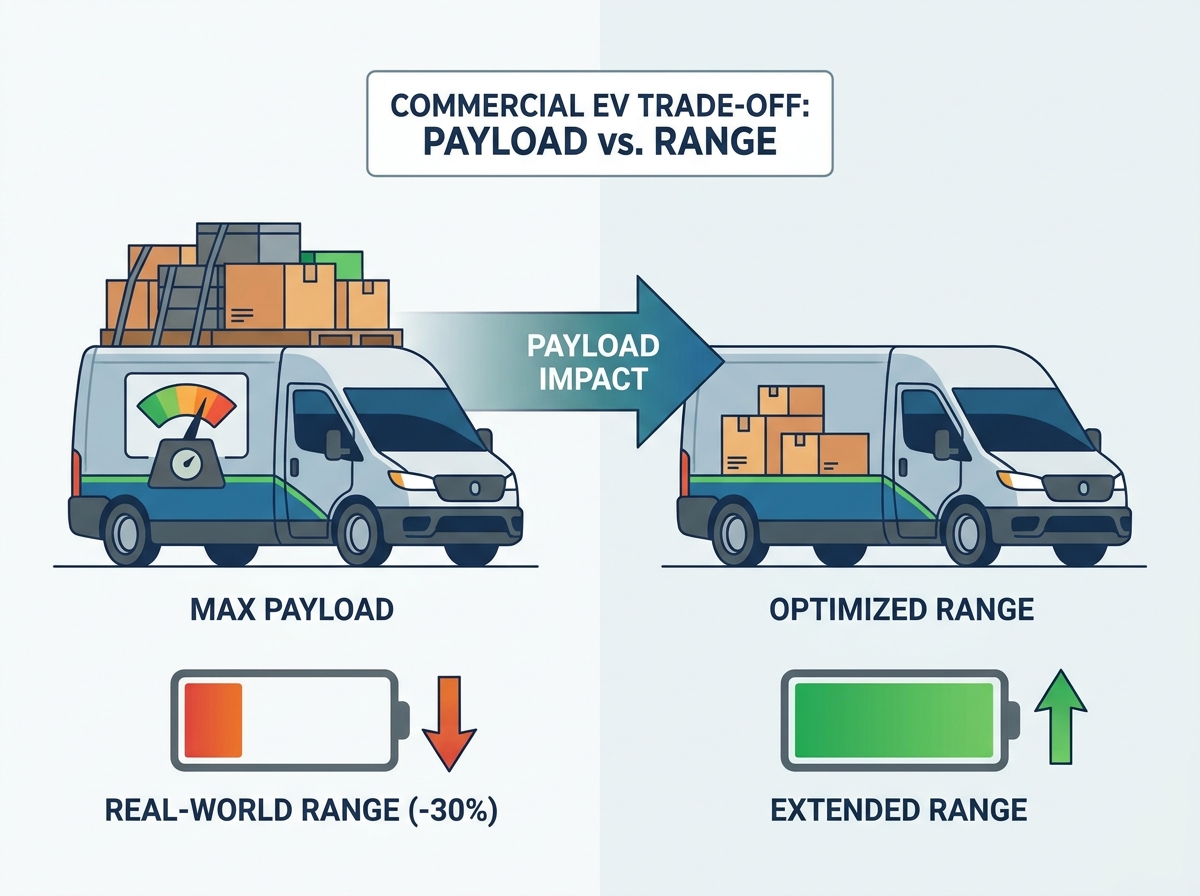
Table: Top 5 Commercial EV Specification Summary
| Vehicle Model | Max Range (Est.) | Max Payload (lbs) | Max Cargo Space (cu ft) | Primary Use Case |
|---|---|---|---|---|
| Ford E-Transit | ~126 miles | 3,880 | 487 | Urban Last-Mile |
| Mercedes-Benz eSprinter | ~249 miles | 2,624 | 488 | Regional/Premium |
| BrightDrop Zevo 600 | ~250 miles | 2,200 | 600 | High-Volume Logistics |
| Rivian Commercial Van | ~153 miles | 2,734 | Varies by wheelbase | Tech-Forward Delivery |
| VW ID. Buzz Cargo | ~254 miles | 1,428 | 137 | Compact Service/Exec |
The Ford E-Transit dominates the early adoption market. It shares identical cargo dimensions with its gasoline counterpart. This allows fleets to transfer existing shelving directly into the new van.
Mercedes-Benz designed the new eSprinter to address range anxiety. It brings premium comfort to demanding delivery routes.
General Motors created BrightDrop to revolutionize enterprise-scale logistics. It focuses entirely on maximizing package throughput.
Rivian built its commercial van from the ground up. It prioritizes software integration and driver safety above all else.
Volkswagen revived a classic design for the modern electric era. The ID. Buzz Cargo blends striking aesthetics with practical urban utility.
Procuring the vehicles is only half the battle. Charging infrastructure dictates the success or failure of your entire electrification program.
Depot charging forms the backbone of commercial EV operations. It is an absolute operational necessity. You must install Level 2 EVSE (Electric Vehicle Supply Equipment) hardware for overnight charging. Level 2 chargers typically deliver between 7 kW and 19.2 kW of power. This speed easily replenishes a commercial van during a 10-hour overnight dwell period. Smart chargers allow you to schedule charging sessions. You can align them with off-peak utility hours to minimize energy expenses. Proper depot charging ensures every vehicle leaves fully loaded with energy every morning.
Installing multiple chargers strains standard commercial electrical panels. You must anticipate utility delays. A site energy audit must precede any vehicle procurement. Utility providers often take months to upgrade local transformers. If you order vehicles before confirming grid capacity, you risk parking unused vans in your lot. Fleet managers must engage their local utility company during the initial planning phase. They will help you determine your site's maximum kilowatt allowance.
Relying on public chargers destroys route efficiency. You face the hidden costs of driver dwell time at public DC fast chargers. Drivers sitting idle for 45 minutes cost you productivity. Variable public charging tariffs also create unpredictable operational budgets. Broken or occupied chargers disrupt tight delivery schedules. Public charging should serve only as an emergency backup. It should never function as your primary fleet energy strategy.
Transitioning a fleet requires a structured, phased approach. Avoid rushing into massive bulk orders without proper validation.
Data eliminates guesswork. You must use internal GPS data from your existing ICE fleet. Analyze the daily mileage of every specific route. Identify routes that safely sit 20% below the EVs' maximum loaded range. These become your prime candidates for electrification. Do not select routes that push the maximum theoretical limits. A route audit also reveals dwell times at loading docks. This helps you identify potential opportunity-charging windows during the work day.
Testing in the real world is non-negotiable. Fleets should lease one or two units of different models first. Run them through a 90-day real-world validation period. This pilot phase allows drivers to test vehicle ergonomics. Dispatchers learn how to manage battery levels natively. You discover how much range heating or air conditioning truly drains on your specific routes. Only after a successful pilot should you execute a mass order.
Not all commercial dealerships understand electric vehicles. You must vet your OEM and dealer network thoroughly. Ask specific questions before signing contracts:
A dealership lacking dedicated EV technicians will severely impact your vehicle uptime.
The "best" commercial EV does not exist in a vacuum. It depends entirely on your specific daily duty cycles and depot infrastructure. You must align payload limits with highly conservative range estimates. Pushing vehicles to their absolute limits results in stranded drivers and missed deliveries. Successful adoption requires patience, robust data analysis, and proper depot preparation. We strongly advise fleet managers to initiate a facility energy audit today. Once your infrastructure capacity is clear, request a commercial demo from your short-listed OEMs. Test the vehicles on your toughest routes.
A: A commercial electric car typically loses between 15% and 30% of its advertised range when fully loaded. This drop depends heavily on route topography, driving speed, and maximum payload weight. Fleet managers should always plan routes using this degraded baseline rather than the unladen manufacturer estimates.
A: Technically yes, but Level 1 charging is operationally unviable for commercial use. It provides only 3 to 5 miles of range per hour. Level 2 charging or DC Fast Charging is mandatory to replenish commercial batteries during overnight depot shifts.
A: Most commercial OEMs provide a standard battery warranty covering 8 years or 100,000 miles. Fleet managers can generally expect a battery degradation rate of 1% to 2% per year, depending on charging habits and environmental conditions.
A: Yes, commercial electric vehicles often qualify for business tax deductions. In the US, IRC Section 45W provides specific federal tax credits for commercial clean vehicles. Local or state fleet rebates may also apply. You should consult with a qualified tax professional to ensure full compliance.


